Two infrared clips in the first PURSUE release carry irresistible titles: “Unresolved UAP Report.” One lasts 5.4 seconds. The other lasts 10.3. Both show small areas of contrast crossing a moving sensor view. Neither gives the public enough geometry to calculate size, distance, or speed. Yet the paired mission reports make them more useful than anonymous moving-dot videos—because they preserve what the military screeners thought they might be looking at.
The first report says “possible missile” and “possible birds.” The second records a UAP that could not be positively identified, but the archive description connects its video to a “probable SU-27/35” even though the report places that aircraft and the UAP in separate entries six minutes apart. That difference is not proof of anything exotic. It is a disclosure problem: the public package does not clearly say which reported event the second clip depicts.
The first clip already comes with ordinary hypotheses
DOW-UAP-D010 is a six-page mission report from May 6, 2022. Its observation section says the operator saw five UAP cross the screen between 1514Z and 1934Z. The first received a visual-recognition estimate of a “possible missile.” The remaining four, according to the same entry, fit more closely with “possible birds.” Those are contemporaneous working labels, not final identifications, and the archive warns that the descriptive language reflects the reporter’s subjective interpretation.
The paired video, DOW-UAP-PR019, shows the event the release associates with the possible missile. For most of the clip, terrain fills the infrared image while the sensor view drifts. Around the middle of the sequence, a small dark, horizontally elongated contrast enters the lower third, moves left to right, and leaves within roughly a second. That is the direct observation available to a public viewer. “Missile” is the operator’s estimate. The archive’s own video description explicitly says it is informational rather than an analytic conclusion.
The distinction matters. An object can move quickly across a screen because it is genuinely fast and distant, because it is slower and close to the sensor, because the sensor platform is moving, because the camera is panning, or because several of those effects combine. The report leaves range blank. The public clip does not expose the sensor model, field of view, line-of-sight track, platform position, or target distance. Without those numbers, converting screen motion into physical speed would be theater dressed as mathematics.
The best ordinary reading is therefore close to the report’s own: the clip may show a missile-like object, and the other brief detections may have been birds. The strongest reason to keep the incident open is not an apparent impossible maneuver; none is demonstrated. It is that the public record preserves a genuine military observation but withholds the measurements needed to choose confidently among the plausible objects.
The second package contains two events, not one
DOW-UAP-D014 is a nine-page mission report covering May 29–30, 2022. Near the beginning, its timeline lists two separate observations. At 0011Z, the crew reported one “probable SU-27/35” landing at an airfield. At 0117Z, six minutes later, it reported “one possible small UAP.” The detailed pages preserve the separation: the 0011Z aircraft appears under Observation, while the 0117Z event has its own UAP section.
The UAP entry is unusually spare. The screener saw one object flying north to northeast and followed it for as long as possible but could not get a positive identification. The form provides no physical description, altitude, velocity, trajectory, or signature. “Flying north to northeast” is a reported direction in the sensor’s operational context, not a public measurement from which an outside reader can reconstruct a track.
The paired file, DOW-UAP-PR021, is a ten-second infrared clip. Two small areas of contrast appear to move together near the center while the background slides through the frame. The public imagery does not reveal a recognizable airframe. It does not show a spectacular acceleration or any other performance that can be quantified from the clip alone.
Here is the important wrinkle. The archive description for PR021 says the accompanying mission report described the UAP as a “probable SU-27/35.” But the report itself does not apply that label to the 0117Z UAP. It applies it to the separate 0011Z landing observation. The archive pairs the report and video, but the public files do not provide the video’s unredacted time or state whether the ten seconds depict the aircraft event, the later UAP event, or a related excerpt selected for some other reason.
There may be a simple explanation. The catalog description may have compressed two entries from one mission, or the video may indeed depict the aircraft and have been attached to the UAP report as contextual media. But a reader cannot repair that ambiguity by assumption. If PR021 shows the probable fighter, the archive label “Unresolved UAP Report” is misleadingly broad. If it shows the later UAP, the SU-27/35 sentence overstates what the report says about that event.
Observation, estimate, and official conclusion are different things
These files are a compact lesson in how UAP claims change as they move through a database. The camera records contrast. A military screener estimates “possible missile,” “possible birds,” or “probable SU-27/35.” A form records that another object could not be positively identified. Finally, a release catalog writes a short public description. Each layer is useful. None can silently substitute for the others.
That is especially important for people who favor disclosure. Skepticism about the label is not skepticism about releasing the material. It is an argument for better disclosure. The files are public enough for anyone to see the six-minute separation in D014; that is real progress. They are not complete enough to determine which timestamp belongs to PR021; that is the next question the government should answer.
The most optimistic interpretation of these releases is not that every “unresolved” clip is extraordinary. It is that official records can now be audited against their summaries, ordinary hypotheses remain visible rather than being hidden, and catalog errors or ambiguities can be identified in public. A durable disclosure process should welcome that correction. It should release not only the image, but the chain that says exactly what the image belongs to.
The best ordinary explanation
For PR019, the operator’s missile-or-bird family of hypotheses is reasonable. A compact nearby bird can cross an infrared field rapidly, while a missile can produce a brief elongated signature. Platform motion and sensor panning complicate both. The clip is too short and the range too unknown to decide among them. For PR021, a conventional aircraft remains plausible: two areas of contrast can come from separate hot regions, sensor processing, or two objects sharing a track. But “plausible aircraft” is not the same as a visually confirmed SU-27 or SU-35, and the public frames do not resolve that model.
The best case for taking the anomaly seriously
These are not social-media reposts. They are released military media tied to operational mission reports, and the screeners were observing in the course of real intelligence work. One operator explicitly followed an object as long as possible and still could not identify it. That gives the observation provenance and makes it worth preserving. The catalog-to-report mismatch also matters independently of object identity: if government disclosure is meant to reduce uncertainty, the event-to-media link must be precise enough to audit.
Evidence verdict: official instruments, incomplete linkage
The clips reach level four on UFOInform’s evidence ladder: official instrumented media with contemporaneous operational records. The two-record packages gesture toward level five, a linked case, but PR021 stops short because the public association is internally ambiguous. Neither case reaches level six, reproducible data. The most defensible conclusion is deliberately narrow: real military observations, credible ordinary candidates, and insufficient public data to close the identifications.
To move these cases upward, release the original media with hashes and timestamps; the sensor model, mode, field of view, and polarity; platform position and attitude; line-of-sight data; slant range or the basis for any range estimate; full continuous footage; and the mission-log entry that maps each clip to a specific report timestamp. For D014 in particular, one sentence stating whether PR021 is the 0011Z aircraft or the 0117Z UAP would resolve the archive’s most immediate question. Raw measurements could then test the objects. Clean linkage should come first.
Evidence on the page
What the released material actually shows
Open each source to inspect the complete record. The caption separates the useful fact from the limit that keeps it from carrying more weight.
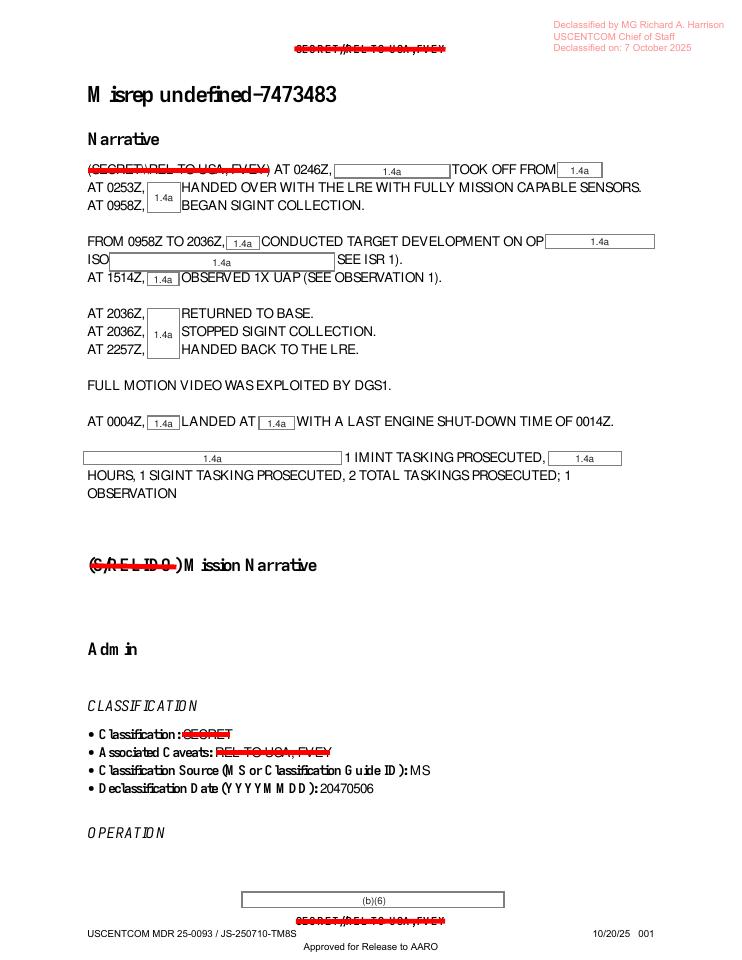
Five observations, two ordinary hypotheses
What it shows: The mission report records one possible missile at 1514Z and four later objects that fit more closely with possible birds.
The limit: The labels are the operator’s contemporaneous estimates, and the report leaves the geometry needed for confirmation blank.
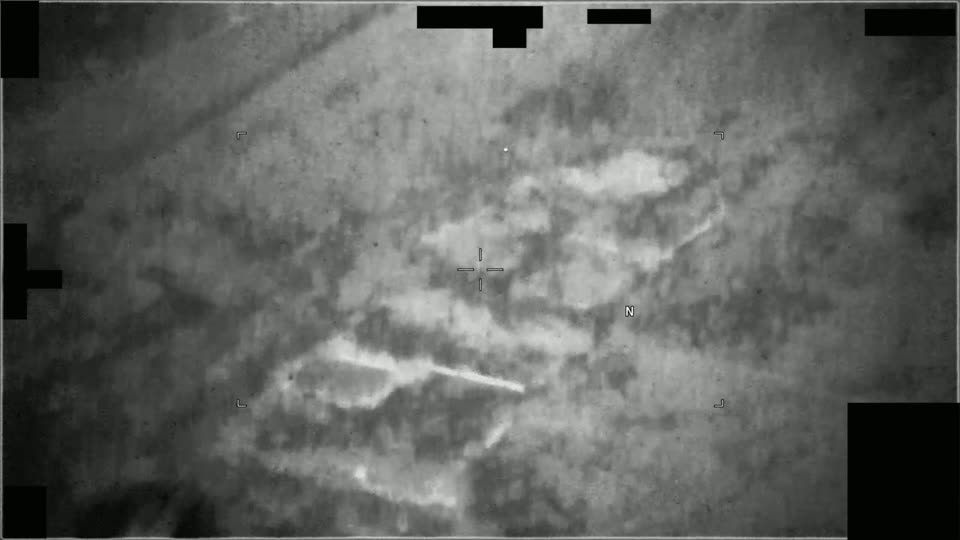
The five-second infrared excerpt
What it shows: A small dark contrast crosses the lower third of a moving infrared view from left to right.
The limit: Without range, sensor state, or platform motion, screen speed cannot be converted into physical performance.
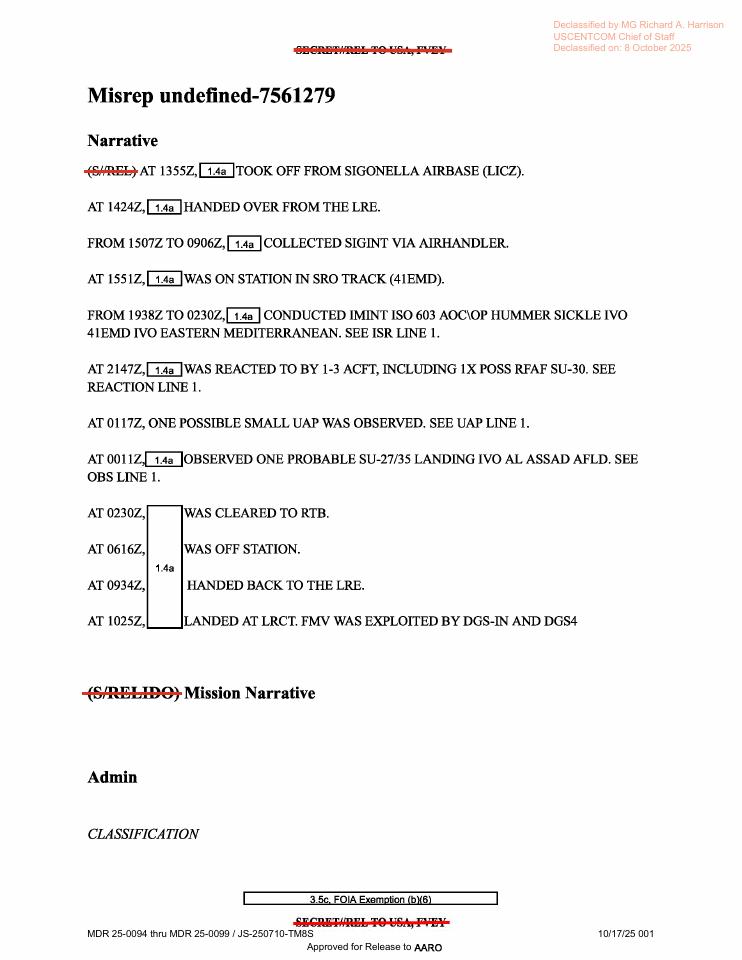
A fighter and a UAP, six minutes apart
What it shows: The report separately records a probable SU-27/35 landing at 0011Z and an unidentified northbound object at 0117Z.
The limit: The UAP entry provides no physical description, altitude, velocity, trajectory, or signature.
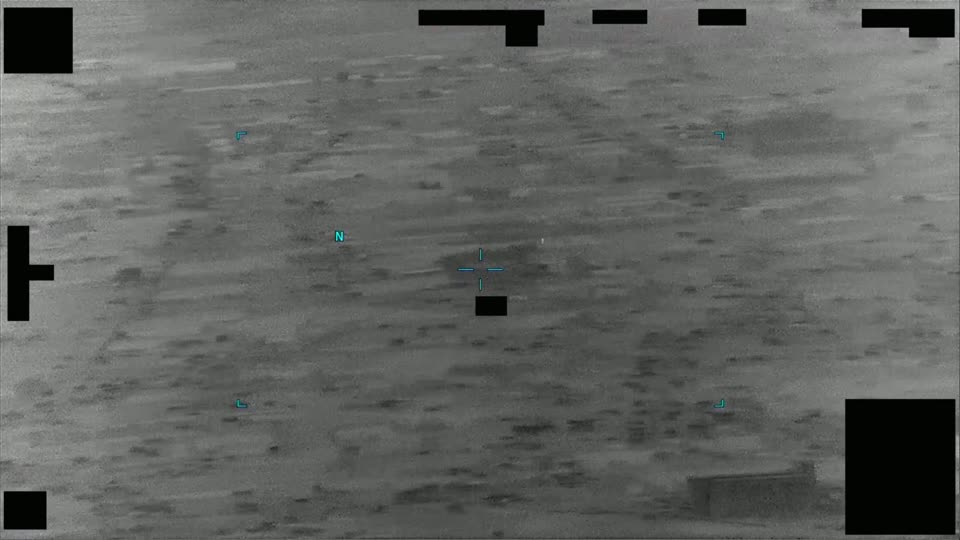
The ten-second pairing ambiguity
What it shows: Two areas of contrast move together near the center of the infrared view throughout the short clip.
The limit: The public package does not say whether this video depicts the probable fighter or the separately logged UAP.
What the record supports
Military sensor operators recorded small infrared contrasts during 2022 missions, made contemporaneous working estimates, and failed to positively identify at least one reported event. The second release package contains a real ambiguity between its catalog description and the report’s separate aircraft and UAP entries.
What it does not establish
The clips do not demonstrate extraordinary speed, acceleration, shape, technology, or origin. They also do not let the public determine whether PR021 depicts the 0011Z probable fighter, the 0117Z unidentified event, or another excerpt from the mission.