AURA archive brief
Five Apollo 12 photographs in PURSUE’s first release put yellow boxes around colored marks in the Moon’s black sky. One frame contains a bright vertical streak. Another contains two small points. The last has five marked features scattered over the sky. PURSUE also released four transcript pages in which Apollo 12 astronauts describe flashes and particles outside the spacecraft.
That combination is almost designed to encourage a single story: astronauts saw luminous objects, and the camera caught them. The public record does not actually make that connection. What it gives us is subtler and, in some ways, more useful: genuine marks in historic mission photography, a separate set of genuine astronaut observations, and no released analysis explaining why they belong together.
The five images are not five views of one tracked object
The first released image corresponds to Apollo frame AS12-46-6842. The other four correspond to AS12-46-6846 through 6849, a consecutive run from Pete Conrad’s second partial panorama at Middle Crescent Crater. NASA’s Apollo Lunar Surface Journal places that second pan at mission time 118:18:41. Conrad had stepped several feet to his left to make a stereo counterpart to an earlier pan. The crew conversation is about camera focus, exposure, crater geology and a hurried return to the lunar module—not lights in the sky.
The sequence matters. A stable distant object should offer some combination of repeatable position, shape or motion after the camera’s changing aim is accounted for. These marks do not provide an obvious track. They vary from tiny blue-white dots to an orange point and segmented vertical streaks. Their number and placement change sharply from frame to frame. That does not prove they are defects, but it prevents the five images from functioning as five-frame corroboration of one craft.
PURSUE’s own language is appropriately restrained. Each catalog entry says the photograph was modified to highlight an area of interest and that the alteration is contextual, not an analytical judgment, investigative conclusion or factual determination. The yellow boxes tell us what the archive’s editors want readers to inspect. They do not tell us what produced the underlying pixels.
The marks predate PURSUE’s annotations
This is the strongest fact in the set. The same points and streaks are visible in high-resolution copies distributed through the Lunar and Planetary Institute and in National Archives scans that retain the dark border around the exposed film area. PURSUE did not paint the features into a blank sky; it magnified features already present in older archival scans.
That finding rules out one weak dismissal, but it does not identify an object in front of Conrad’s lens. A mark preserved in several digital copies can still originate on the original film, during development, in later handling, or in an upstream scan copied by multiple archives. Independent websites are not independent measurements when they ultimately reproduce the same negative or scan lineage.
The NASA journal provides a useful warning from the same magazine. It notes that a broad discoloration visible in nearby frames came from a dust smudge on the lens first apparent at frame 6813. That note does not explain every bright point in frames 6842 and 6846–6849. It does establish that this camera sequence contains known optical contamination, which has to remain in the ordinary-explanation column.
The transcript describes real observations—but different events
On flight day five, lunar module pilot Alan Bean reported looking through the alignment optical telescope into a dark quadrant and seeing “particles of light” or flashes sailing away. He first considered material from the water boiler, then said some seemed to be “escaping the Moon.” The statement is a first-hand observation. It is also an estimate made without a range measurement. Apparent direction in black space does not determine the distance, size or source of a luminous particle.
Later in the released excerpt, commander Pete Conrad describes “little bits and pieces” floating with the spacecraft and becoming visible when a tracking light flashed on them. That passage supplies a concrete nearby mechanism: loose material illuminated close to the vehicle. Mission Control also discusses the tracking light’s electrical state. Neither exchange is contemporaneous with the surface panorama, and neither astronaut says he saw the features later marked in the photographs.
The transcript therefore strengthens one modest conclusion: Apollo crews really did observe luminous particles and debris-like material in space. It does not authenticate the photo marks as those same particles, and it does not turn either set into evidence of a vehicle.
What the record supports
Five government-released Apollo 12 photographs contain small anomalous-looking marks in the sky area, and those marks are visible in pre-PURSUE archival copies. Four of the frames belong to a documented consecutive panorama. A separate official transcript records astronauts describing flashes, particles and nearby floating material during the mission. The selection is worth preserving and testing because the underlying media are real, not generic UFO illustrations.
What it does not establish
The release does not establish that the marks were objects in the lunar sky, that the five photographs depict a common source, or that the transcript refers to the photographed features. It provides no negative examination, scan-provenance report, photogrammetric track, angular measurement, witness statement tied to the exposures, or analytic conclusion. “Highlighted by PURSUE” is not the same claim as “validated by PURSUE.”
Why would the government release this?
The most defensible reading is archival rather than declarative. PURSUE is showing material that has circulated as UAP evidence and exposing the exact government-held records behind the claims. Its disclaimers repeatedly separate selection from endorsement. That is a meaningful form of disclosure: the public can inspect what officials chose to preserve without pretending the act of publication solves the case.
There is still an unanswered editorial question. PURSUE does not publish a selection memo explaining who chose these frames, what anomaly-detection process was used, whether image specialists reviewed them, or why frames 6843–6845 were omitted while 6846–6849 were included. Reading between the lines should start there. The release signals that the features were considered relevant enough to show. It does not reveal whether that relevance came from a technical review, public interest, a congressional production request, or simple completeness.
Evidence verdict
Layer 4 for the archival anomaly; Layer 1 for an extraordinary explanation. The photographs are official instrumented records, and the transcript is an official first-hand record, so the existence of the marks and the astronauts’ separate observations is well grounded. The claim that the marks are external vehicles has no linked witness, range, track, sensor corroboration or published analysis. The transcript cannot elevate the photo case because the times, viewing conditions and described phenomena are not connected.
This is not a dead end. It is a clean testable fork. An artifact explanation should predict that the marks stay fixed to particular film frames, differ across independent scans of the same negative, or show morphology associated with emulsion damage, dust or scanning. An external-object explanation should produce geometry that is coherent across overlapping panorama frames or survive direct examination of the original negative as a scene exposure rather than surface damage.
What would move the case upward
Release the original film identifiers and storage history; raw, color-managed rescans of the complete frames and adjacent exposures; documentation of every crop, enhancement and annotation; and an inspection report distinguishing emulsion, lens and scanner artifacts. Publish camera pointing, exposure timing and panorama geometry precise enough to register the sky portions across frames. If the negatives show the features as photographed light and a repeatable angular track emerges across overlapping views, the case could move toward linked multi-source evidence. If the marks change with scan generation or sit physically on the emulsion, the ordinary explanation would become much stronger. Either outcome would be progress.
Evidence on the page
What the released material actually shows
Open each source to inspect the complete record. The caption separates the useful fact from the limit that keeps it from carrying more weight.
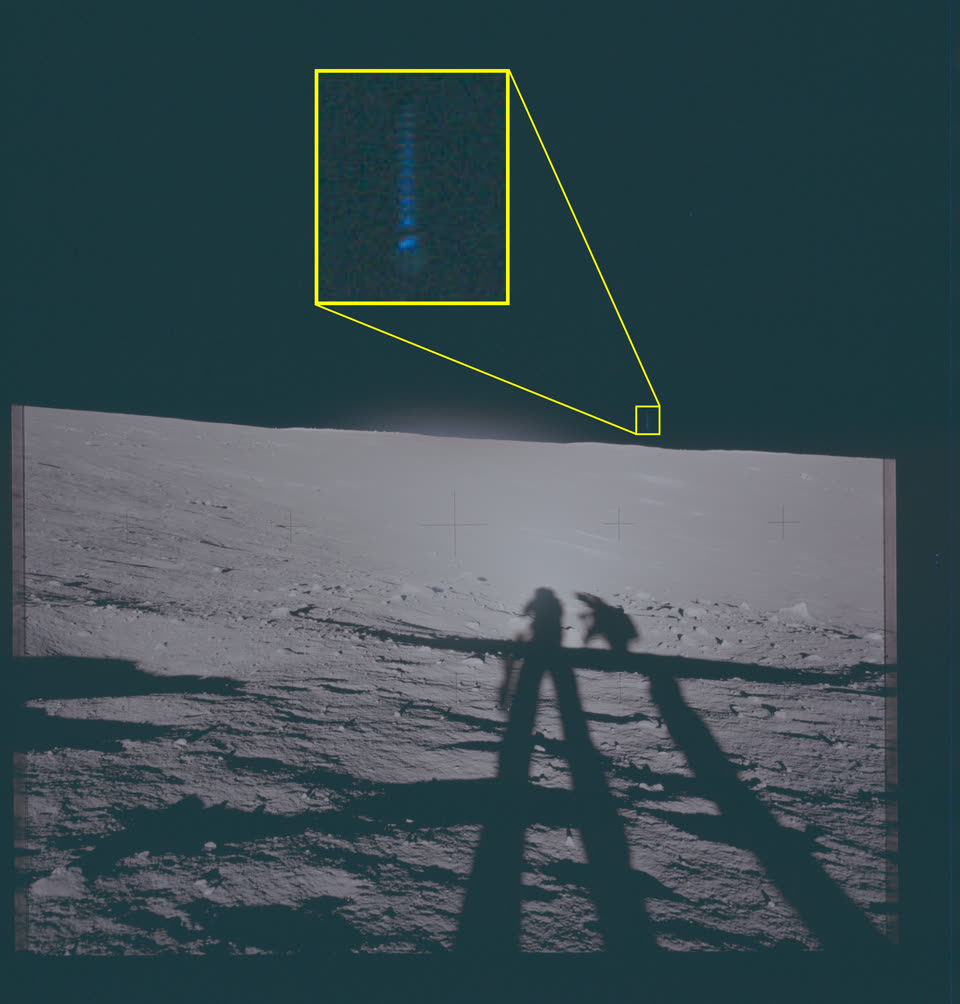
Frame 6842: the segmented blue streak
What it shows: A narrow cyan-blue segmented feature rises just above the right side of the lunar horizon, with fainter blue points higher in the frame. The same feature is present in older archival scans.
The limit: It appears in one still image, has no measured range or trajectory, and sits in a magazine sequence known to contain a documented lens smudge. A photographed mark is not yet a photographed object.
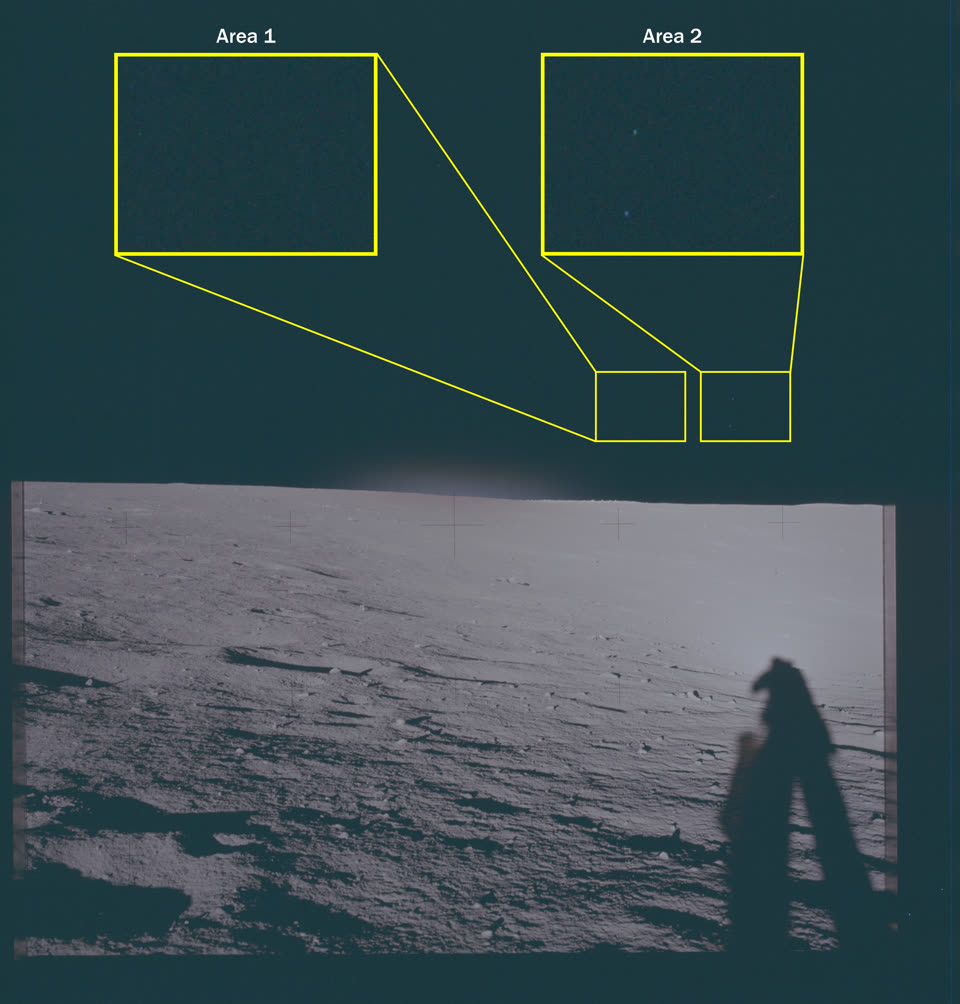
Frame 6846: two small points
What it shows: Two tiny blue-white points appear above the horizon in the first of the four consecutive frames selected from Conrad’s second Middle Crescent panorama.
The limit: The points do not provide resolvable structure, and the release supplies no registration showing that either one persists as the camera turns through the next exposures.
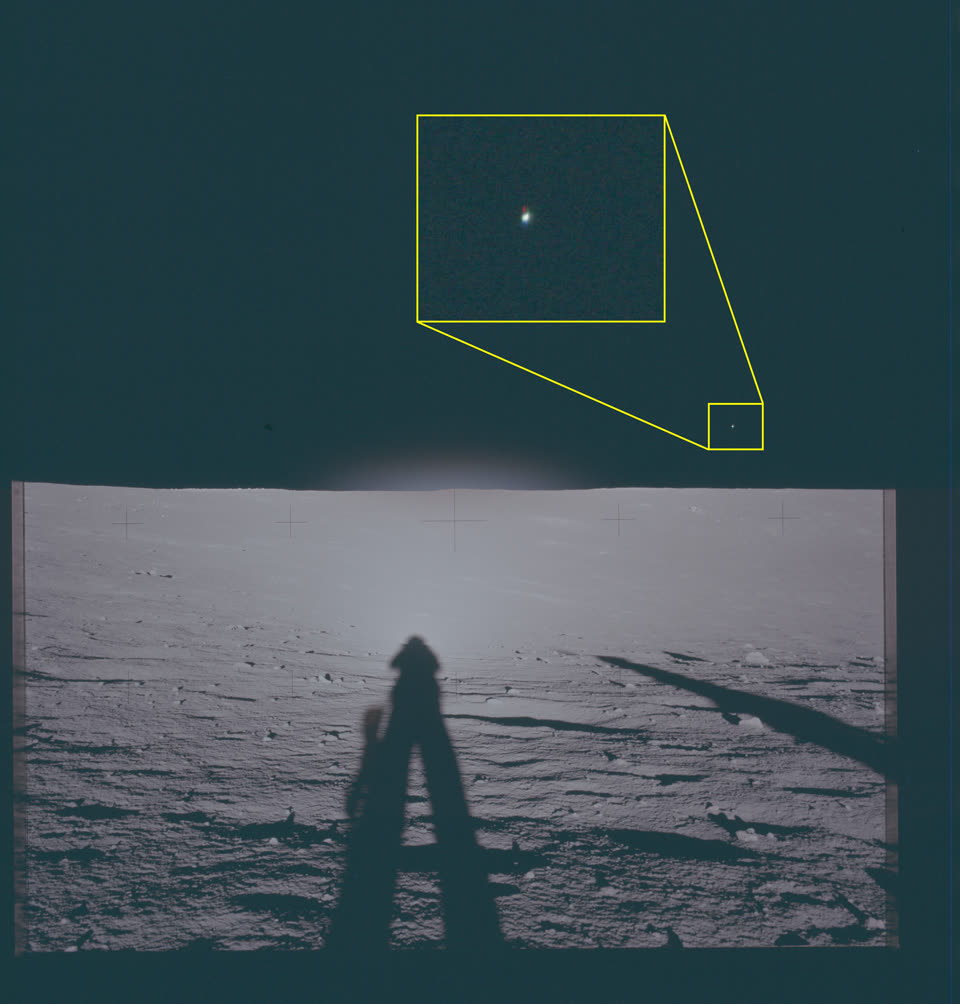
Frame 6847: one bright colored spot
What it shows: The next panorama frame contains a small bright mark with white and reddish color near the right side of the sky area.
The limit: Color and apparent brightness in a digitized film scan can reflect emulsion, processing and scanner behavior. No original-negative analysis accompanies the crop.
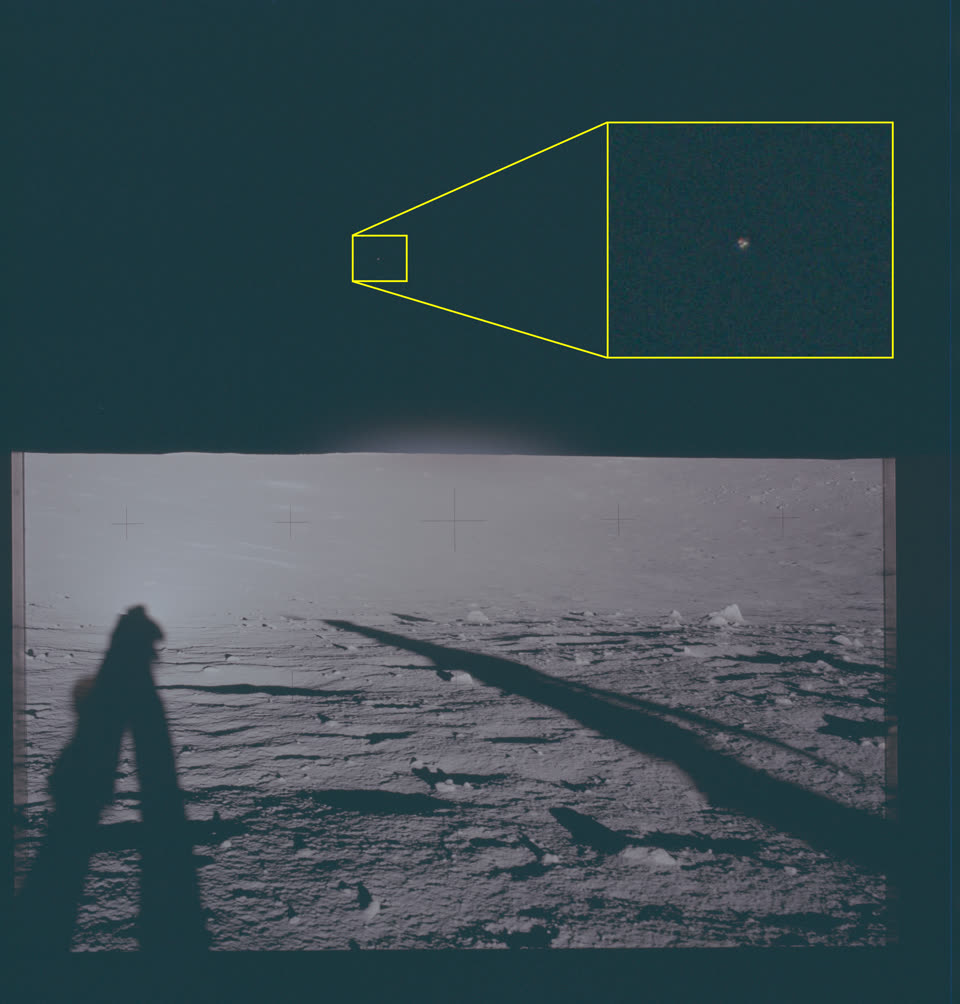
Frame 6848: a different point in a different place
What it shows: A small orange-white point is visible higher and farther left than the marked feature in the preceding frame while the panorama continues rightward.
The limit: PURSUE does not publish the camera-registration work needed to show that this is the same moving source, a different source, or an unrelated image-level mark.
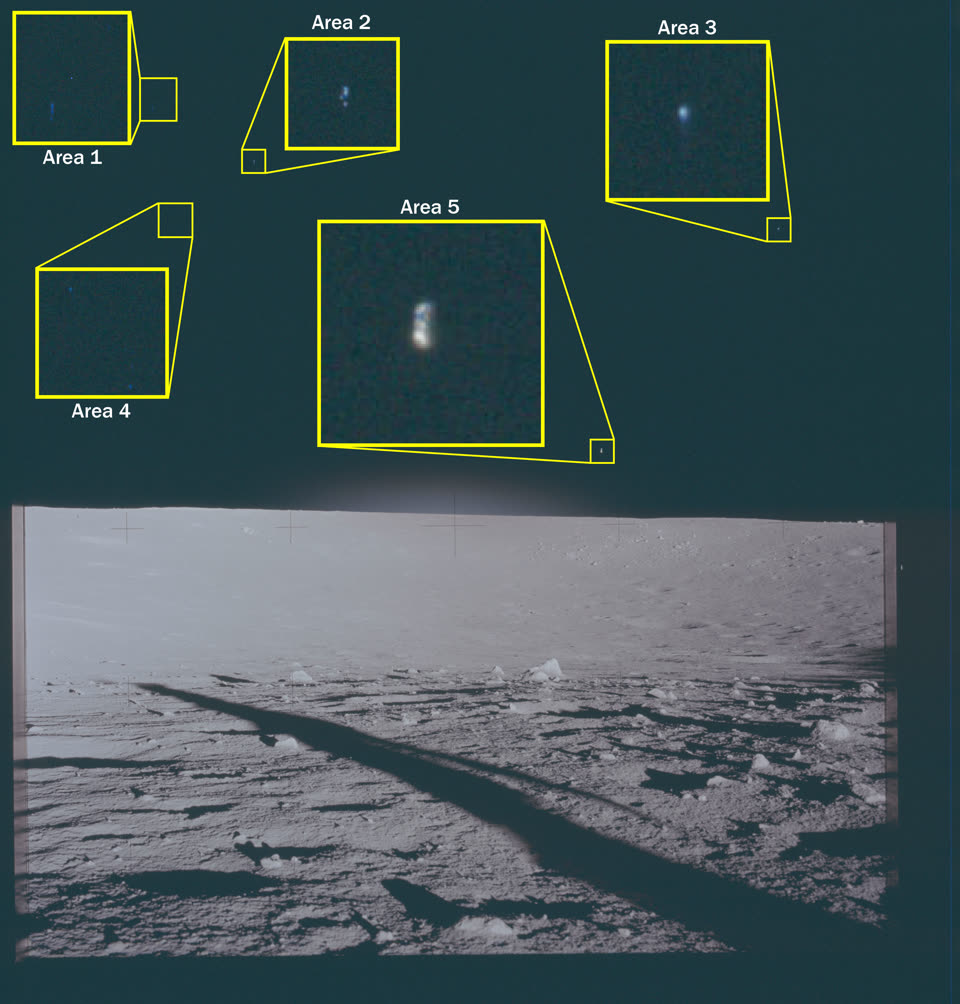
Frame 6849: five marks, mixed shapes
What it shows: The final selected frame contains five highlighted features, including points and short vertical streaks, distributed across the dark sky.
The limit: The sudden multiplicity and varied morphology can fit film or scan contamination at least as well as several external objects. No contemporaneous visual report is tied to the exposure.
Best ordinary explanation
A mixture of film, lens, processing or scan artifacts is the leading explanation for the photographic marks. The transcript’s own ordinary candidates—water-boiler particles and small debris illuminated near the spacecraft—fit its observations better than a distant structured craft.
Best case for taking it seriously
The features were not invented for the release, and several are strong enough to survive different archival presentations. Original negatives and documented rescans could test an artifact hypothesis decisively. Disclosure is most valuable when it makes that comparison possible.