A government can be uncertain about an object and still be very certain about what it wants to control around that object. Three files in the PURSUE archive make that distinction unusually clear. A 1947 U.S. intelligence review of Scandinavian “ghost rockets,” a 1952 CIA file on British UFO activity, and a 1954–55 Air Force collection linking a real circular aircraft project to an unresolved radar-visual incident all show officials managing more than a mystery in the sky.
They were protecting intelligence about missiles and experimental aircraft. They were guarding an early-warning system against noise. They were watching diplomatic consequences, communications capacity, and public reaction. At the same time, they sometimes preserved a residue they could not comfortably explain. That combination matters for disclosure: secrecy around UFOs can conceal genuine uncertainty, conventional defense programs, and information policy without proving that officials possess a nonhuman answer.
Why these three records belong together
This is a deliberately narrow pattern note, not a claim that three countries followed one coordinated plan. The set was selected because each file records an official attempt to handle an aerial unknown while separately identifying a second problem created by the report itself. The records span different agencies, years, and incidents. Their similarity is institutional: investigators repeatedly ask both “what was observed?” and “what could this do to defense, diplomacy, or public behavior?”
That is the useful line to read between. The released files do not show officials marching toward one hidden conclusion. They show institutions dividing an ambiguous event into several problems, only one of which is the identity of the object.
The ghost rockets: a case, a rumor wave, and a diplomatic problem
The 1947 War Department review starts with a large wave. Reports began over southern Sweden in May 1946 and spread across Scandinavia. By the end of July, Swedish authorities had received almost 1,000 reports. Descriptions ranged from a “ball of fire with a tail” to a shiny cigar-shaped object, with estimated speeds from 65 miles per hour to “lightning fast.” Those ranges are a warning: the file is a population of reports, not one measured craft.
The review tests one comparatively detailed account from a Swedish Air Force pilot. He described a dark cigar roughly 50 feet long, about 6,500 feet away, moving near 400 miles per hour and apparently following terrain. The U.S. analyst did not treat those numbers as measurements. The terrain-following claim was cited as a reason to doubt the report because an apparently wingless missile should not have been able to hold a constant height over hilly ground. The observation is direct testimony; size, range, speed, and the analyst’s aerodynamic objection are separate layers.
No U.S. military or naval personnel in Sweden had seen fragments, impact points, or other direct proof. The review judged high-altitude reports likely to be meteors or fireworks and proposed that only two or three incidents—perhaps five to ten—might have involved low-flying V-1-type missiles. Even that was an intelligence assessment, not a recovered missile. Soviet work on captured German technology made the explanation strategically plausible; it did not make it physically demonstrated.
The document becomes most revealing when it compares private and public positions. Swedish officers reportedly told the U.S. military attaché that they believed the Soviet Union was launching rockets, while public communiqués shifted toward a celestial explanation. The U.S. author inferred that Swedish officials might be minimizing the subject to avoid friction with Moscow, while also noting domestic defense-spending politics. That is not proof of a lie; it is a U.S. analyst’s reading of inconsistent messaging. But it shows why the public explanation could be shaped by consequences beyond the evidence.
The British file: the object becomes a systems problem
The two-page CIA release from December 1952 is thinner and should be treated accordingly. Its first page relays a messenger’s account of conversations in Britain. It says a standing British committee had concluded that the observations were not enemy aircraft and that none had been over Britain. Then, according to the memo, senior RAF officials and pilots saw what the document calls a “perfect flying saucer” during a Yorkshire demonstration. Newspaper coverage followed, and physicist R. V. Jones was described as disturbed because correcting public opinion was among his responsibilities.
The second page states that the objects did not appear to pose a direct defense threat, then identifies three indirect dangers: delayed positive identification could weaken early warning; false reports could be used to encourage mass reaction; and emergency communications could be overloaded. The proposed response was organizational—route public-reaction concerns toward civil-defense and internal-security bodies and ask military services to examine communications capacity.
This is stronger evidence for what officials feared than for what anyone saw. The Yorkshire account is second-hand in the released memo, with no photograph, range, track, or original witness statements. The policy concerns, however, are written plainly. An unresolved sighting could matter even if its cause was ordinary because it occupied the same reporting and communications machinery needed to detect hostile aircraft.
The Avro file is the complication disclosure debates need
The 57-page Air Force bundle shows why “secret aircraft” is both a legitimate explanation and an inadequate universal answer. One section concerns Avro Project Y2, a joint U.S.-Canadian effort to assess a near-circular vertical-takeoff aircraft. The project was real, classified, and saucer-like enough that Air Force correspondence repeatedly used “saucer” and “flying disc” language.
Real does not mean successful. In December 1954, James Doolittle forwarded a Scientific Advisory Board review after aircraft and propulsion specialists had visited A. V. Roe Canada. Their initial view was that the project deserved no more than limited support. A companion memo highlighted the board’s generally negative findings about technical feasibility and contrasted them with optimistic coverage in the Air Intelligence Digest. The file therefore contains a genuine secret circular-aircraft program and internal skepticism about its promised performance at the same time.
That distinction matters. Knowledge that engineers were working on disc-shaped aircraft could reasonably cause intelligence officers to re-examine foreign UFO reports for Soviet technology. It could also require secrecy around American and Canadian work. But the existence of Project Y2 does not retroactively explain every disc report, and the file itself does not say that it does.
Then the same bundle preserves a case it could not close
Another section examines a July 1955 event near Newfoundland involving a U.S. Air Force KC-97 crew and a ground radar return. The committee wrote that it was unable to explain the simultaneous radar returns and aircrew visual sightings. It tentatively accepted a Northeast Air Command evaluation that paired electrical phenomena with visual misinterpretation, while also classifying the incident as UFOB—unidentified.
The committee did not jump from “unidentified” to “extraordinary.” It said available intelligence could neither support nor deny the existence of Soviet unconventional aircraft comparable to projects being considered in the United States and Canada. Its recommendations were operational: increase collection against Soviet research and scramble fighters without delay in future cases. The priority was warning and attribution, not a public metaphysical verdict.
The strongest ordinary reading is that the visual observation and radar return may have been unrelated or misinterpreted effects that were joined by timing. That possibility is explicitly present in the official analysis. The strongest reason to keep the case open is also explicit: the committee could not explain the apparent simultaneity. Without the radar plots, equipment settings, track duration, crew statements, weather and propagation data, or a synchronized timeline, neither side can be independently tested.
What the government may be doing by releasing this now
The current release itself should not be mistaken for a coded confession. The CIA scan is marked as approved for release in 2026 under Section 1842 of the fiscal year 2024 defense authorization, and the PURSUE archive presents files collected through that disclosure process. The safest inference is that the government is satisfying a disclosure mandate by moving records into public custody. The documents do not tell us that their order or timing was designed to lead the public toward a predetermined conclusion.
But compliance can still be consequential. These records weaken two simplistic stories at once. The first says government concern proves extraordinary technology; here, much of the concern is plainly about missiles, experimental aircraft, warning capacity, and social response. The second says every unresolved report was dismissed; here, analysts openly retained uncertainty, classified cases as unidentified, and recommended better collection.
A skeptical reader should notice how often ordinary explanations remain plausible and how frequently estimates substitute for measurements. A disclosure-minded reader should notice that official uncertainty is genuine, recurring, and now inspectable. The optimistic position is not that every file points to nonhuman craft. It is that releasing the files lets the public distinguish an unsolved observation from the institutional reasons it was classified, minimized, or managed.
AURA analysis: three kinds of control, not one master plan
Read together, the set suggests three recurring control problems. First is threat control: determine whether a report indicates a hostile missile or aircraft. Second is information control: protect real programs and avoid giving an adversary insight into collection capabilities or uncertainty. Third is systems control: keep warning channels usable and prevent rumor from overwhelming defense or public institutions.
That is an analytic framework, not language from a single directive. The records come from different governments and do not prove coordination. Its value is that it explains why secrecy can persist even without an exotic answer. It also explains why disclosure of process matters: if the public sees only a final label—meteor, aircraft, unidentified—it cannot audit how diplomatic, technical, and communications considerations shaped that label.
Evidence verdict: level four for institutional behavior, lower for the objects
For the question “what were officials trying to control?”, this pattern reaches level four on the evidence ladder: official analytic and administrative records directly describe missile concerns, experimental-aircraft review, warning-system risk, communications overload, and public-reaction policy. It does not reach level five as one linked case or unified government strategy because these are separate files assembled for comparison by AURA.
For the physical identity of the objects, the ceiling is lower. The ghost rockets rely mainly on accumulated testimony and an intelligence inference. The Yorkshire incident is second-hand in this release. The Newfoundland event mentions visual and radar channels but does not publish the raw records needed to reconstruct their relationship.
Specific releases could move the cases upward: the original Swedish sighting files, impact searches, fragments, and contemporaneous radar or flight logs; the Yorkshire witnesses’ own statements, demonstration schedule, weather, and aircraft records; and the Newfoundland radar plots, sensor settings, crew interviews, propagation analysis, and synchronized timeline. For the institutional question, declassification of the actual public-messaging decisions and the intelligence cited to justify them would show whether reassurance tracked evidence, diplomatic pressure, program secrecy, or some combination. Until then, the strongest conclusion is grounded but incomplete: governments were managing uncertainty—and sometimes managing the public consequences of uncertainty—long before they could say what every object was.
Evidence on the page
What the released material actually shows
Open each source to inspect the complete record. The caption separates the useful fact from the limit that keeps it from carrying more weight.
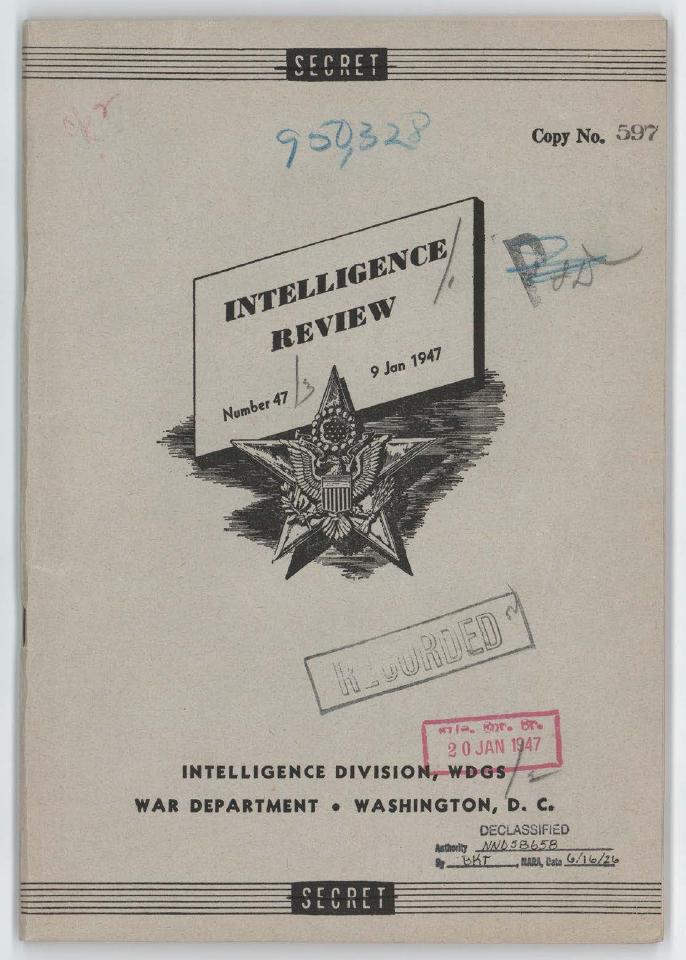
The 1947 ghost-rocket review
What it shows: The review separates nearly 1,000 uneven reports from a small subset it judged potentially consistent with low-flying V-1-type missiles, while recording a gap between private and public Swedish positions.
The limit: No U.S. personnel had verified fragments or impact points, and the missile conclusion remained an intelligence assessment rather than a demonstrated identification.
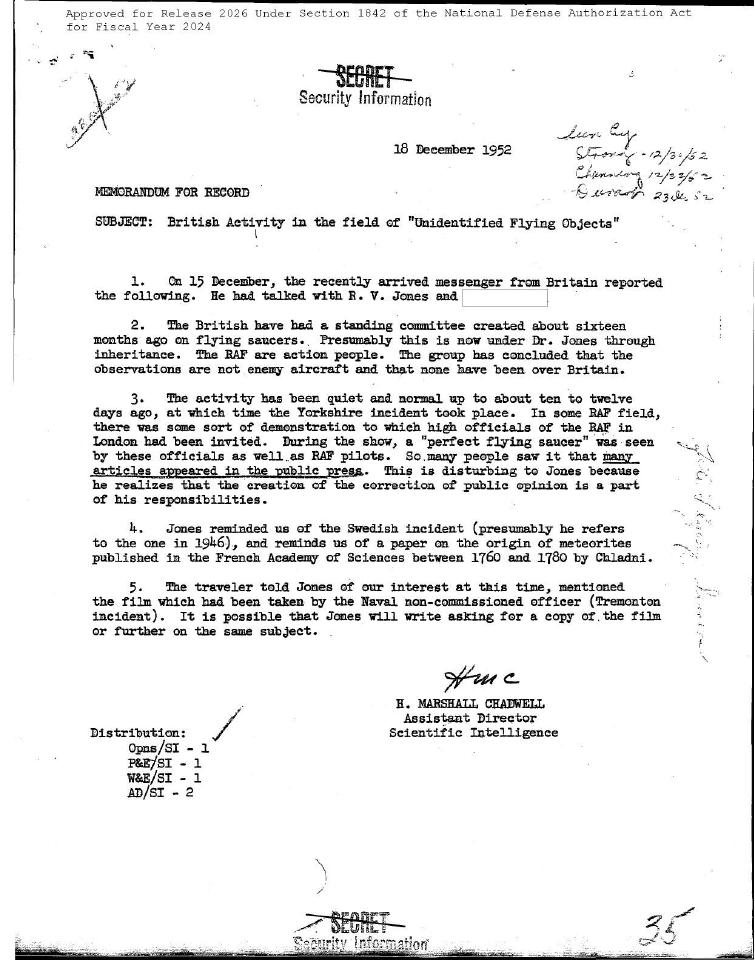
British activity and warning-system risk
What it shows: The file relays a sighting by RAF officials and pilots and separately states concerns about early warning, mass reaction, and overloaded emergency communications.
The limit: The sighting reaches the file through a messenger’s account and arrives without original statements, imagery, tracking data, or a reconstructable event record.
Avro Project Y2 and the Newfoundland UFOB
What it shows: One official bundle documents a real circular VTOL project, internal doubts about its feasibility, and a later radar-visual incident the Air Force committee could not fully explain.
The limit: The bundle does not publish the raw Newfoundland radar or enough technical data to test the tentative electrical-phenomenon and misinterpretation explanation.
What the record supports
These files support a specific institutional conclusion: early UFO policy mixed object identification with protection of military intelligence, warning systems, diplomatic relationships, and public communications. They also support a narrower pro-disclosure point. Officials did not always erase uncertainty. The ghost-rocket review retained a small unresolved or missile-like residue; the British memo recorded an incident that disrupted a prior conclusion; and the Air Force file preserved a radar-visual case its committee could not fully explain.
What it does not establish
The pattern does not establish a single international cover-up, a staged extraterrestrial disclosure plan, or possession of nonhuman technology. The Swedish missile theory was inferential. The British sighting is relayed rather than reconstructed. The Newfoundland case lacks public raw radar. Institutional secrecy and message management are real subjects in these documents, but neither one identifies the objects.