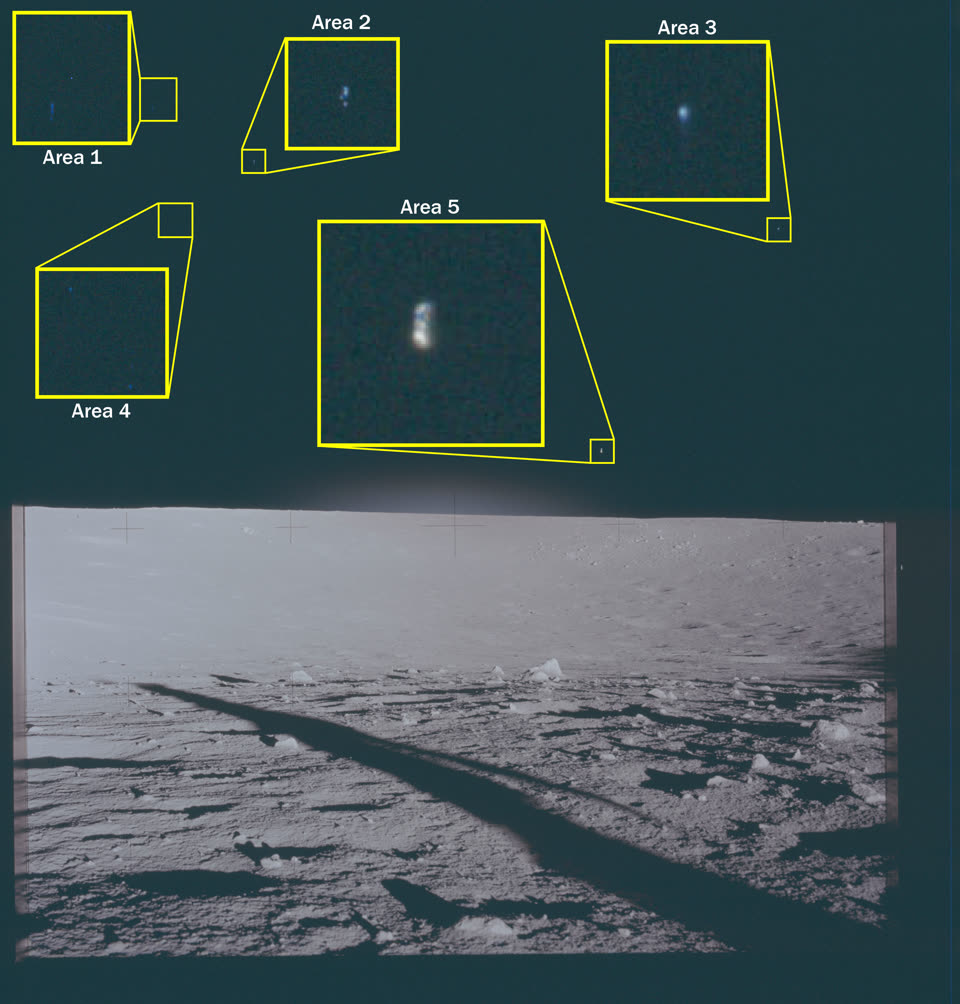
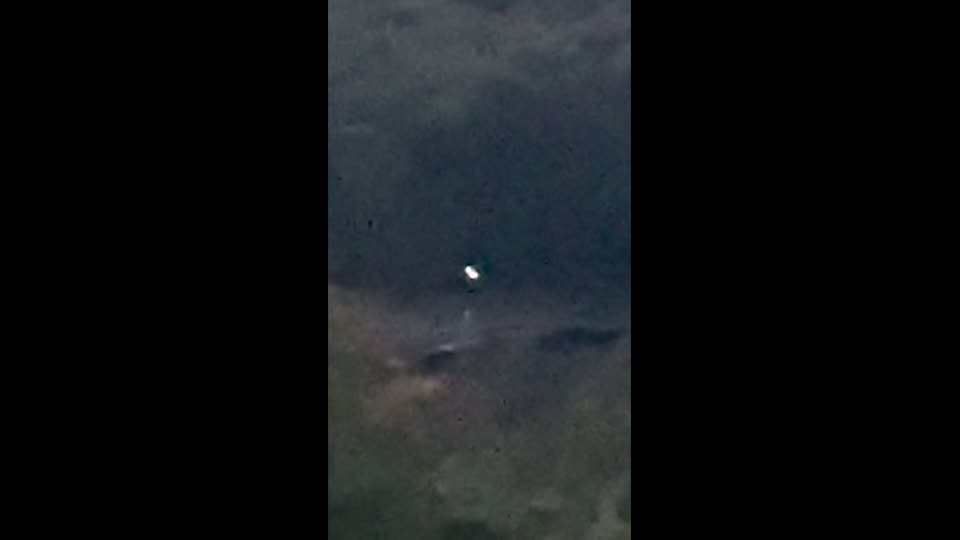
On November 3, 1948, Headquarters U.S. Air Force sent Air Materiel Command two questions that were related but not identical. What were the flying-object reports? And what, if anything, should the Air Force tell the press?
The first question was treated as a defense problem. The memo said some reports described speed and maneuverability beyond known aircraft and that the objects might be domestic or foreign. It called for increased efforts until conclusive evidence could be obtained, because national defense required enough information to devise countermeasures. The second question was a public-pressure problem. The press, it warned, would demand to know what the Air Force did and did not know. Silence would not remain acceptable.
Five days later, Air Materiel Command returned an answer that deserves a careful reading. It did not say the entire subject was imaginary. It divided the reports into categories: confirmed or probable balloons; astronomical objects such as Venus; possible illusion, hallucination, or hoax; and a remaining group for which no ordinary explanation was then available. It also said there was no physical evidence for the unidentified sightings and no tangible evidence for an interplanetary origin.
The reply ended with a communications recommendation. Officials should not present the unidentified and inconclusive cases to the press. If reporters insisted on a statement, the Air Force could say that many sightings were weather balloons or astronomical bodies and that the rest remained under investigation. That recommendation is genuine evidence of message management. It is not, by itself, evidence that officials possessed a hidden extraterrestrial answer.
What the record supports
The packet supports three conclusions. First, senior Air Force offices considered the reports important enough to investigate as a possible national-security problem. Second, the investigators believed that many witnesses had seen something they could not classify, even while ordinary explanations accounted for a large share of the reports. Third, the public account they proposed was narrower than the internal discussion: resolved examples would lead, while the unresolved residue would stay out of the briefing.
That last point matters for disclosure. A public statement can be literally accurate and still leave out the part people most want to examine. Saying that many reports were balloons or celestial bodies did not answer what remained after those cases were removed. The newly inspectable record lets readers see both the reassuring explanation and the uncertainty that sat behind it.
What it does not establish
The correspondence does not establish that any sighting involved a non-human craft, a secret breakthrough vehicle, or a confirmed foreign platform. It contains no recovered material, calibrated sensor file, radar plot, or complete case package. Its references to extraordinary speed and maneuverability came from reports whose underlying ranges, sizes, and distances were often uncertain.
It also does not prove a single, decades-long disclosure plan. This was a 1948 bureaucratic exchange produced during a period of intense concern about Soviet capabilities, new aircraft forms, high-altitude balloons, rockets, and the reliability of air defense. The decision to limit what went to the press may reflect secrecy, institutional caution, uncertainty, or all three. The record shows the decision; it does not reveal one hidden motive behind every later government statement.
Two problems hidden inside one memo
The November 3 request begins with Project Sign, the Air Force investigation established at Wright-Patterson after the 1947 wave of reports. Its authors wrote that some type of flying object had apparently been observed, while identification and origin remained unclear. That statement is stronger than a blanket dismissal, but narrower than it first sounds. It says witnesses generated a real intelligence problem; it does not say every reported performance was accurate or that one kind of object caused every incident.
The request then moves from observation to consequence. If objects with extreme reported performance were domestic, another U.S. program might be operating without the investigators' knowledge. If foreign, the defense implications were obvious. Either possibility justified collection. The memo's urgency therefore measures the cost of being wrong, not the probability of an exotic answer. Intelligence organizations investigate low-probability possibilities when the consequences could be high.
The press question was equally practical. Headquarters acknowledged that it had too little defensible information for a public presentation, but expected reporters to force the issue. It asked Air Materiel Command not only for conclusions, but for advice on whether information should be offered proactively or withheld until the press specifically sought it. The document is unusually useful because the epistemic problem and the communications problem appear on the same page.
The reply separates sightings from interpretations
Air Materiel Command said it had studied roughly 180 incidents, supplementing initial reports through field agencies, checklists, interviews, and some personal investigation. It organized descriptions into discs, cigar or torpedo forms, balloon-like objects, and balls of light. Those are witness-description categories, not verified vehicle types. A round appearance can be produced by very different things when distance, angle, and illumination are unknown.
The reply identified some cases as weather or research balloons and thought many similar round reports were probably the same, even when confirmation was impossible. It pointed to Venus as an example of an astronomical object reported as a high, silvery daytime object. It also considered psychological and deliberate explanations. After those possibilities, however, it retained a group for which no reasonable everyday explanation was available on the information then in hand.
This is the key distinction: unexplained described the state of the file, not the nature of the object. The investigators explicitly said physical evidence had not been obtained. They noted the interplanetary possibility, then said tangible support for it was completely lacking. Their bottom line was that witnesses in most cases had probably seen something they could not classify within their experience, but there was no conclusive proof that the unidentified objects—apart from known balloons—were real aircraft.
Observation, estimate, and analysis are different layers
The companion Project Sign records make the limits easier to see. The progress report cataloged 100 cases and preserved recurring claims about shape, color, speed, and motion. It also preserved uneven reporting. Numerous entries lack stated altitude, distance, duration, weather, or corroborating material. A witness may reliably report a light moving across the sky while still being unable to determine its range. Without range, an angular motion cannot yield a trustworthy linear speed.
Air Intelligence Study No. 203 took the pattern seriously enough to examine domestic and foreign origins. In the Cold War setting, analysts considered advanced Soviet aircraft, captured German design knowledge, reconnaissance, and testing of U.S. defenses. Those possibilities document the strategic frame through which the reports were read. They are hypotheses generated from concern, not positive identifications. The study could say that some type of object had been seen while still leaving open misidentification, natural phenomena, domestic devices, or foreign unconventional aircraft.
This separation is essential whenever a historical file mentions extreme performance. Observation is what a witness directly perceived: a point of light, a shape, a change of position. Estimate is a judgment about distance, size, altitude, or speed. Official analysis is the agency's attempt to compare that report with known objects and threat possibilities. A formal letter can authenticate the existence of the analysis without validating every estimate inside the reports that prompted it.
The best ordinary explanation
The ordinary explanation is not one universal answer. It is a mixture: balloons, planets and meteors, aircraft viewed under unfamiliar conditions, perceptual error, rumor, and incomplete reporting. The 1948 documents themselves support that mixed model. Investigators could resolve some events and provisionally group others by resemblance, while poor data prevented confident closure of a residual set.
The Air Force was also operating in a technological transition. Jet aircraft, rockets, flying-wing designs, research balloons, and classified programs made the sky genuinely less familiar. Security compartmentation could prevent one office from recognizing another program. None of that requires a non-human origin, and all of it raises the expected number of sincere but mistaken reports.
There is also a mundane reason to keep inconclusive material out of a press statement: an agency may avoid amplifying claims it cannot verify. That can be risk management rather than deception. A short briefing built around cases with known explanations is easier to defend than a public tour through contradictory reports and untested hypotheses.
The best case for taking the anomaly seriously
The stronger case is institutional and cumulative. The documents show that the Air Force did not treat every report as a joke or fabrication. It built reporting channels, collected hundreds of incidents across overlapping studies, consulted technical personnel, and considered whether the pattern exposed a foreign capability or an air-defense weakness. Some witnesses were pilots, weather personnel, or military officers whose reports could not simply be dismissed because the conclusion was inconvenient.
More importantly, ordinary explanations did not close every case on the available record. That unresolved remainder is not proof of extraordinary craft, but it is a legitimate research target. If officials believed a small fraction might represent a new technology, a sensor failure, an intelligence operation, or an inadequately understood phenomenon, continued collection was rational. The pro-disclosure position is strongest when it demands the data needed to discriminate among those possibilities rather than declaring victory before the evidence arrives.
The press recommendation adds another reason for attention. Public understanding was deliberately shaped around the solved portion of the case set. The unexplained portion was not announced with equal detail. Even if every residual case eventually has an ordinary cause, that asymmetry can make later skepticism toward official messaging understandable. Transparency is the remedy: release the case-level evidence and let the strength of each explanation be tested.
What the release means now
The present archive does not disclose a hidden 1948 conclusion. It discloses the government's reasoning process: what officials thought they knew, what they could not establish, what threats they were obliged to consider, and what they recommended saying publicly. That is a meaningful form of disclosure because it replaces a caricature—either total cover-up or total debunking—with the messier documentary record.
Reading between the lines should begin with what is actually on them. Internally, officials expressed urgency and entertained broad possibilities. Analytically, they emphasized weak evidence and ordinary explanations. Publicly, they proposed a narrower message that foregrounded resolved cases. Those positions can all be true at once. The unresolved question is whether any underlying case would survive modern, independent analysis if its complete data package were released.
Evidence verdict: Layer 4 of 7
This packet reaches Layer 4—official instrument or formal analysis. It is a multi-document government record with identifiable offices, dates, analytic claims, and a clear press recommendation. It proves that the Air Force investigated the reports, retained an unexplained residue, considered serious defense possibilities, and managed how that uncertainty would be communicated.
It does not reach Layer 5 as a linked case package because the correspondence is not joined to a single event with complete witness statements, imagery, instrument records, and environmental context. It is even farther from Layer 6 reproducible data or Layer 7 demonstrated cause. The file establishes an institutional fact—serious investigation under uncertainty—not an extraordinary origin.
To move this evidence upward, the archive would need to connect each major conclusion to original case files: complete witness statements; first-generation photographs or film with provenance; radar plots or sensor logs; calibration and timing data; weather, astronomy, balloon-launch, aircraft, and test-program records; documented chain of custody; and a report-by-report explanation showing which cases were resolved and why. Physical material with a secure provenance, available for independent testing, would change the evidentiary class entirely. Until then, the honest conclusion is optimistic but unfinished: the government has released proof of the question and proof of its messaging choices, not proof of the final answer.
Evidence on the page
What the released material actually shows
Open each source to inspect the complete record. The caption separates the useful fact from the limit that keeps it from carrying more weight.
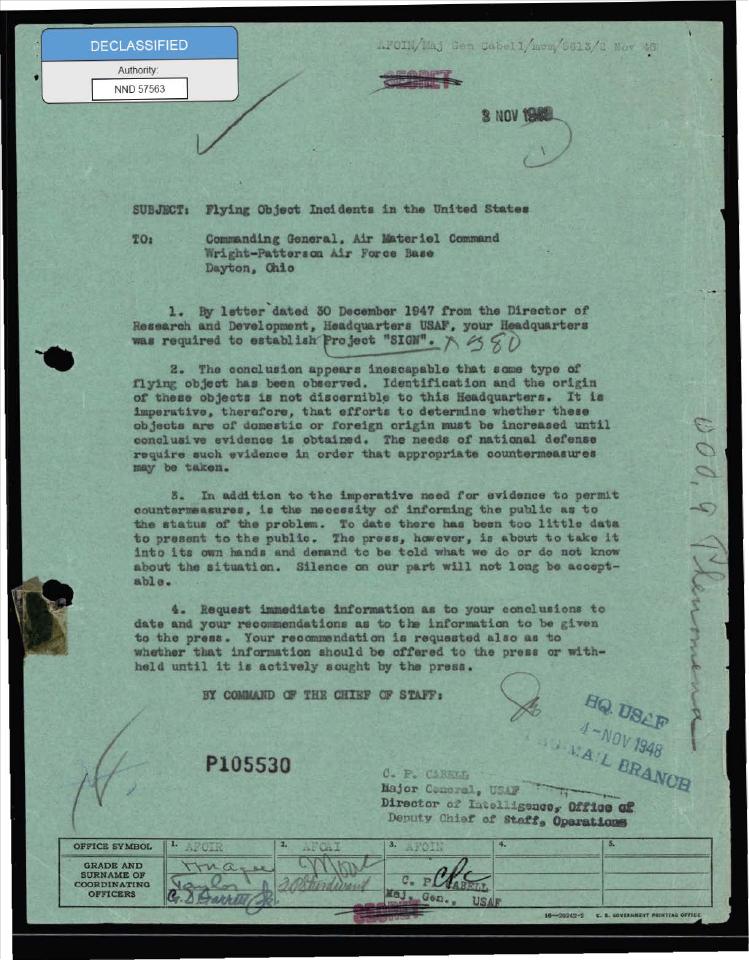
The November 1948 inquiry and press recommendation
What it shows: Headquarters asked for urgent conclusions and advice on what to tell the press. Air Materiel Command separated balloons and celestial bodies from an unresolved remainder, found no physical or interplanetary evidence, and recommended keeping inconclusive cases out of the public statement.
The limit: This is an administrative and analytical packet, not a complete event file. It authenticates the reasoning and communications choice but does not supply calibrated measurements or physical evidence for the underlying sightings.
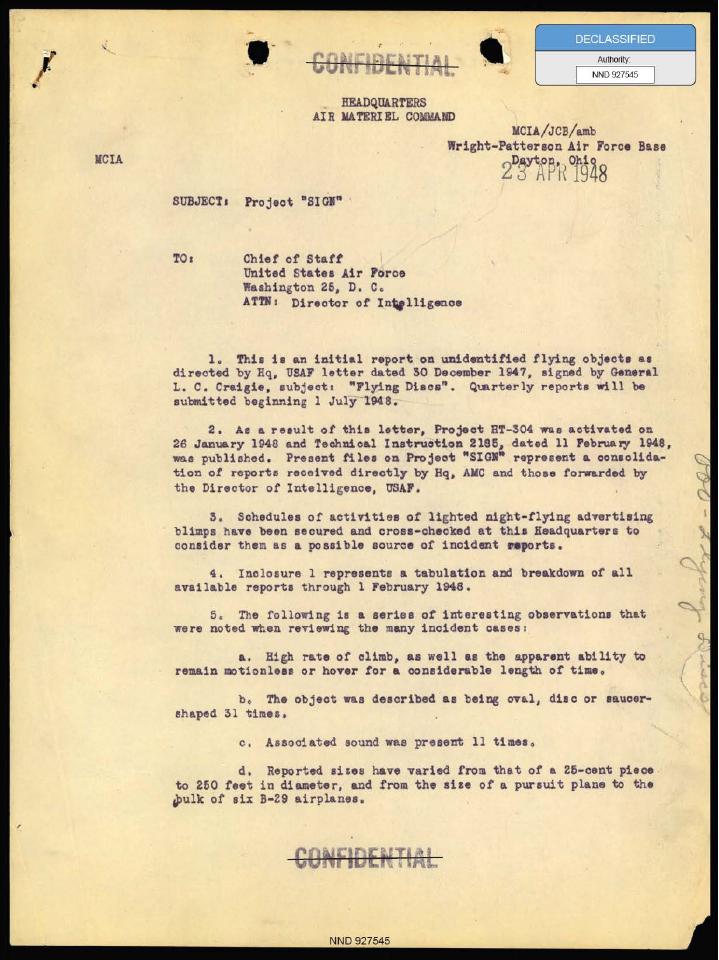
Project Sign's 100-case progress report
What it shows: The case catalog shows the breadth of reports and the recurring attributes analysts were trying to compare across witnesses, locations, and dates.
The limit: Many entries contain estimated or unstated distance, altitude, speed, weather, and corroboration. One hundred catalog entries are not one hundred independent confirmations of a single phenomenon.
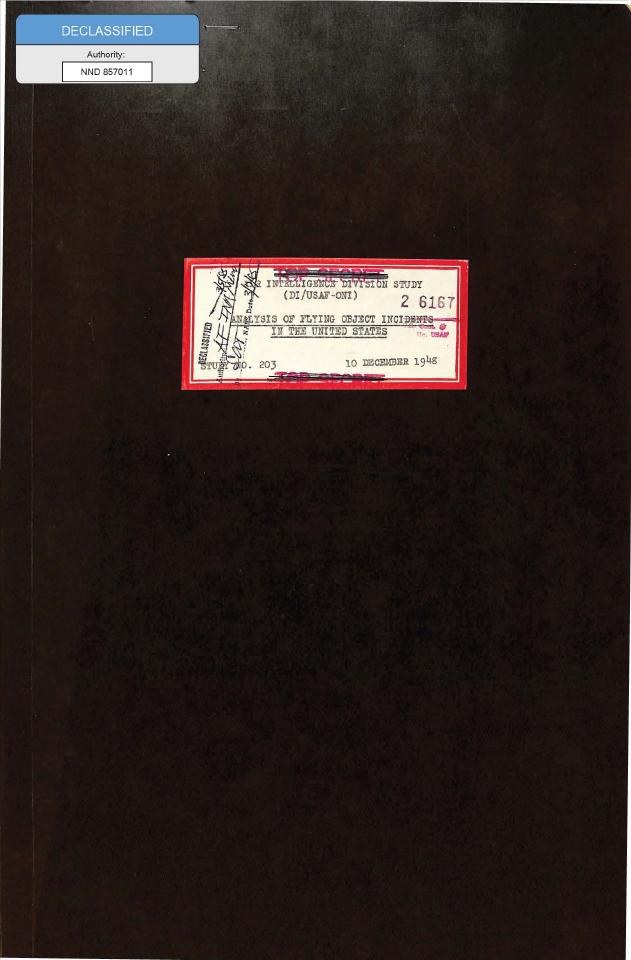
Air Intelligence Study No. 203
What it shows: The study concluded that some kind of object had been observed and tested domestic, natural, and foreign hypotheses, including possible Soviet aircraft or reconnaissance in the early Cold War.
The limit: The foreign-technology discussion is a strategic hypothesis framed by 1948 threat concerns. It is not a direct attribution, and the study leaves several ordinary and unconventional possibilities open.
Why this still matters
A skeptical reading and a pro-disclosure reading can coexist. Skepticism keeps unresolved reports from becoming proof by repetition. Disclosure makes it possible to test whether official reassurance accurately represented the full analysis. Here, the released documents show a real gap between the complexity of the internal problem and the simplicity of the proposed public line. That gap is worth documenting without inflating it into a conclusion the files cannot carry.
The most important fact is not that the Air Force privately wrote the words "another planet." It is that officials considered multiple hypotheses, admitted the evidence was insufficient, and then chose how much of that uncertainty the public should hear. The archive turns that old editorial decision into something the public can finally audit.