Twenty-eight PDFs, and one case that deserves a real investigation
The Department of War published PURSUE Release 7 on October 23, 2026: 28 PDFs, no new video bundle, and a catalog that now totals 478 public records. The department's notice says more files will follow on a rolling basis. This drop is smaller than most of its predecessors, but it is unusually coherent. It connects a modern AARO debrief to an FBI statement, opens a large tranche of BAASS-era work, adds four Catalina Island cases, and releases Cold War correspondence about recovering space-vehicle fragments.
The most important record is also the easiest to oversell. Three federal law-enforcement agents reportedly observed a dark triangular object in the western United States in June 2026. Two saw it visually; one of them also used a handheld thermal monocular, while a third agent first detected a thermally elevated object from a separate observation post. This is stronger than a lone light in a phone video. It is still not the sensor package the public would need to test the reported performance.
The triangle report contains several independent strengths
AARO's memorandum says the two primary witnesses regularly worked around conventional aircraft and drones. It places the object between roughly 1.4 and 3.2 miles away using terrain references and says the witnesses estimated a 13-to-15-foot wingspan by comparing the silhouette with trees along the ridge. The described sequence is specific: about ten seconds of vertical ascent, about twenty seconds hovering, then a two-to-three-second bank and descent into a canyon. The witnesses reported no sound, no visible propulsion, and an apparently uniform thermal signature without an exhaust hot spot.
Those are the observations as documented. The claimed speed is different. AARO says the witnesses compared it with a fighter jet, but it also states that no instrumented speed measurement was obtained. Size, altitude, range, and speed remain witness estimates derived from an unfamiliar object against distant terrain. The word "instantaneous" describes how the transition appeared; it is not a frame-by-frame acceleration measurement.
The paired FBI FD-302 matters because it preserves a co-signed statement from two agents rather than merely repeating AARO's later prose. It agrees on the dark triangular form, the vertical ascent, the lack of sound, and the uniform thermal appearance. Yet it also exposes a major discrepancy: the FBI statement says the total sighting lasted approximately three seconds, while AARO's phase-by-phase account adds up to more than thirty seconds before the final maneuver. That may be a drafting error or a reference only to the terminal movement, but the public records do not reconcile it.
A 1957 B-52 return is quieter evidence, but it is instrumented
The Saudi Arabia file records a B-52 crew's January 1957 gunnery-scope contact during a Strategic Air Command mission. The unidentified return reportedly stayed near the 6,000-yard marker for five to seven minutes, appeared smaller than the return from another B-52 at 5,000 yards, and disappeared left when the reporting aircraft banked left. The report's significance line says the return appeared where no aircraft were expected.
This is not a visual craft description. It is a contemporaneous instrument report with a named platform, operator position, approximate coordinates, altitude, duration, and a hand-drawn scope presentation. That gives it more structure than many historical sightings. It also leaves open ordinary technical explanations: another aircraft, propagation or display behavior, electronic interference, or a geometry-dependent return. Release 7 does not include raw scope data, maintenance records, mission traffic, or independent radar correlation that could choose among them.
The Utah Ranch report is a test of whether we mean what we say about evidence
The 60-page Utah Ranch investigation is the drop's most sensational document. It records stories of lights, large bipedal dog-like creatures, a giant worm, a prehistoric-looking bird, portals, and other phenomena. BAASS mapped witness-estimated travel paths, installed game cameras, collected hair, measured radio-frequency signals, and placed plants as possible biological sensors.
But the same report supplies its own corrective. Laboratory testing identified one hair sample as raccoon and three others as canine, with the canine sequence common in domestic dogs. A pair of radio-frequency spikes fell in bands allocated to satellite, military, radio-location, and radio-navigation uses; the report itself called for comparison with satellite frequencies and schedules. The plant work was too early for a conclusion, and the initial inspection found no dark-green mutations in the tobacco leaves. The field team documented extraordinary testimony. Its released physical results did not confirm an extraordinary creature or energy source.
That is not a reason to mock the witnesses or bury the file. It is the reason to publish the whole file. Disclosure is most useful when readers can watch a claim encounter testing and see which parts survive.
The BAASS self-assessment shows how analysis can outrun measurement
A separate 141-page BAASS self-assessment describes personnel, sensors, databases, and computational modeling developed under a Defense Intelligence Agency contract. Its most important sentence is not one of its confident threat claims. Discussing the 2004 Tic Tac event, the report acknowledges that there was "little hard data" and that most analysis had to use parametric studies or assumptions based on eyewitness testimony. Because an exact maneuver duration was unknown, analysts modeled a range from 0.5 to 10 seconds.
That distinction is essential. A sophisticated fluid-dynamics model can accurately calculate the consequences of an assumed speed, shape, or acceleration. It cannot prove that the real object had those inputs. Release 7 demonstrates that government-funded analysts took UAP performance seriously and built tools to explore it. It also shows that impressive charts can inherit the uncertainty of the witness estimates underneath them.
The "cover" memo is real; its surrounding folder changes its meaning
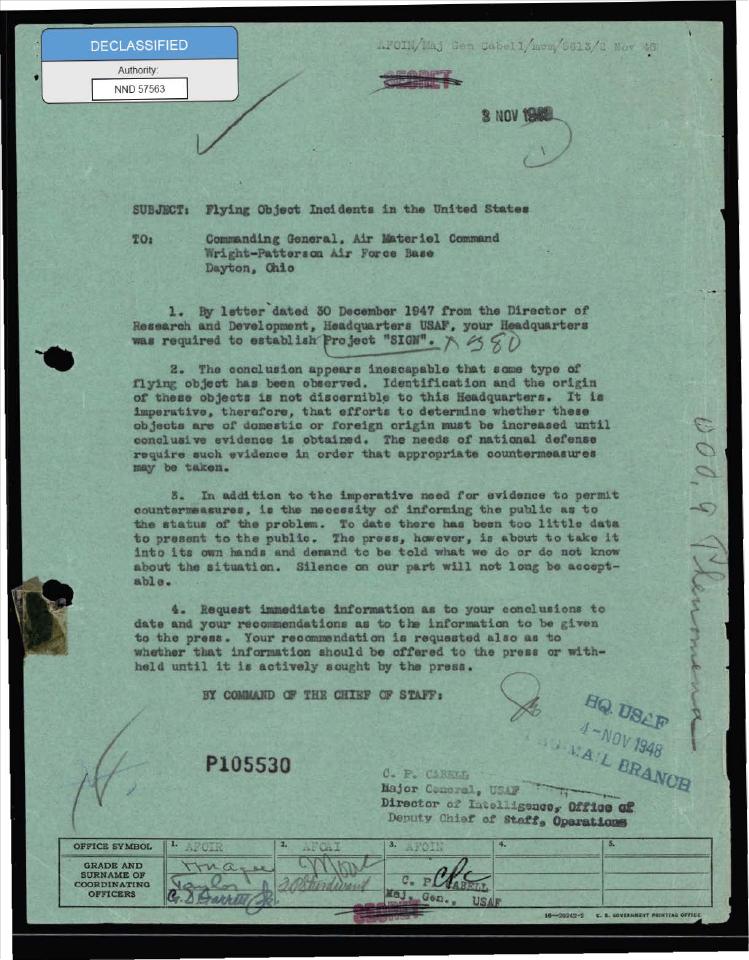
A one-page 1963 White House-era memorandum says some officials feared a public announcement would "scare people needlessly" and records a complaint that the Defense Department and Air Force wanted to use NASA as a "cover." Isolated, those phrases look explosive. The accompanying 72-page correspondence identifies the subject repeatedly: fragments of American and foreign space vehicles returning to Earth during the Cold War. Agencies were debating who would collect, identify, analyze, retain, return, and publicly discuss satellite debris—including foreign hardware with obvious intelligence value.
The documents support secrecy, bureaucratic conflict, and strategic exploitation of recovered foreign material. They do not identify extraterrestrial material. Reading between the lines should mean reading the lines around the exciting one, too.
The Catalina cluster is a warning about catalog labels
Four Catalina Island records span 1949 to 1955, but they do not form one accumulating case. The 1955 record is titled "Unresolved UAP Report" in the catalog while its own Project Blue Book card concludes "probable meteor." The 1953 report records a stationary light and notes an astronomical explanation involving planets. The 1952 case came from three Boy Scouts without instruments, and the reporting officer said their reliability could not be estimated. The 1949 six-object report was marked insufficient data.
The location recurs; the evidentiary quality does not compound. A cluster becomes meaningful only when timing, behavior, independent sensors, and environmental conditions support a common cause.
Evidence verdict: strong enough to demand the missing data, not strong enough to name the object
On UFOInform's evidence ladder, the 2026 triangle case reaches the multi-witness, multi-mode observation tier: trained federal agents, separated positions, visual observation, and handheld thermal viewing. It does not reach the reproducible-data tier. No thermal file, calibrated frames, exact timestamps, sensor specifications, platform logs, radar track, or complete site geometry was released. The disagreement over duration prevents a clean kinematic reconstruction before it even begins.
The optimistic reading is that AARO published a current case whose reported behavior is genuinely difficult to square with ordinary small drones. The skeptical reading is that every extraordinary performance claim still depends on human estimates at long range, with the primary sensor product absent. Both readings can be true. The government's choice to release the AARO memorandum and FBI statement makes the case more accountable; releasing the underlying thermal data would make it testable.
To move this case upward, release the original thermal recording with native metadata; the monocular model, field of view, zoom, palette, calibration, and recording settings; synchronized radio logs; exact observation times and surveyed positions; ridge and tree measurements used for scale; weather and wind data; airspace and drone activity; and any radar, acoustic, or additional electro-optical collection. Reconcile whether the observation lasted three seconds or more than thirty. With that package, independent analysts could calculate angular motion, bound range and size, test the no-exhaust claim, and compare conventional aircraft or UAS explanations. Without it, Release 7 gives us a serious report—not a solved object.
Evidence on the page
What the released material actually shows
Open each source to inspect the complete record. The caption separates the useful fact from the limit that keeps it from carrying more weight.
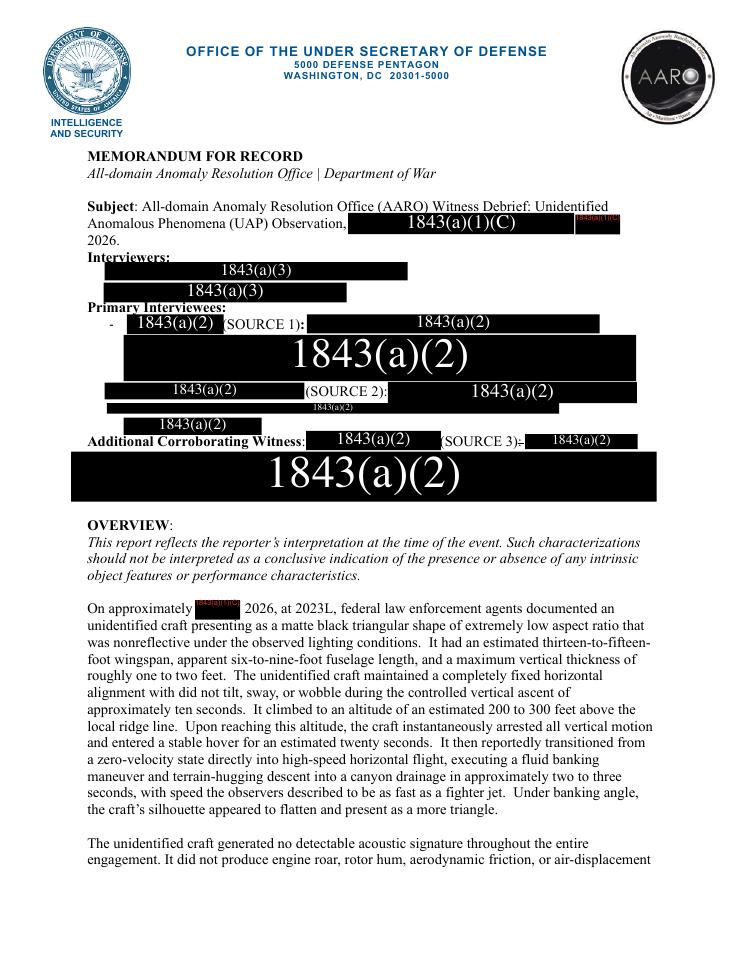
AARO's 2026 triangle debrief
What it shows: Three federal agents contributed to a report of a dark triangle; two primary witnesses described a vertical ascent, hover, silent rapid departure, and uniform handheld-thermal appearance.
The limit: No original thermal media or instrumented speed was released, and the size, range, altitude, and performance are estimates based on terrain and witness perception.
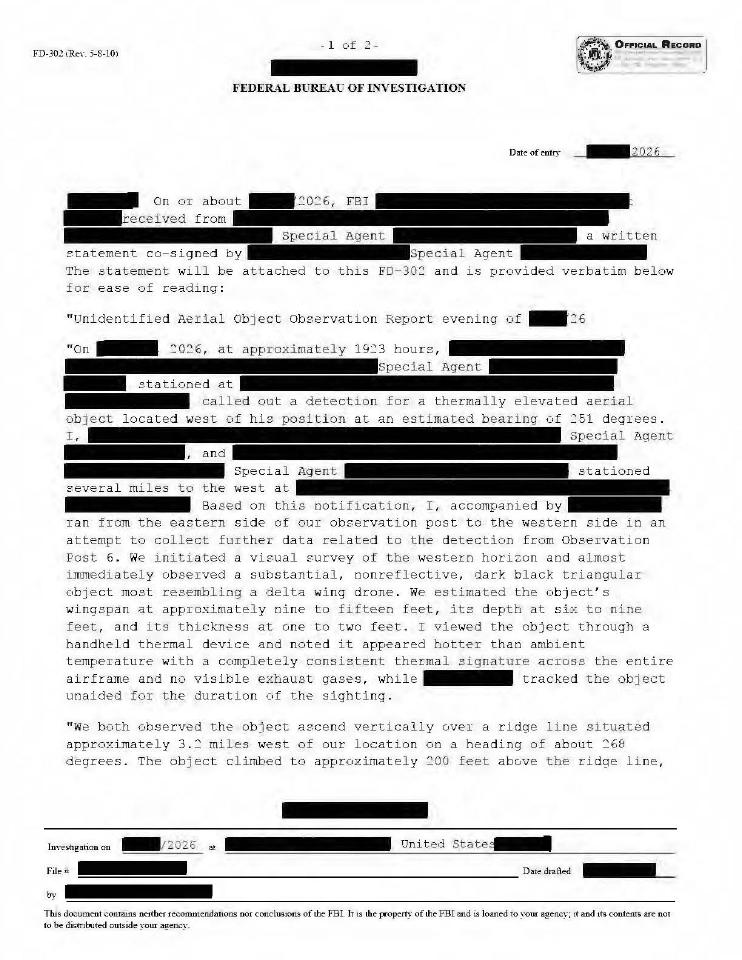
The paired FBI witness statement
What it shows: A co-signed FD-302 independently preserves the agents' description of a triangular object, thermal elevation, vertical ascent, and lack of sound.
The limit: Its approximately three-second total duration conflicts with AARO's phase chronology of more than thirty seconds, and the public package does not explain the difference.
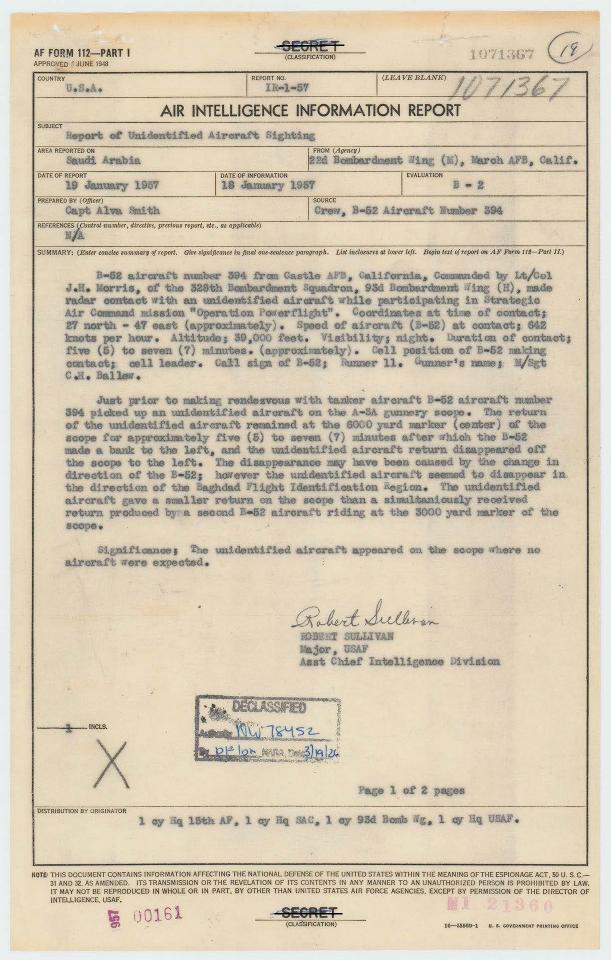
A B-52 gunnery-scope return over Saudi Arabia
What it shows: A contemporaneous 1957 report says an unexpected return remained near the 6,000-yard marker for five to seven minutes and appeared smaller than a second B-52 return.
The limit: There was no visual observation or released raw radar data, independent track, maintenance history, or traffic record to distinguish an aircraft from propagation, display, or electronic effects.
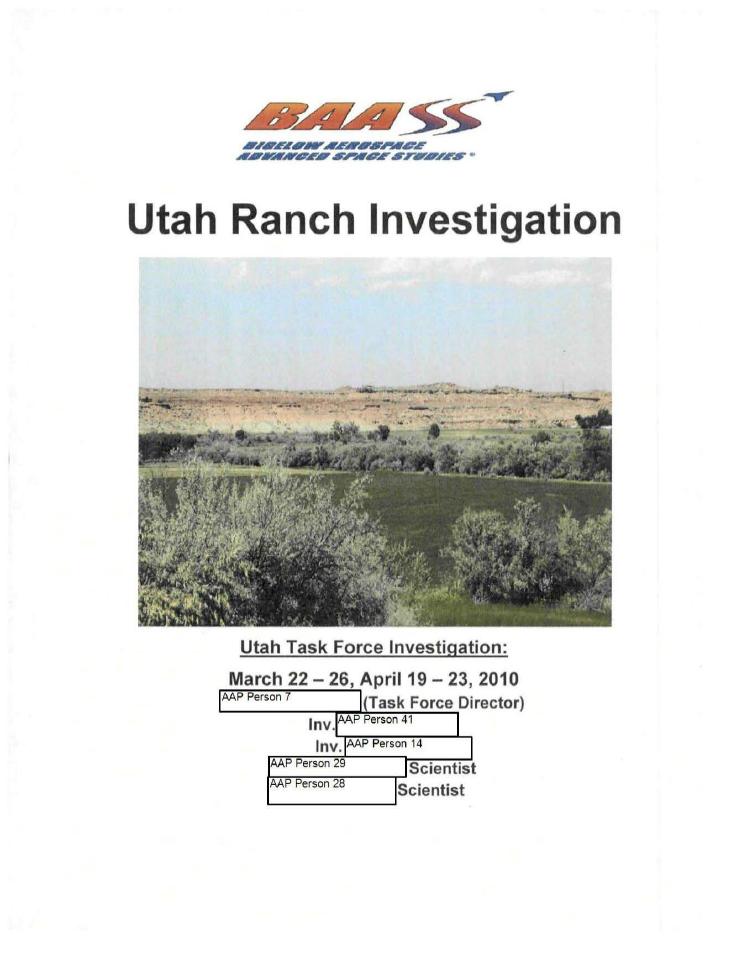
What the Utah Ranch testing actually found
What it shows: BAASS interviewed witnesses, installed cameras, sampled hair, measured radio frequencies, and ran biological-sensor experiments around the ranch.
The limit: Released hair tests found raccoon and common canine DNA; the radio bands had conventional satellite and military allocations; the plant work was preliminary and had not shown the proposed effect.
BAASS's own hard-data caveat
What it shows: The self-assessment documents a government-funded UAP research capability with sensors, databases, and engineering software.
The limit: For its flagship Tic Tac analysis, BAASS acknowledged little hard data and modeled assumed event durations from 0.5 to 10 seconds; the simulation cannot validate the assumed inputs.
What the record supports
Release 7 adds a multi-witness modern triangle report with visual and handheld-thermal observation, a paired FBI statement, a structured 1957 instrument contact, and unusually candid BAASS records showing what a government-funded contractor investigated and assumed.
What it does not establish
The drop does not identify the 2026 object, measure its speed, release its thermal recording, reconcile the conflicting duration, or demonstrate non-human technology. Program documents prove activity and institutional interest; they do not validate every hypothesis the program entertained.