On an October night in 1955, U.S. Senator Richard Russell and three American companions were traveling by train through Soviet Azerbaijan when they saw two luminous events rise into the dark sky. Russell called what he had seen a flying saucer. The CIA took the report seriously enough to interview the group, circulate top-secret memoranda, compare their descriptions, and ask whether the Soviet Union had developed a radically new aircraft.
The answer was not a brush-off. It was also not confirmation. The paired PURSUE records show an intelligence service separating what four people observed from what they inferred, then testing the foreign-technology hypothesis against both ordinary aircraft and a real Western program for a saucer-shaped vertical-takeoff vehicle. The case is interesting precisely because the witnesses were credible and the conclusion remained narrower than their first impression.
What the train party actually reported
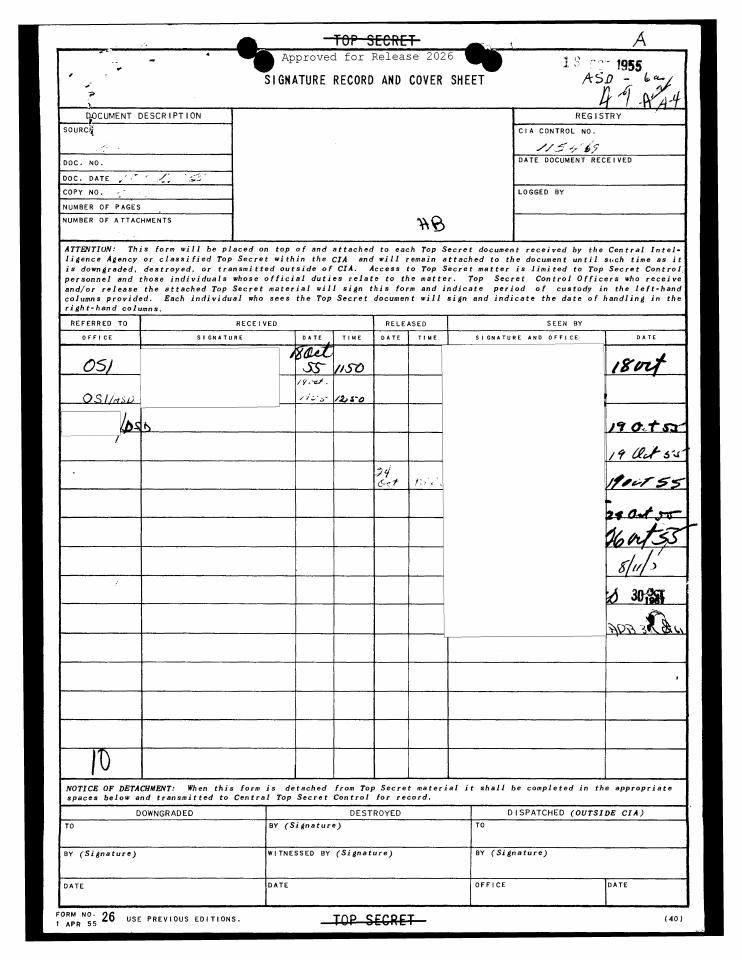
CIA-UAP-D020 is a two-page memorandum plus its control sheet. It says all four participants were interviewed and summarizes their accounts. The group was traveling by train from Baku toward Tiflis, now Tbilisi. Roughly ten minutes after passing Alyat at about 1910 hours, when it was already dark, Russell noticed a small, generally round glowing ball rising rapidly. He alerted the others. A few minutes later, the party observed another event.
The memo does not preserve one perfectly shared picture. Russell reported a luminous ball but did not see a solid body. Another observer described two lights resembling a vertical line: a steady light near the top and rotating light or lights near the base. Russell thought the object could have been as large as a jet, while two companions considered its apparent size comparable to a U.S. jet fighter. The same paragraph immediately supplies the problem with those estimates: there were no nearby objects available to establish scale.
The group generally described a rotating or whirling appearance during a steep initial rise. The memo says two witnesses did not notice a course change, while two others thought the object turned sharply into horizontal flight. No one reported a visible trail. One companion described a triangular arrangement of three lights that appeared to come from a launching area. Those differences do not erase the common observation of rising lights. They do show why “four witnesses” should not be compressed into “four identical accounts.”
There was no photograph, radar track, recovered material, or measured angle in the released pair. The public record is an official summary of interviews, not four signed first-person statements. Even the strongest biographical credential cannot supply the missing range. A senator can be an excellent witness to the fact that something looked strange and still be unable to determine its size, speed, or construction from lights against a dark sky.
The CIA separated the observation from the saucer
The analytical judgment in D020 is easy to miss because the most dramatic language appears first. Assistant Director for Scientific Intelligence Herbert Scoville wrote that only one witness’s testimony would support a radically unconventional aircraft. The other observations, he said, could probably be explained by steep-climbing aircraft or missiles. The evidence was not firm enough to conclude that the Soviets had a radically new type of aircraft.
That is a confidence judgment, not an identification. “Probably” leaves room for uncertainty. The memo does not name a specific Soviet flight, match the event to a launch log, or demonstrate exactly how two conventional aircraft produced every reported detail. Its conclusion is narrower: the observations did not require the extraordinary intelligence claim being tested.
CIA-UAP-D021 shows more of the reasoning. Its author notes that Russell saw lights rather than a clearly resolved body and that the event occurred at an estimated high altitude. The memo also raises the possibility that the other observers’ interpretations were influenced after Russell described the first event as a flying saucer. That is not an accusation of dishonesty. It is a standard problem in group observation: once a label enters the compartment, later memories do not develop in separate laboratory jars.
A later official CIA history gives the institutional bottom line. After the interviews, the agency concluded that the sighting did not support a Soviet saucer-like aircraft and said the objects were probably normal jets in a steep climb. The later history also places the case inside Cold War anxiety about rapid Soviet progress in missiles, nuclear weapons, and aerospace technology. That context explains why an ambiguous light was a legitimate intelligence question rather than merely a curiosity.
Project Y made the exotic-aircraft question reasonable
D021 contains a detail that makes the analysis more revealing. While considering whether the Soviets could have a saucer-like vehicle, the CIA pointed to Project Y at Avro Aircraft in Canada, a real effort to develop an unconventional circular aircraft. The memo lists extraordinary projected performance—very high altitude, high speed, vertical takeoff—but also says the work was still in an early research stage and that a prototype was years away.
This was not evidence that Russell saw Project Y, nor that the Soviets had duplicated it. It was a comparator: U.S. intelligence knew engineers were genuinely studying aircraft that looked like the popular image of a flying saucer. That made the foreign-development hypothesis technically imaginable. It did not make it the best fit for the train observation.
The National Museum of the U.S. Air Force’s history of the later Avrocar provides a useful reality check. The circular test vehicle proved unstable more than a few feet off the ground, reached only about 35 miles per hour, and was canceled in 1961. The distance between projected performance and demonstrated hardware was enormous. Classified aircraft proposals, it turns out, are not immune to brochure numbers.
That history strengthens the case for investigation while weakening a common leap. Governments really did fund saucer-shaped aircraft. Therefore a 1955 observer’s “saucer” interpretation cannot be dismissed as technologically unthinkable. But the existence of one unsuccessful Western program does not identify unrelated lights over the Soviet Union. Secret development is a hypothesis to test, not a blank check for every unusual shape.
Four evidentiary layers, four different claims
The direct observation is the modest core: two luminous events rose into the night sky near a moving train. The witness estimates add apparent rotation, jet-like size, steep ascent, and—in two accounts—a sharp transition toward horizontal flight. The contemporary CIA hypothesis is steep-climbing aircraft or missiles. The later CIA historical assessment favors normal jets in a steep climb and rejects the Soviet-breakthrough inference.
AURA’s analysis sits one layer farther out. The ordinary explanation fits the low-information conditions and many reported features, but it is not independently demonstrated by the released files. The unconventional-aircraft interpretation is possible in the abstract, and the Cold War gave officials good reason to ask. It is not supported by the measurements needed to move from “unfamiliar lights” to “new vehicle.”
The best ordinary explanation
Conventional jets or missiles climbing steeply remain the strongest explanation in the released record. At night, a bright exhaust or aircraft light can be visible while the body is not. Viewed from a moving train with no fixed range, a climb can look nearly vertical and a change in line of sight can look like an abrupt turn. Distance also weakens sound as a reliable discriminator. This explanation accounts for the luminous appearance and steep motion without requiring a vehicle beyond 1955 aerospace capability. What it lacks is a matched Soviet flight or launch record.
The best case for taking the anomaly seriously
The witnesses were identifiable American officials, not an anonymous retelling. More than one person saw the second event, the group described a recurring sequence, and the report entered the intelligence system close enough to the incident for formal interviews and analysis. The Soviet Union was advancing rapidly in aircraft, missiles, and space technology; Sputnik would follow two years later. Asking whether the lights represented a surprise program was responsible. The unusual part that survives is not proof of a saucer, but the combination of consecutive events, steep ascent, and disagreement about a transition to horizontal flight.
What this episode says about disclosure
The paired documents reveal more than a verdict. They show the CIA preserving witness disagreement, stating an ordinary explanation with calibrated confidence, and disclosing the real experimental program it used as a comparator. That is the kind of release that helps the public read between the lines without inventing lines that are not there. Better disclosure does not require officials to endorse the most exciting interpretation; it requires enough of the reasoning chain for outsiders to see how the conclusion was reached and where it remains incomplete.
Evidence verdict: official analysis, unrecoverable geometry
The case reaches level four on UFOInform’s evidence ladder because multiple identifiable witnesses are preserved in paired official reporting and analysis. It does not reach level five as a reconstructable linked case: the public record lacks the underlying witness statements, precise geometry, and an independent operational record for the objects. It is historically auditable but physically irreproducible.
To move the case upward, the archive would need the original Prague dispatch referenced by the analysis, complete individual interview notes, exact train position and speed, viewing bearings and elevations, event duration, weather and astronomical conditions, and Soviet aircraft, missile, radar, or test-range logs for the same place and time. A contemporaneous photograph or calibrated track would be stronger still. Seventy-one years later, some of that evidence may no longer exist. The honest endpoint is therefore neither “solved” nor “Soviet saucer”: a credible observation with a good ordinary explanation that the released record cannot finally verify.
Evidence on the page
What the released material actually shows
Open each source to inspect the complete record. The caption separates the useful fact from the limit that keeps it from carrying more weight.
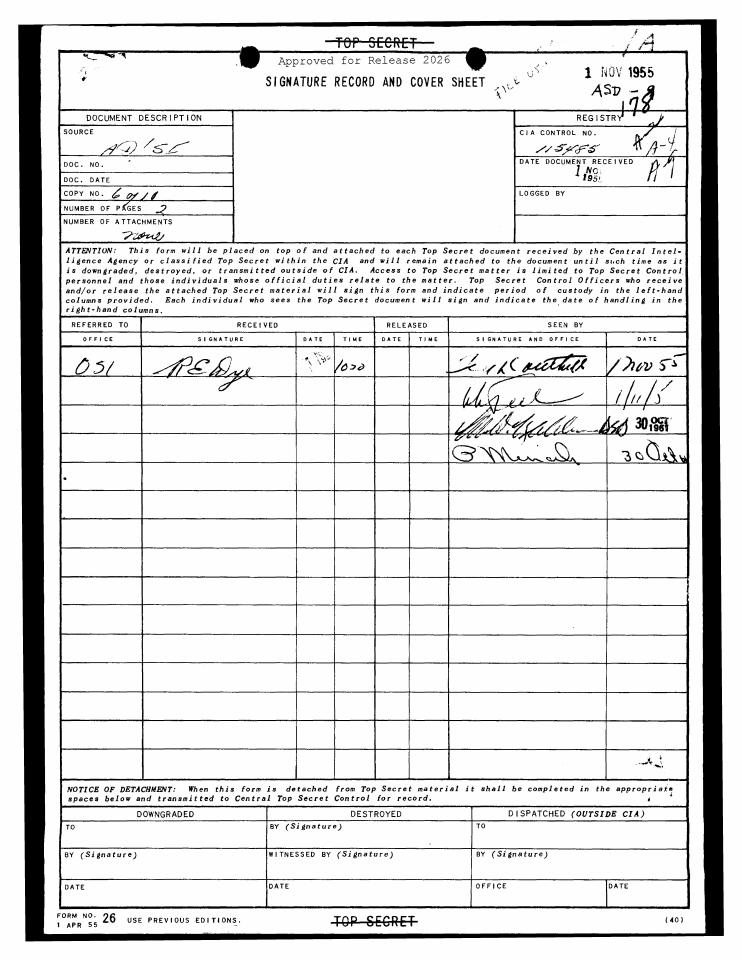
The four-witness interview summary
What it shows: The CIA memo preserves two rising luminous events and records where the witnesses agreed and where their descriptions diverged.
The limit: It summarizes interviews rather than publishing four first-person statements, and it contains no measured range, angle, image, or track.
The intelligence analysis and Project Y comparison
What it shows: The analysis tests ordinary aircraft, missiles, group interpretation, and a real Western saucer-shaped research program against the report.
The limit: Its steep-climbing-aircraft judgment is plausible but is not tied to a specific Soviet flight or launch record.
What the record supports
Russell and three companions reported two luminous events during a 1955 train journey in the Soviet Union. The CIA interviewed the group, documented meaningful differences among their accounts, and seriously evaluated whether the sightings indicated foreign aerospace technology.
What it does not establish
The memoranda do not identify a specific jet or missile, and they do not demonstrate a saucer-shaped Soviet aircraft. Apparent size, rotation, altitude, and maneuver were witness estimates made at night without a recoverable scale or instrument record.