The short answer: the public record now contains a small number of cases that deserve serious continued investigation. It still contains no publicly reproducible proof of nonhuman technology.
No hype, no reflexive dismissal
The signal is real. The conclusion is not here yet.
Credible government witnesses have reported persistent, structured events. Some cases include radar references, infrared observations, several viewing positions, or serious exclusion of ordinary hypotheses. That is enough to reject the idea that every case is merely a hoax or a confused civilian looking at Venus.
But the decisive public package is still missing: original data, full metadata, calibrated geometry, synchronized sensors, transparent analysis, and independent reproduction. “Unresolved” means the released evidence does not settle the cause. It does not name the cause for us.
The evidence ladder
The best public cases stop here.
This is a map of evidentiary completeness, not a probability that “aliens are real.” Individual records may sit lower.
1AllegationA story with no recoverable source
2First-hand witnessAn identifiable observer
3Multiple witnessesSeparate views of the event
4Official instrumentMedia, radar, or formal analysis
5Linked caseBest public material · context still incomplete
7Demonstrated causeIndependent validation or replication
Current position: a few cases approach a linked multi-source package. None in the public PURSUE archive gives independent analysts everything required to reproduce extraordinary speed, acceleration, material, or origin claims.
Disclosure progress
The files are getting more auditable.
UFOInform editorial index, 0–10. It scores access, provenance, context, visible hypothesis testing, and independent reproducibility—not belief or extraterrestrial probability.
R1 · May 8Bulk access and common record IDs
R2 · May 22More media and operational narratives
R3 · Jun 12Hypotheses and confidence become visible
R4 · Jul 10Stronger program and image sequences
R5 · Aug 7Linked verification and radar-visual history
R6 · Sep 18Contracts and case histories become auditable
The line rises because the cumulative archive now exposes more context and more of the government’s reasoning. It does not show a steady march toward an extraterrestrial conclusion. The final two points on the evidence ladder remain largely empty.
The must-see set
The best evidence—and its ceiling.
Ranked for public evidentiary value, not visual drama. Every card says what is genuinely interesting and what prevents a stronger claim.
01Layer 5 of 7
Strong lead · testimony-led
The Western U.S. event
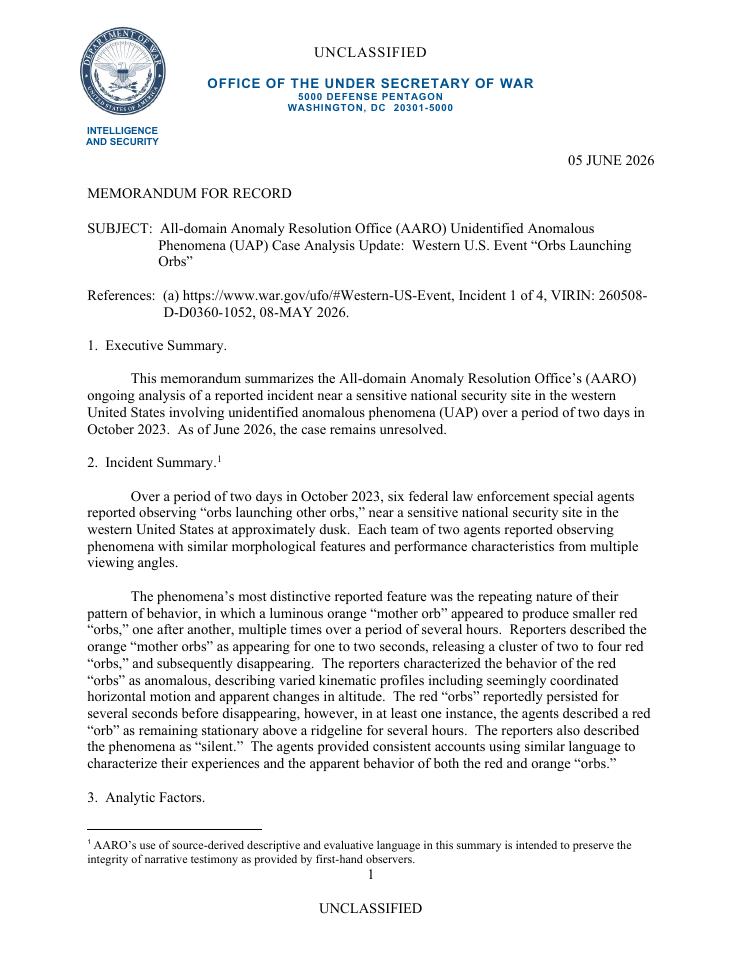
Six federal agents in three teams reported related “orbs” from different angles over two days. AARO compared their accounts with flight, radar, and ADS-B data, found flares plausible for about 60 percent of the activity, and left the rest unresolved.
What it showsConsistent trained witnesses and real hypothesis testing can leave a meaningful unresolved residue.
What holds it backThe unresolved portion rests on narrative testimony. No witness collected contemporaneous imagery or technical data.
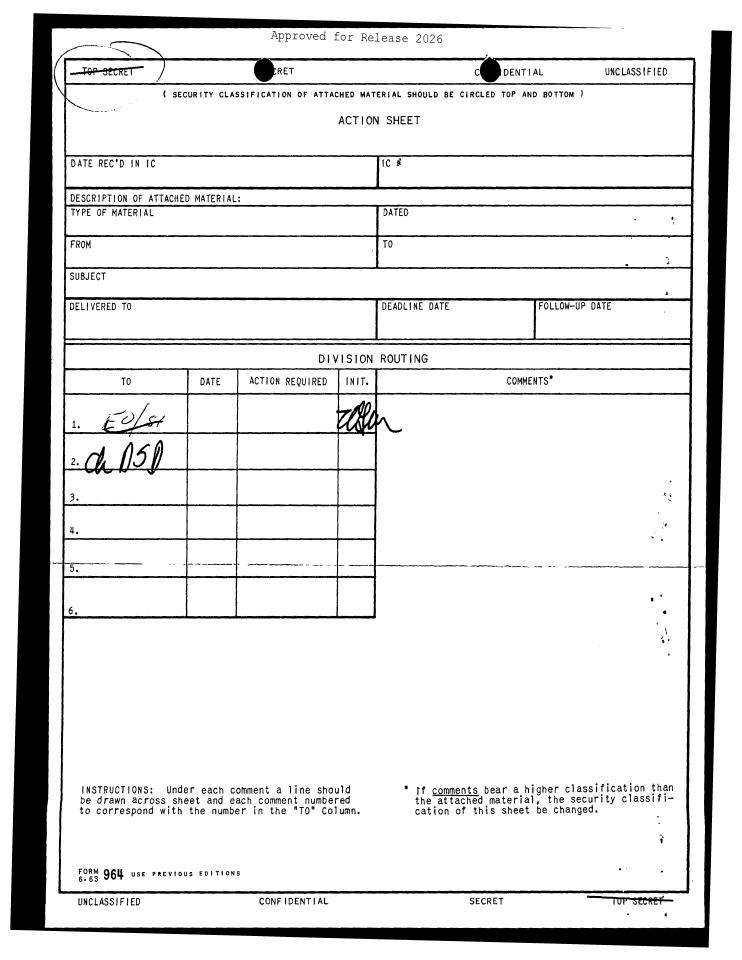
A Navy pilot reported a fighter-sized delta shape above Mach 3 while the USS Gyatt reportedly tracked an object near 3,800 knots. CIA offices considered foreign reconnaissance and ruled out domestic OXCART aircraft.
What it showsA visual report and a reported naval radar track were treated as one intelligence problem, not a lone anecdote.
What holds it backThe public file is a later memorandum. The underlying radar photographs, calibration, geometry, and complete pilot report are not available for reconstruction.
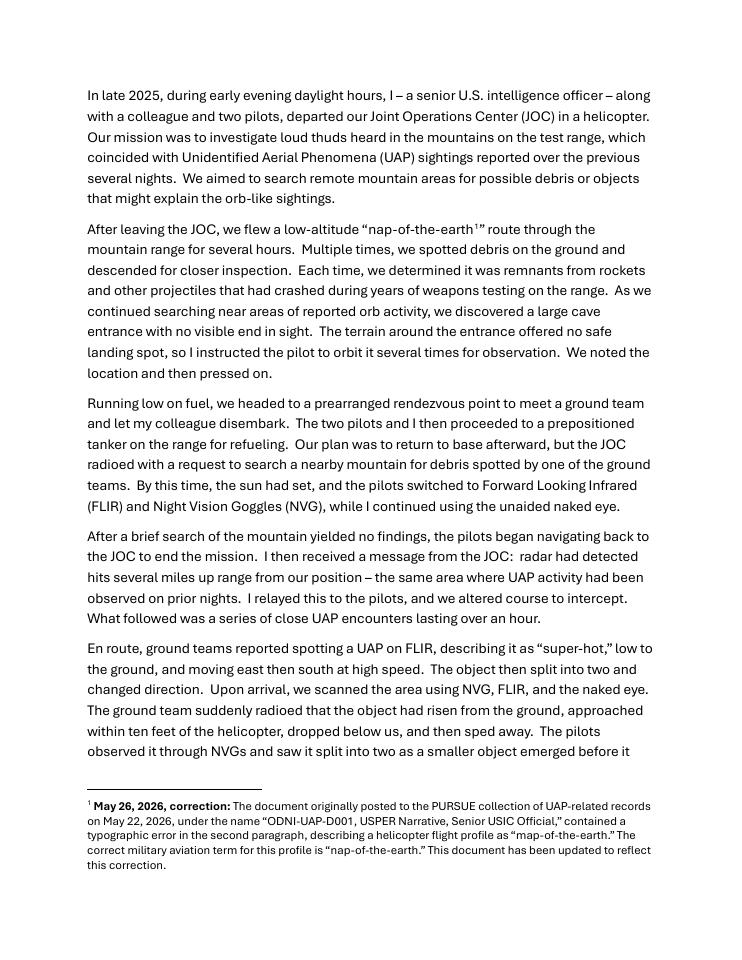
A helicopter crew, ground teams, radar direction from an operations center, infrared observations, and fighter activity appear in one first-hand narrative describing close glowing orbs and an apparent split.
What it showsThe report has unusually dense operational context and more than one observer or sensing channel in the surrounding event.
What holds it backThe release does not provide one synchronized timeline linking each radar hit, infrared file, witness, and aircraft position to the same target.
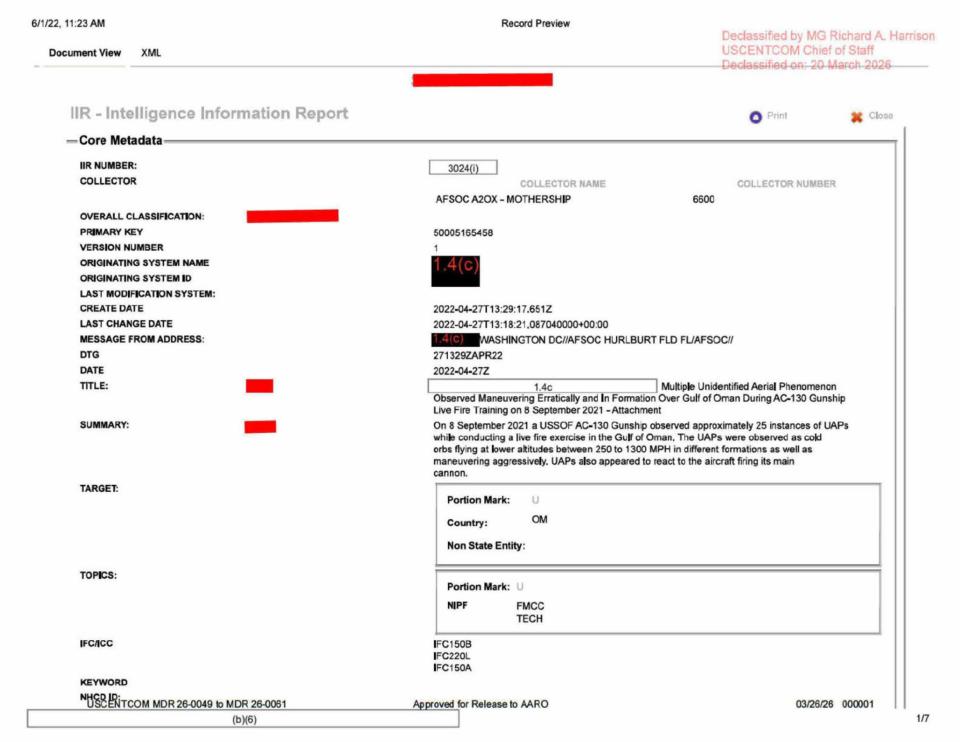
An AC-130 crew reported roughly 25 instances during a 2021 live-fire exercise, with apparently rapid movement and reactions to weapons activity.
What it showsA real operational report records repeated observations by an aircrew in a defined mission context.
What holds it backThe recorder was reportedly not working during the sightings. The dramatic speeds and behavior are witness estimates in an unevaluated intelligence report.
A military-looking infrared sequence appears to show two contrasts converging and one fragmenting in a high-energy event.
What it showsThe released pixels preserve a real, potentially consequential visual sequence from a file AARO considers likely military in origin.
What holds it backThe title is uploader-defined, the chain is incomplete, and the public file lacks the mission, sensor, and weapon records needed to authenticate the full attribution.
An experienced Navy photographer recorded 12 to 14 bright objects in 1952. The Air Force tested several explanations and later favored sunlit seabirds.
What it showsA sincere, technically experienced witness and authentic film can generate a durable unresolved-looking case.
What holds it backNo fixed reference points allow distance, size, altitude, or speed to be recovered; later comparable films supported the bird explanation.
A government file is not government confirmation.It may preserve a claim, an interview, an unevaluated report, or a rejected hypothesis.
A rendering is not a photograph.It shows how a witness and illustrator reconstructed memory after the event.
A filename is not chain of custody.Useful labels can survive even when the records that authenticate them do not travel with the file.
“Unresolved” is not a cause.Some cases resist ordinary explanations; others simply lack enough data to choose among them.
Repeated language is not independent corroboration.“Orb” or “triangle” can describe different events, perceptual groupings, and technologies.
A contract proves work was purchased—not that the subject worked.AAWSAP documents funded studies of exotic ideas. It does not demonstrate a functioning warp drive.
What the releases still withhold
This is what would actually move the needle.
The gap is less about another dramatic clip and more about the technical package around it.
01
Original sensor files
Uncompressed media, radar data, file hashes, frame timing, and the complete sequence before editing or export.
02
Calibration and geometry
Sensor model, field of view, platform position and attitude, range constraints, weather, and processing settings.
03
Synchronized timelines
A shared clock connecting witnesses, radar hits, infrared imagery, aircraft logs, and known traffic.
04
Full analytic case files
Competing hypotheses, calculations, source reliability, confidence changes, and the evidence behind final dispositions.
05
Selection rationale
Why these 447 records were released, what remains under review, what was excluded, and which cases are complete.
06
Independent access
Enough declassified data for scientists outside government to reproduce measurements and publish disagreement.
UFOInform’s current assessment
We are past “nothing to investigate.” We are not at “extraordinary origin demonstrated.”
PURSUE has materially improved the public’s ability to audit what government collected, spent, considered, and sometimes failed to resolve. Its strongest cases justify better collection and fuller release. The honest next milestone is not disclosure theater. It is a public case package that independent experts can calculate from beginning to end.
The assessment above is UFOInform editorial analysis. Record facts link to the public files in this archive. The framework also follows the government’s own recurring limitation: useful conclusions require calibrated, contextualized data rather than isolated imagery.