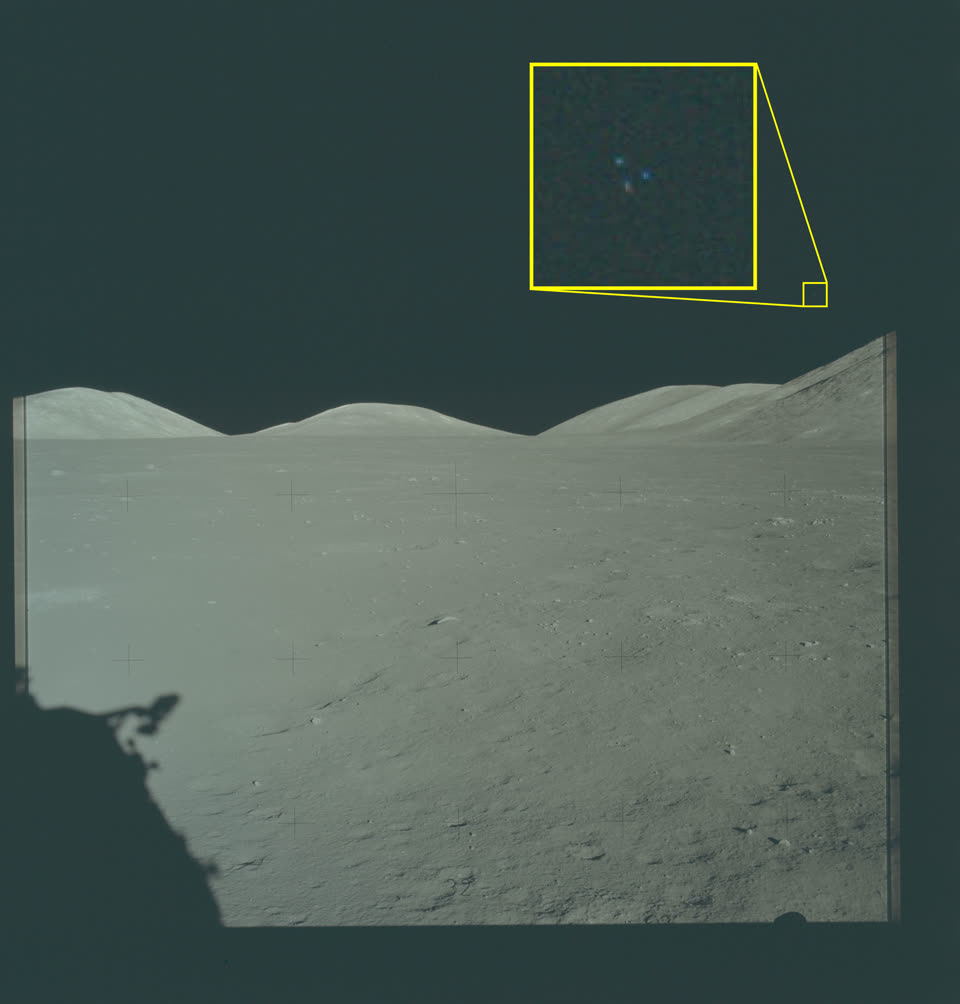
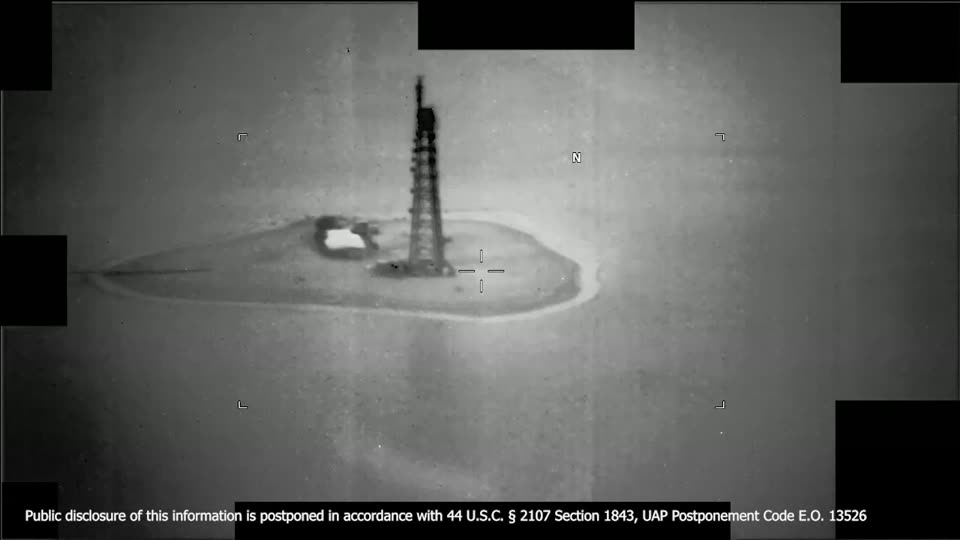
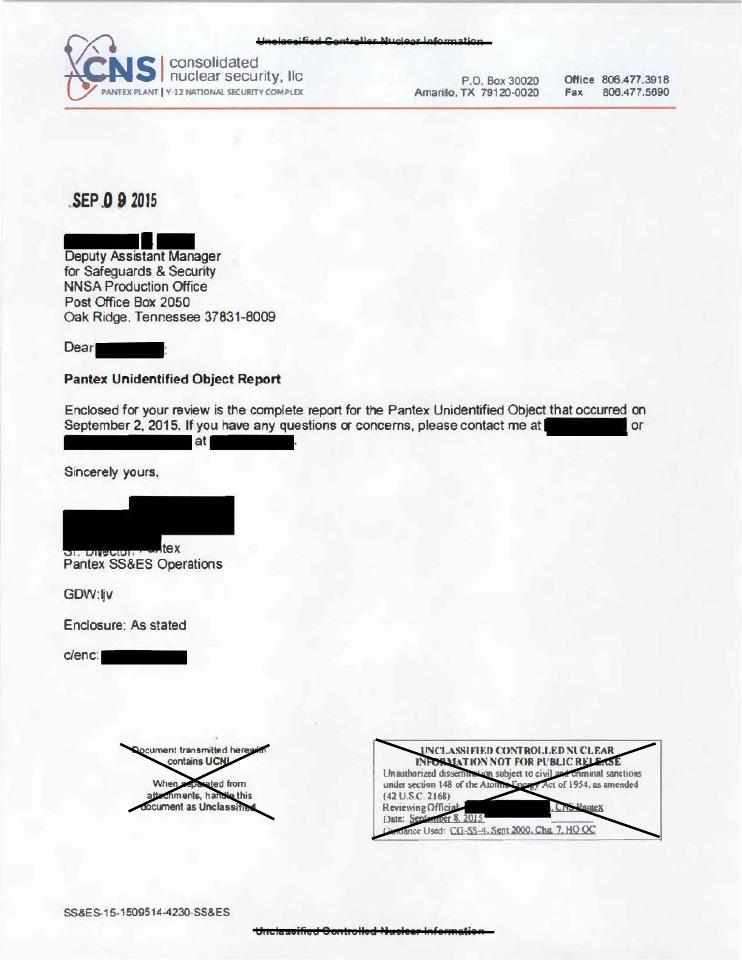
The Western U.S. event is one of the strongest witness-led cases in the PURSUE archive. Six federal law-enforcement agents, split among three teams, described related orange and red lights over two nights near a sensitive national-security site. AARO checked exercise records, flight logs, radar and ADS-B data, found a conventional answer for much of the activity—and left a remainder unresolved.
The headline-grabbing line is that “unrecognized technology” may account for up to 40 percent of the reported phenomena. The responsible reading is neither to wave that sentence away nor to translate it into “40 percent chance of aliens.” It is a provisional, exclusion-based hypothesis resting on testimony. That distinction is where this case becomes useful.
First, separate the four cases inside the case
The May 2026 overview groups seven federal employees’ reports into four categories: orange lights apparently producing smaller red lights; a large fiery orb near a ridge; a low, dark form initially mistaken for a car; and a later, faint or partly transparent kite-like form. AARO’s June analysis, DOW-UAP-D077, is narrower. It evaluates the repeated “orbs launching orbs” reports from six agents over two days.
That scope matters. The fiery orb and kite accounts are not extra instrument confirmations of the launch pattern. They are additional witness reports from the same broader operation. Treating all four descriptions as one shape-shifting object would add a conclusion the files do not make.
What the official analysis actually found
The agents described orange lights appearing for one or two seconds, followed by clusters of two to four smaller red lights. Some red lights moved in coordinated horizontal paths; some appeared to change altitude; at least one reportedly remained stationary over a ridgeline for hours. The teams were in different positions, used similar language, and were working an assignment related to unauthorized drone activity.
AARO did more than collect the stories. It compared them with commercial and military flight logs, radar, spatial estimates and ADS-B records. Historical records showed U.S. aircraft in the area actively dispensing infrared countermeasure flares during an exercise. Their timing, direction and apparent behavior made aircraft and flares a plausible explanation for about 60 percent of the activity.
The remaining 40 percent did not line up with known aircraft in the observers’ estimated lines of sight. A light reported as stationary for hours also conflicts with the burn time and descent of a flare. AARO ruled military-aircraft exhaust out, called ordinary multirotor drones unlikely, judged foreign technology highly unlikely, and found the weather generally unsuited to the natural effects it considered.
Forty percent is a remainder, not a probability
The memo does not publish a row-by-row ledger showing which sighting went into the 60 percent group and which went into the 40 percent group. It also does not release the underlying radar plots, ADS-B selections, team coordinates, flare models or line-of-sight calculations. Outside readers can audit AARO’s stated logic; they cannot reproduce the split.
Just as important, the radar and ADS-B checks are described mainly as controls for known traffic. The memo does not say radar produced a track of an unidentified object performing the reported motions. “No known aircraft in the estimated sightline” is useful exclusion evidence. It is not the same thing as a measured anomalous trajectory.
The official PURSUE archive still lists Release 06 as the latest release. This article uses the May overview and the expanded analysis and narratives released in June.
The witness files add detail—and show the limits
Witness 1’s account is unusually helpful because it contains a correction. The agent first guessed that the large fiery orb was 500 to 600 meters away. A later rangefinder measurement put the hillside near 1,100 meters. The overview consequently estimates a diameter of 12 to 18 meters, but that size still depends on placing the light at the hillside. The observation may be sincere and precise as a memory of a bright circle; its physical scale remains conditional.
Witness 2 described the orange-and-red lights, several apparent vehicle-like lights over rough terrain, and a later road pursuit. The language becomes highly interpretive: the objects seemed purposeful, reactive and technologically advanced. The same document openly labels its illustrations as AI-generated from prompts roughly two and a half years after the event. Those pictures are witness aids, not camera frames. The narrative also says some road-pursuit video exists and that its audio reactions may be more useful, but that raw footage is not part of the public case package.
Witness 5 supplied a more time-ordered account. The agent recorded a bright orange light at 18:58, smaller red lights at 19:18, another large light at 19:37, and the low red-and-white pair around 04:30. Night vision was used briefly; another search employed thermal binoculars. Yet the released memorandum does not provide an instrument recording. The team’s later observation of fresh-looking scrapes around a plant has no published sampling, laboratory analysis or chain of custody, so it cannot function as physical evidence.
These differences do not discredit the agents. They show why “multiple witnesses” is not the same as “multiple calibrated measurements.” People can independently agree that lights were present while remaining wrong about distance, grouping, motion or whether appearances at different times shared one source.
The best ordinary explanation is a mixture
The strongest ordinary explanation is the one AARO could tie to records: aircraft dispensing infrared countermeasure flares. The agents said the lights did not look like familiar illumination flares, but AARO noted that the specific countermeasure flares used in the exercise have different visual characteristics. That is concrete positive evidence, not a generic suggestion that every light was “probably a flare.”
For the remainder, the most economical model is not necessarily one exotic machine. It may be a mixture of distant exercise activity, mis-ranged ground or celestial lights, an unlisted U.S. capability, and memory-driven grouping of events observed in darkness. Once teams were alerted to odd lights, repeated attention could increase both useful reporting and perceptual priming. That is a limitation to test, not an accusation that trained observers imagined everything.
AARO’s own Blue Force review leaves a notable door open: individual reported characteristics resembled certain U.S. military technologies, although historical records were inconclusive and no single known capability explained the entire account. The dry joke is that “inconclusive deconfliction” is government language for a filing cabinet that refuses to confess.
The best case for taking it seriously
The strongest pro-anomaly argument is cumulative but specific. Three teams described related luminous behavior from different positions. AARO rated the agents’ operational awareness and familiarity with U.S. systems favorably. Known aircraft and flares explained much of the pattern, yet the agency said some reports were inconsistent with aircraft location data and known flare persistence. It also consulted intelligence partners, weather specialists and program offices before keeping the case open.
That does not prove a vehicle. It does justify continued investigation. A disclosure process earns trust by publishing both halves: the ordinary explanation that fits most observations and the residue that the available data cannot close. “Unresolved” should be the start of the next collection plan, not the end of the press release.
Evidence verdict: Layer 4 as a case file, Layer 3 for the anomaly
The public package reaches Layer 4 of 7 as an official analytic record because AARO documented hypothesis testing and cross-correlation with flight, radar and ADS-B information. The anomalous portion itself remains at Layer 3: several witnesses, but no released instrument measurement of the reported object. The official analysis strengthens the case that something warranted investigation; it does not upgrade testimony into raw data.
To move upward, AARO should publish the exact event timeline; observer positions and sightlines at a safe resolution; the aircraft and flare inventory with burn and descent profiles; the radar and ADS-B extracts used in the comparison; any contemporaneous road video and audio with metadata; and a table assigning each observation to the resolved or unresolved set. A repeat event would need synchronized calibrated cameras or multispectral sensors at separate positions, plus radar and exercise logs.
The public can reconstruct the reasoning only partially. It can compare the witnesses, see where estimates changed, and test whether AARO’s written conclusions follow. It cannot calculate the reported speed, range or 60/40 division from the released data. For a case presented as a model of serious government analysis, that missing reproducibility is now the most important fact to disclose.
Evidence on the page
What the released material actually shows
Open each source to inspect the complete record. The caption separates the useful fact from the limit that keeps it from carrying more weight.
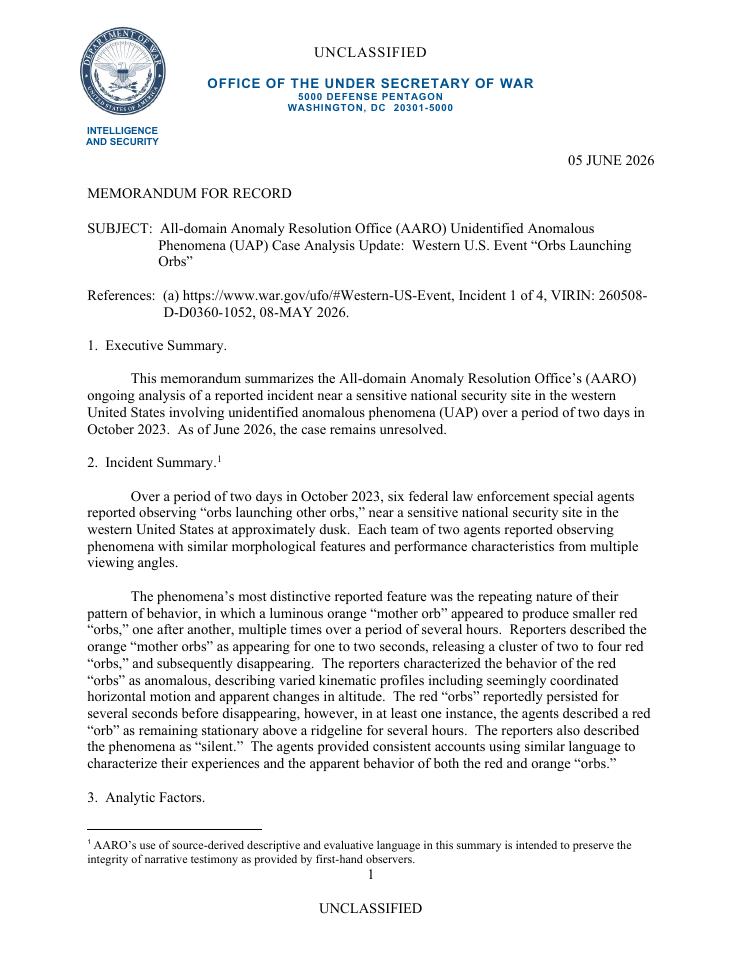
AARO’s June 2026 analysis update
What it shows: The memo records six agents, three teams, known exercise flares, hypothesis testing, and a remaining unresolved component.
The limit: The 60/40 split and line-of-sight exclusions cannot be independently recalculated without the underlying data and case-by-case ledger.
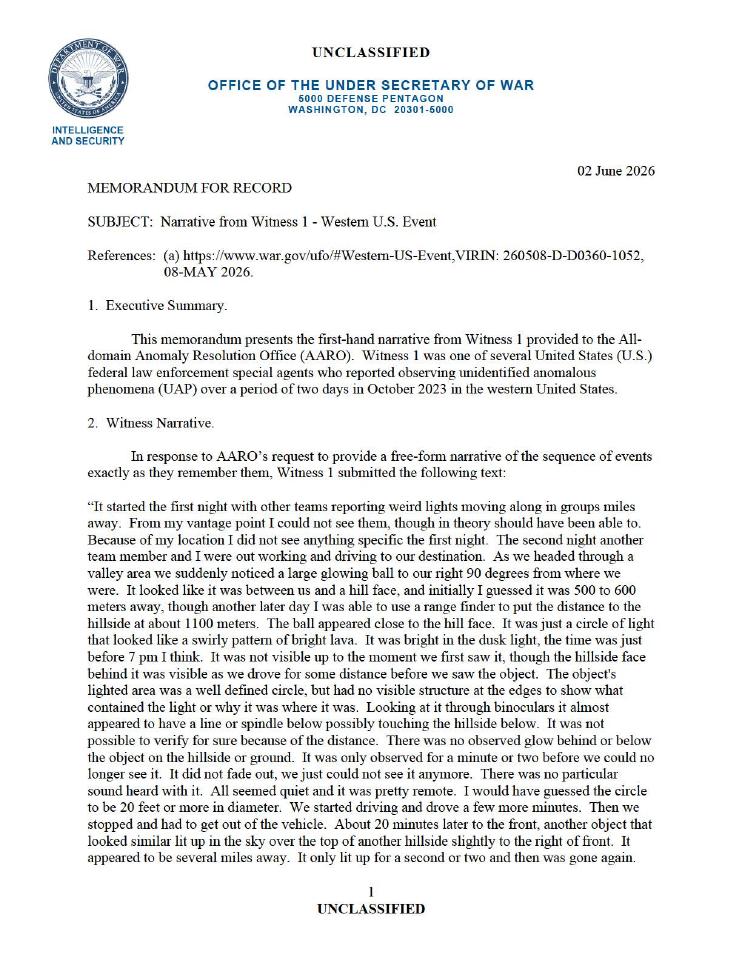
Witness 1: range corrected after the event
What it shows: The agent describes the fiery orb, repeated red-light releases, and later low dark and translucent forms in a first-person narrative.
The limit: A later rangefinder doubled the initial distance estimate, showing how strongly inferred size depends on uncertain placement.
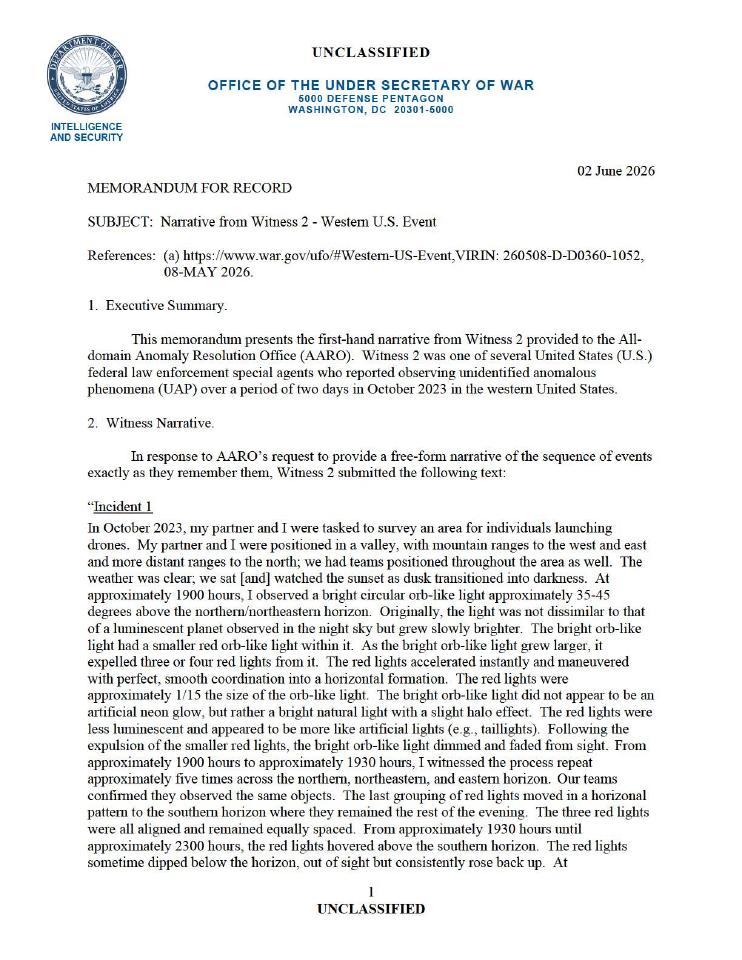
Witness 2: detailed narrative and later recreations
What it shows: The record preserves three reported incidents and explicitly labels its included illustrations as AI-generated from the witness’s prompts.
The limit: The recreations were made about two and a half years later and are not photographs or independent confirmation.
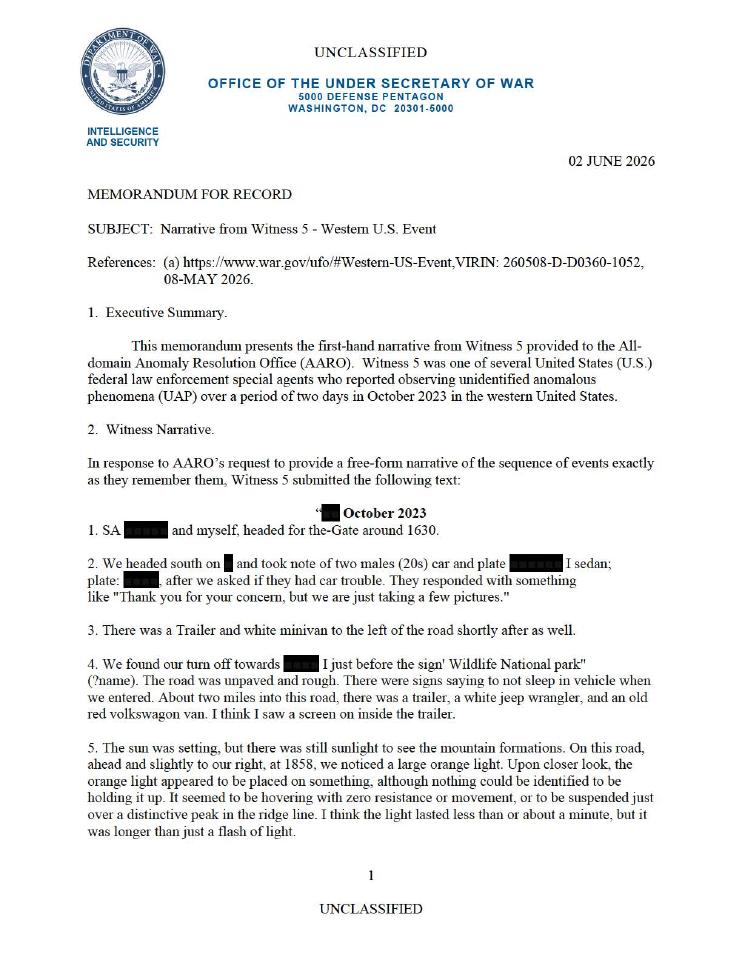
Witness 5: timed sequence and instrument attempts
What it shows: The narrative supplies times, describes brief night-vision viewing, and records a later thermal search and return to the site.
The limit: No night-vision or thermal recording, physical sample, or documented chain of custody appears in the public package.
What the record supports
Multiple federal agents reported recurring, related lights from separate positions. AARO found that exercise aircraft and flares plausibly explain much—but not all—of the reported activity, and its published review considered several competing hypotheses rather than declaring a cause.
What it does not establish
The public package does not show a sensor track of an anomalous object, independently verify the witnesses’ distance and speed estimates, identify the unresolved remainder as one phenomenon, or demonstrate extraterrestrial origin.