A rendering is an answer to a question
Release 5 includes several FBI interview summaries describing triangular or apparently triangular aerial phenomena, along with digital renderings made from witness descriptions. The images are memorable: dark forms, translucent surfaces, separated lights, and broad silhouettes. They are also downstream evidence. Each began with an observation, passed through memory and an interview, and became a visual reconstruction.
That process is not inherently unreliable. Police sketches, accident diagrams, and scientific illustrations can preserve information that no camera captured. But the final image should be read as a structured account of what the witness meant, not as a recovered photograph of what physically occupied the sky.
Lights can create edges the eye never measured
Several points of light naturally invite the brain to connect them. Three lights suggest a triangle even when they belong to separate objects or sit at different distances. A dark region between them can feel like a solid surface, especially against a night sky with few depth cues. Conversely, a genuinely solid object may be described mainly through its lights because its edges were difficult to see.
The released cases vary. One file records a former military pilot recalling incidents across 2002 and 2023–2024, including an Afghanistan observation. Another describes a dark translucent triangle in Colorado Springs in 2023. A separate case describes a large triangle with red lights. Their shared vocabulary makes comparison worthwhile, but the differences in date, setting, visibility, witness position, and available corroboration remain central.
Why the images still help
Renderings can force vague language into explicit choices. Was the form opaque or translucent? Were lights on the corners or beyond them? Did the witness perceive surface texture, or only an outline? Those decisions can reveal whether two verbal reports are actually similar. They can also expose ambiguity that prose hides.
The best practice is to keep the interview and rendering side by side. If the picture adds a crisp edge the statement never supports, that addition should not quietly become fact. If the witness reviewed and corrected the image, that chain should be documented. A good reconstruction makes uncertainty visible rather than airbrushing it away.
The pattern is a research question
Triangle reports are worth indexing across agencies and decades. A useful study would compare lighting geometry, viewing angle, duration, weather, aircraft activity, radar coverage, and whether witnesses perceived an actual surface. Counting triangle-shaped reports alone cannot reveal how many independent physical objects were involved.
From points of light to an implied surface
Triangle reports often begin with three or more lights. The visual system is excellent at grouping points into edges and surfaces, especially against a dark, featureless sky. Once the observer perceives a connected object, later memory and interview language may preserve the inferred triangle rather than the original set of lights. That does not mean the report is invented. It means shape can be a conclusion drawn by perception.
The FBI interviews are useful because they preserve variation. Some witnesses describe a dark or translucent form connecting lights; others report a large shape, red lights, or airborne points whose relationship is less certain. Treating every use of “triangle” as the same morphology erases the details that could distinguish aircraft, formations, perspective effects, and genuinely unexplained observations.
A rendering is a disciplined illustration, not captured light
Witness-guided digital renderings can be valuable. They force choices about number, placement, apparent color, orientation, and background. They help readers understand what an interview summary means. But the pixels originate in the reconstruction process, not the event. A realistic image can therefore be faithful to memory without independently corroborating memory.
The evidentiary chain should be read in order: event, human perception, memory, interview, written summary, artist or software interpretation, witness feedback, final rendering. Each link may be careful; each also transforms the information. The final image is strongest as evidence of the witness’s communicated model, not the object’s physical surface.
What comparison can legitimately reveal
Comparing reports can identify recurring descriptive elements worth collecting prospectively: light spacing, angular extent, sound, duration, occlusion of stars, radar returns, and relative motion. It cannot establish prevalence in the world because the archive is a selected government collection and because memorable shapes may be more likely to be reported.
The best next step is not to stack more drawings. It is to translate future triangle reports into measurements: simultaneous views from separated locations, calibrated images with star fields, aircraft and satellite traffic, audio, radar, and exact time. If multiple observers can independently establish a rigid outline and common motion, the shape becomes more than an inference.
A simple test could settle more than another interview
If stars are visible behind or between the reported lights, calibrated imagery can test whether a dark body actually blocks them. Two separated cameras can triangulate range and determine whether the lights maintain a rigid geometry. Precise timing can compare the event with aircraft formations, satellites, and training activity. These are modest requirements, not science-fiction sensors. Their absence explains why the archive can preserve several sincere triangle accounts while remaining unable to say whether witnesses saw one large surface, several coordinated lights, or a perspective effect.
Evidence verdict: a pattern in testimony, not yet a demonstrated craft class
The current set reaches layer three where witnesses are identifiable and some accounts are independent. The renderings remain at the testimony layer because they visualize accounts rather than add a separate sensor. No released case in this group supplies public raw data sufficient to establish one common object type.
The records support saying that multiple military or government-connected witnesses described triangle-like configurations across different incidents. They do not support saying that one triangular technology recurred. The needle moves when geometry, timing, and independent instrumentation connect the lights into a measured body rather than a compelling picture.
Evidence on the page
What the released material actually shows
Open each source to inspect the complete record. The caption separates the useful fact from the limit that keeps it from carrying more weight.
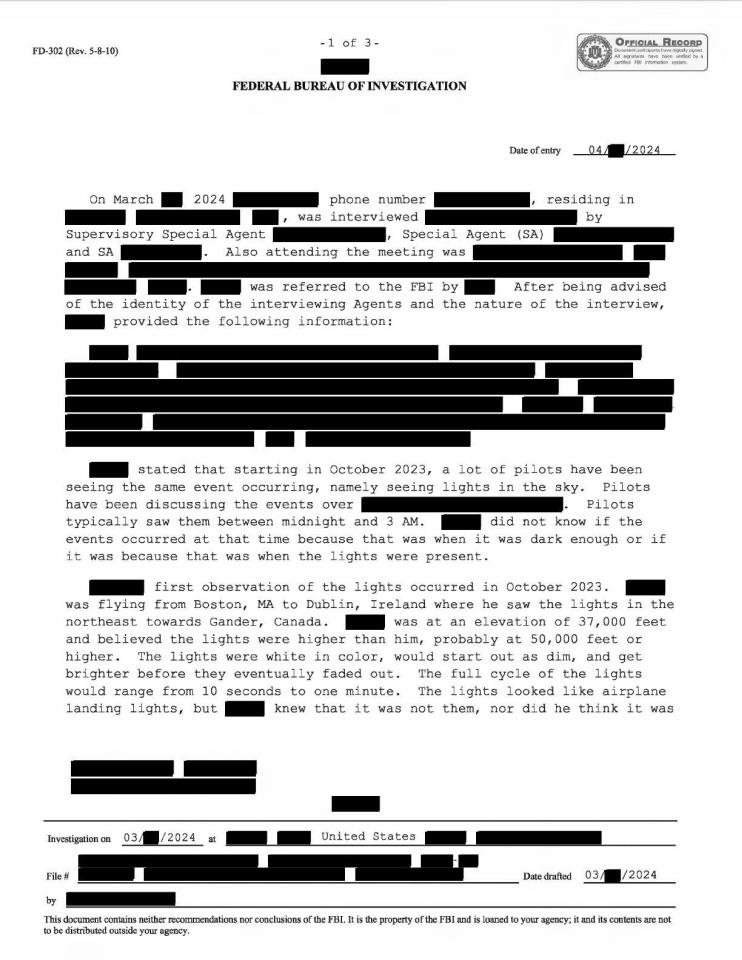
Airborne lights and triangle interview
What it shows: An FBI interview preserves a former military pilot’s accounts across several years and settings.
The limit: The events are retrospective testimony and should not be merged simply because triangle language appears.
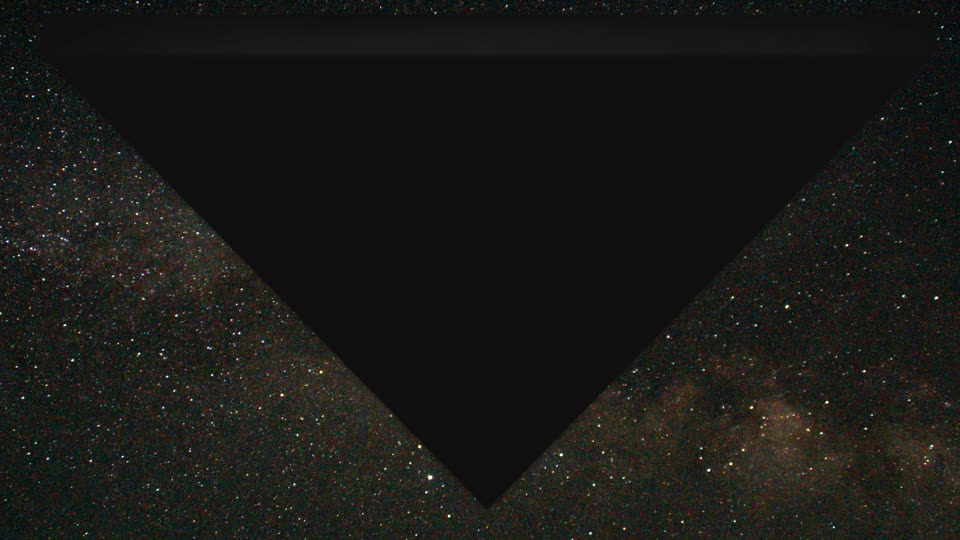
Witness-guided triangle rendering
What it shows: The companion image makes the observer’s reported geometry legible to a reader.
The limit: It is a reconstruction created after the event, not a photograph or independent sensor return.
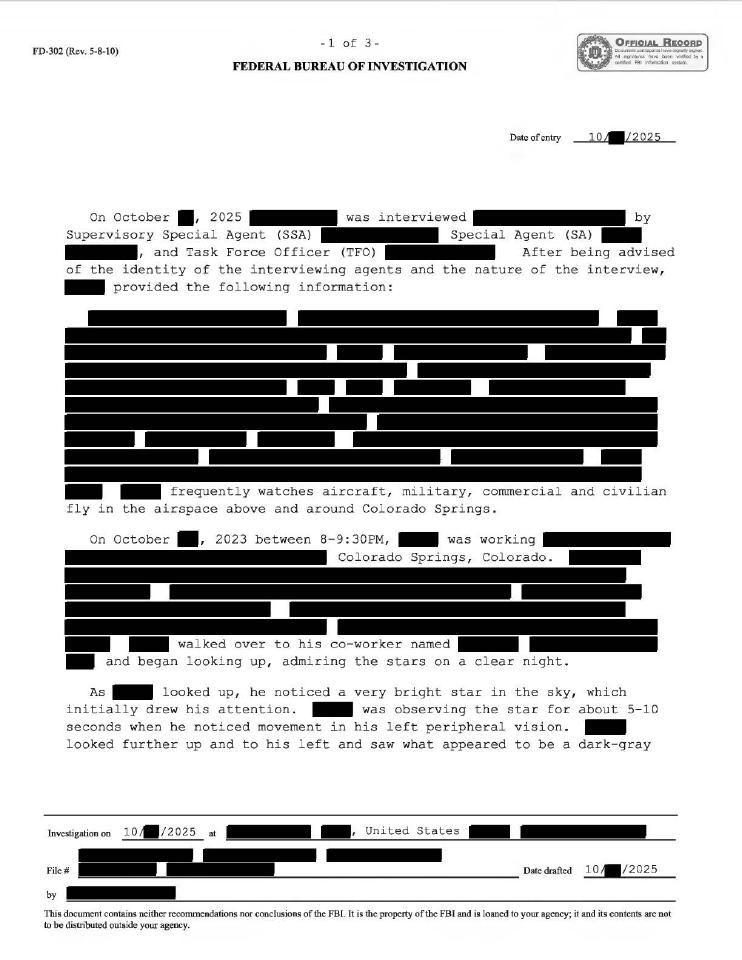
A separate triangle account
What it shows: Another released record supplies a comparison point for lights, apparent edges, and motion.
The limit: Similarity in descriptive language does not establish common hardware, location, or cause.
What the record supports
Multiple interviewees described triangular configurations or forms, and the FBI preserved several accounts with witness-guided visual reconstructions that make comparison possible.
What it does not establish
The renderings are not photographs, similar shapes do not prove a common vehicle, and a triangle inferred from lights may not represent a single solid object.