The first version had everything
In November 1963, a Portuguese-language broadcast from Brazil carried an extraordinary report from Conde, Bahia: a large metallic sphere had allegedly crashed, and a dead occupant had been found wearing a uniform or spacesuit marked with strange symbols. The Foreign Broadcast Information Service captured the account. It reached files associated with the National Aeronautics and Space Council, the White House-level body then coordinating space policy.
This is the stage at which a modern retelling might stop. A government document contains the words. A presidential office took notice. The details are cinematic. But the archive preserves what happened next, and what happened next is the entire reason the file is useful.
Officials asked the embassy to verify it
Handwritten notes record an interagency request for the State Department to check the story with the U.S. Embassy in Rio de Janeiro. The embassy then tried to make sure Washington and Rio were discussing the same claim despite a poor telephone connection. Its cable repeats the press descriptions so there would be no ambiguity about the rumor being tested.
The embassy’s understanding was much less dramatic. A weather balloon had reportedly been in the vicinity, but no crashed object matching the story had been found. Follow-on correspondence continued the clarification. The documentary chain transforms the meaning of the first report: government possession of a rumor becomes evidence that officials investigated it, not evidence that they confirmed it.
This is what a healthy archive should preserve
False or unverified stories belong in a transparency collection when they influenced official action. Removing them would erase how information moved and how decisions were made. Keeping them requires readers to follow the full chain rather than treating every page as an equally endorsed finding.
The Bahia file is also a warning about decontextualized document screenshots. A cropped image of the initial wire can truthfully show that a government office received a “dead crewman” report while hiding the cables that weakened it. The screenshot is authentic; the implication is not.
The interesting part is the correction
AURA likes mysteries, but this one earns its place for another reason. It demonstrates verification in motion. An alarming report crossed agencies, prompted a query, and lost credibility when people closer to the event could not confirm the crash. That may be less thrilling than a metallic sphere. It is much more instructive about how archives should be read.
The archive captures a claim losing weight
The Bahia chain begins with the kind of story that normally outruns its sources: a metallic sphere, a crash, and a dead occupant in unusual clothing. Its value is not that the government recorded those words. The value is that the records show the allegation being passed to offices capable of checking local information and returning a less sensational answer.
The presidential-level inquiry establishes official awareness, not official endorsement. Administrations routinely ask agencies to verify extraordinary or politically sensitive reporting. The State Department and embassy responses then narrow the claim: a weather balloon had reportedly been seen, while the dramatic crash and body could not be verified. Each step changes the evidentiary status.
Why a government document can contain false material
Archival readers sometimes treat classification, letterhead, or senior routing as a truth stamp. In reality, government records preserve questions, rumors, unevaluated intelligence, allegations, and rejected hypotheses alongside findings. A document proves that its author wrote or received a claim. Whether it proves the underlying event depends on sources, corroboration, and follow-up.
Bahia is an unusually clean lesson because the chain remains visible. The first record captures the spectacular report; later correspondence records verification efforts; the diplomatic answer fails to confirm the central details. The existence of several documents therefore weakens the extraordinary account instead of multiplying it.
The ordinary explanation is not fully proved either
The weather-balloon information is more plausible and comes through an official channel, but the released file still does not present a recovered balloon, serial number, launch record, or complete local investigation. The correct verdict is not that every detail was solved. It is that the best available follow-up did not substantiate the extraordinary details and supplied an ordinary event that may have seeded the report.
That difference is important. “Unverified” does not mean impossible. It means the claim has not earned the status of evidence. A responsible archive can preserve the story, the inquiry, and the failure to confirm without pretending the remaining gap favors the most dramatic version.
Why this case belongs beside the strongest ones
Bahia functions as a control. It demonstrates that official interest, several documents, and an unresolved remainder can coexist with a claim that loses credibility under checking. Any method that counts government paperwork as confirmation would rank Bahia upward when the content of the paperwork clearly pushes it down. The same discipline must apply to favorite cases: follow the direction of verification, separate the event from the response, and allow a linked record chain to weaken an extraordinary story. A trustworthy archive needs negative examples because they show that its standard can actually reject a claim.
Evidence verdict: a strong debunking chain, a weak encounter claim
For the institutional story, the documents reach layer five: linked primary correspondence shows a claim moving through government and receiving follow-up. For the alleged craft and occupant, the file remains at layer one—an unsupported retelling whose core details were not verified.
Contemporaneous police records, medical or morgue records, crash-site photographs, named witnesses, physical material, or a recoverable balloon record could alter the assessment. In their absence, Bahia belongs in the archive as an example of verification reducing a claim, not as evidence that a dead nonhuman pilot was recovered.
Evidence on the page
What the released material actually shows
Open each source to inspect the complete record. The caption separates the useful fact from the limit that keeps it from carrying more weight.
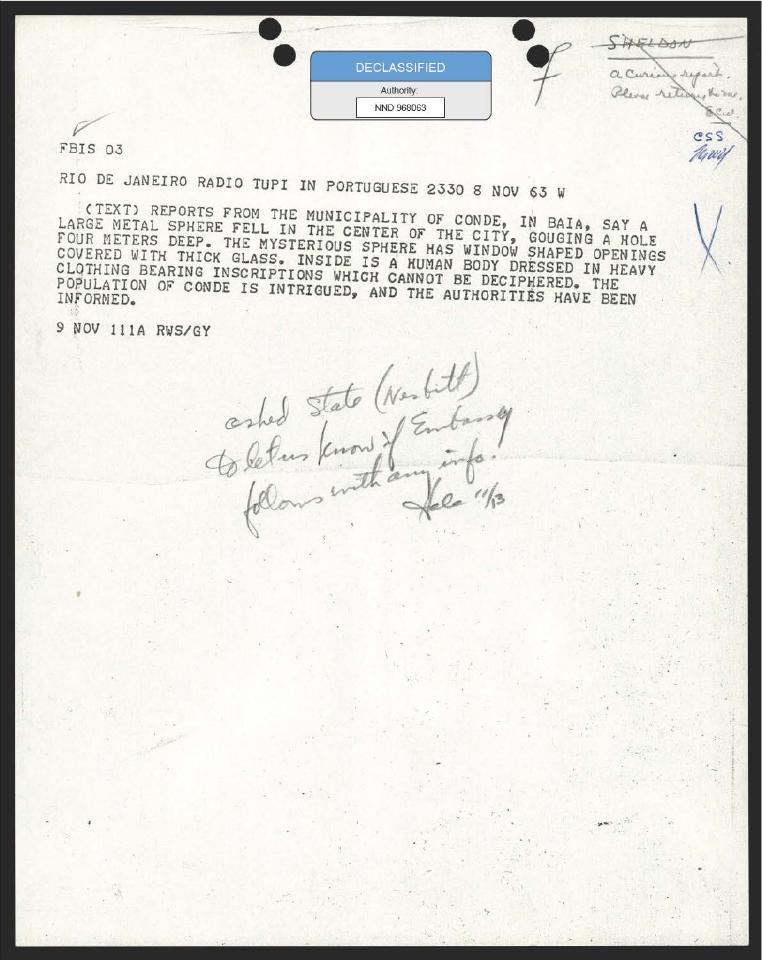
The initial White House inquiry
What it shows: A presidential office asks for verification of a sensational report circulating from Brazil.
The limit: Senior attention proves the question reached government, not that the alleged crash or occupant existed.
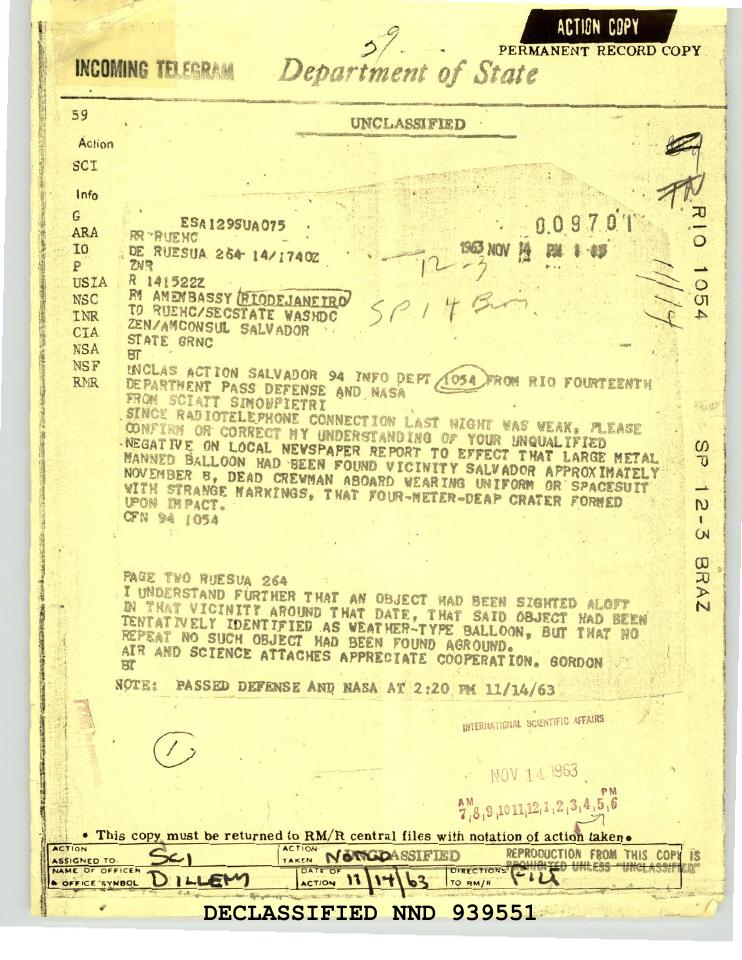
State Department follow-up
What it shows: The claim is routed into diplomatic channels for local checking rather than accepted at face value.
The limit: Administrative follow-up is a process record and adds no independent physical evidence.
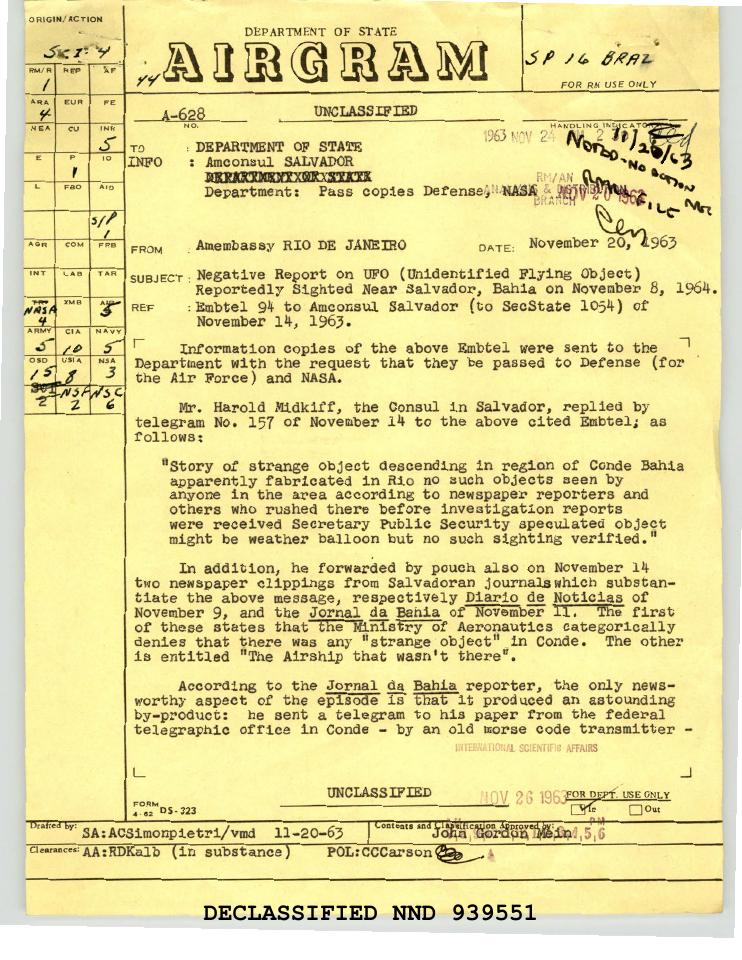
The embassy’s answer
What it shows: The response notes a reported weather balloon but does not verify a crash or dead occupant.
The limit: The ordinary explanation is plausible rather than fully reconstructed; the decisive point is the failure to corroborate the extraordinary claim.
What the record supports
U.S. officials received and investigated a Brazilian media report about a crashed metallic sphere and alleged occupant. Embassy reporting found a possible weather-balloon report but no confirmed crash matching the sensational account.
What it does not establish
The presence of the original rumor in presidential and intelligence files does not validate its claims. The released chain supplies no confirmed craft, body, spacesuit, or strange markings.