Three photographs are better than one
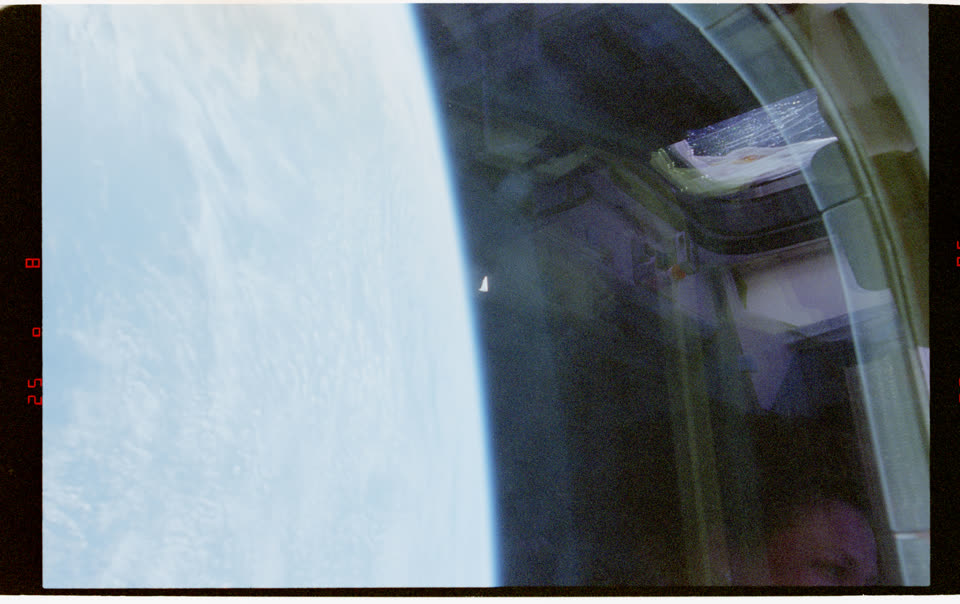
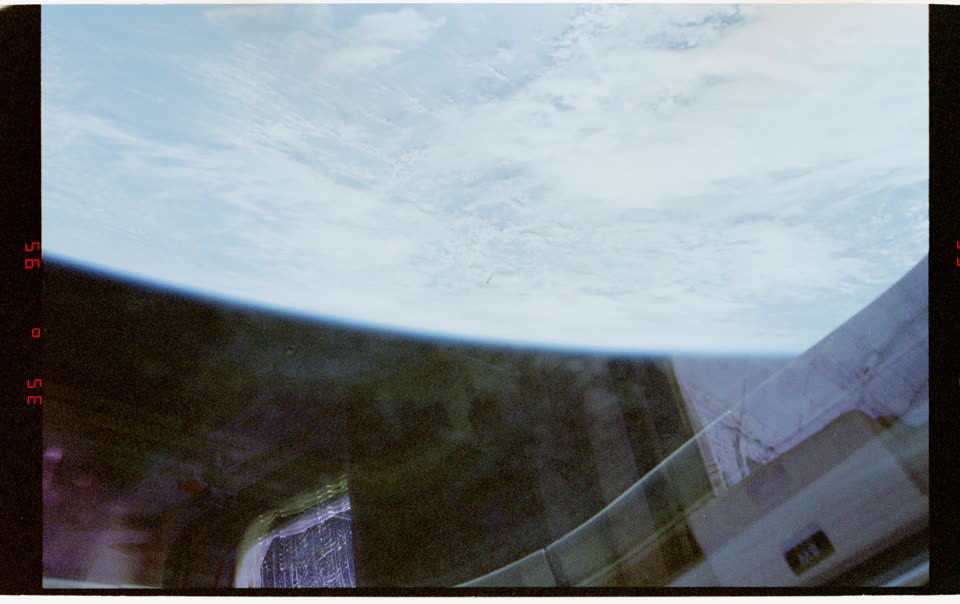
During Space Shuttle Columbia’s STS-80 mission in late 1996, astronauts captured three images containing an unidentified object in low-Earth orbit. The released records show the object in relation to Earth’s limb and the surrounding frame. Multiple images matter because they reduce the chance that a single mark is a one-frame defect or a simple scanning accident.
They also invite a familiar mistake: assuming that an object visible against Earth must be near Earth’s surface or large enough to command the scene. A two-dimensional photograph records direction and brightness. It does not automatically record distance.
The missing variable changes everything
If the object was close to the shuttle, a small piece of ice or debris could occupy the same apparent size as a much larger object farther away. If it was distant, its motion relative to the frame could reflect the shuttle’s movement, the camera’s orientation, or the object’s own path. Without reliable range, even a precise pixel measurement cannot become a physical diameter.
The Earth limb provides a useful visual reference but not necessarily a shared distance plane. Human vision tends to place unrelated points into one scene, especially when one background dominates. Orbital imagery makes that intuition hazardous because foreground particles, spacecraft debris, clouds, stars, and distant objects can overlap in projection.
What a useful analysis would need
A stronger reconstruction would use original image metadata, exact timestamps, camera model and settings, shuttle attitude, window or payload-bay geometry, consecutive frames, and records of venting or spacecraft operations. Star-field registration could help determine pointing. If the object moved across frames, a calibrated sequence might constrain angular velocity. None of those steps guarantees identification, but each turns appearance into a measurement.
The three released images are therefore a good archival object and an incomplete physical case. They confirm that a visual feature persisted across the selected material. They do not tell a reader whether that feature was inches away, kilometers away, or an artifact shared across an imaging process.
Why “unidentified” is the correct caption
There is no shame in a modest conclusion. The photographs deserve to be preserved and compared with mission records. Labeling the object unidentified does not imply failure, only that the public package lacks enough information for a defensible attribution. Space is large. A pixel remains stubbornly small.
Three frames solve one question and expose four others
The STS-80 sequence establishes that a visible form appears in more than one released image. That is useful because it reduces the chance that the central feature is a one-frame compression error or isolated blemish. It also allows a reader to compare its position relative to the frame and Earth’s limb. What the sequence does not supply is the object’s range.
Range is the hinge for every dramatic inference. Angular size becomes physical size only when distance is known. Angular displacement becomes linear speed only when distance and frame timing are known. A nearby ice particle, a piece of shuttle-associated debris, and a distant larger object can produce superficially similar marks. The photographs preserve angle; they do not automatically preserve depth.
Earth’s limb looks like a ruler but is not one
The planet in the background gives the scene intuitive scale, which is precisely why the images are persuasive. But an object between camera and limb is not necessarily near Earth’s surface. It may be much closer to the orbiter and merely overlap the same line of sight. Without camera orientation, focal length, exposure, exact timing, and object tracking across frames, the limb is scenery rather than a measuring stick.
Illumination matters as well. Small nearby material can brighten abruptly when it crosses sunlight; exposure settings can enlarge a saturated point; motion during exposure can stretch it. None of those possibilities identifies the STS-80 object. They explain why shape and apparent location alone cannot carry the conclusion.
Why official release still matters
The photographs belong in the archive because they let readers work from first-generation government-held imagery rather than a cropped repost. The sequence can be compared, hashed, and paired with mission documentation. Official release narrows questions about whether the image exists. It does not confer an extraordinary interpretation.
A serious follow-up would use the mission timeline, camera specifications, original negatives or highest-resolution scans, spacecraft attitude, orbital position, and any adjacent frames. Analysts could then test whether the object’s motion is consistent with shuttle-associated debris, a distant orbital body, or an imaging artifact. Without those inputs, enlarging the JPEG mostly enlarges uncertainty.
The most useful experiment is a reconstruction, not a vote
A proper reanalysis would begin by registering the three frames against fixed features in the camera view, then model the shuttle’s attitude and orbital motion for the precise exposure times. Candidate distances could be tested to see which trajectories remain physically plausible. Nearby-particle models should predict illumination and apparent drift; distant-object models should predict a different parallax signature. Publishing those assumptions would let competing analysts disagree about calculations rather than impressions. None of that guarantees an identification, but it would transform the question from “What does this look like?” into “Which geometries survive the data?”
Evidence verdict: authentic imagery below the reconstruction threshold
The sequence reaches layer four: official instrumented imagery with mission provenance. It does not reach layer five or six because the released package does not provide enough linked camera and trajectory data for an outside analyst to recover distance and motion. Three photographs are more informative than one, but they are not a three-dimensional track.
The strongest defensible statement is that STS-80 imagery contains an unidentified visible object across a short sequence. The material does not show extraordinary acceleration, scale, or composition. The data that would move it upward are mundane and exacting: original frame timing, optics, orientation, exposure, and a complete neighboring sequence.
Evidence on the page
What the released material actually shows
Open each source to inspect the complete record. The caption separates the useful fact from the limit that keeps it from carrying more weight.
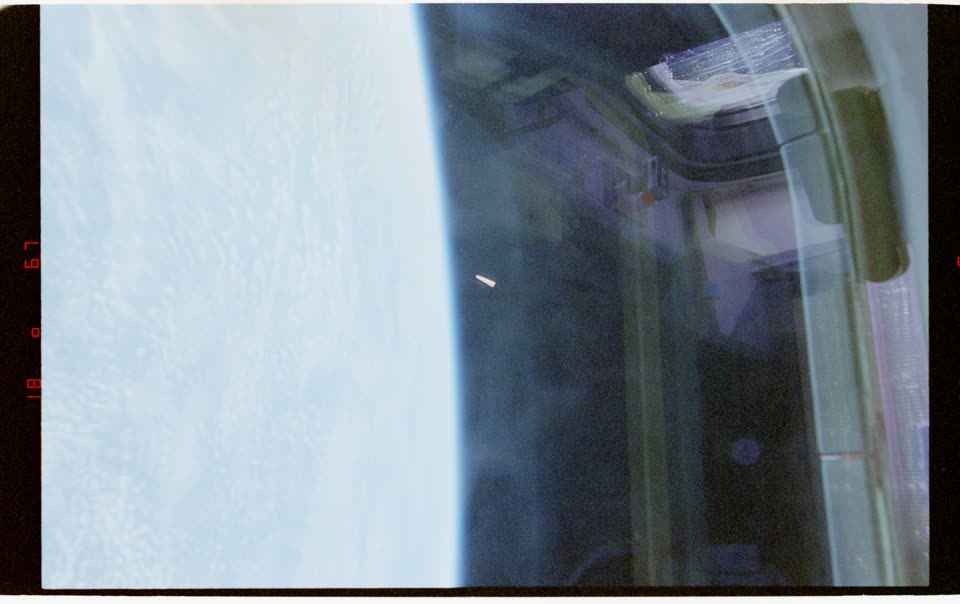
STS-80 image one
What it shows: A distinct object is visible near the center of the frame to the right of Earth’s limb.
The limit: Its overlap with Earth in the image does not establish that it is near Earth rather than near the camera.
STS-80 image two
What it shows: A second frame shows the feature again and permits comparison across the sequence.
The limit: Without exact frame timing and camera orientation, apparent displacement cannot be converted into speed.
STS-80 image three
What it shows: The third released image confirms that the archive contains a short series rather than one isolated frame.
The limit: Three processed images still lack the optics, exposure, range, and adjacent frames required for reconstruction.
What the record supports
Three released STS-80 photographs contain an object or image feature visible near Earth’s limb, providing more than a single isolated frame for examination.
What it does not establish
The images alone do not determine the object’s distance, physical size, speed, composition, or origin. Apparent placement against Earth does not prove that the object occupied the same depth as the planet below.