Before Blue Book, there was Sign
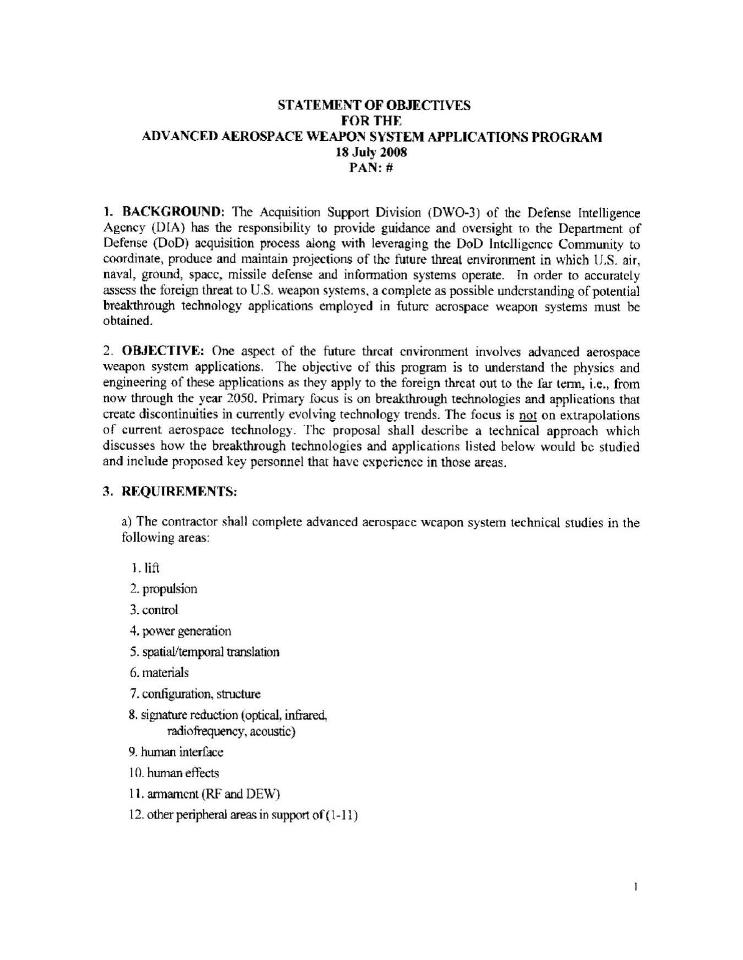
Project Blue Book became the famous name, but the U.S. Air Force had already tried to organize the UFO problem in 1948. The Project Sign progress report details 100 sightings collected across 1947 and 1948. Read with Air Materiel Command analyses from the same period, it captures an institution deciding what counted as a case, which witnesses deserved follow-up, and how to compare stories that rarely arrived with instrument-quality measurements.
The files are not a secret final estimate tucked behind a curtain. Their value is procedural. They show the Air Force sorting reports by observer, location, apparent behavior, weather, astronomy, known aircraft, and the quality of supporting material. The investigators were building a taxonomy while the phenomenon’s public vocabulary was still being built around them.
One hundred reports do not equal one hundred unknowns
A case count is not an evidence count. Some reports may describe the same event. Some contain enough information for an ordinary explanation; others remain open because the needed details were never collected. A witness’s apparent speed estimate can become meaningless without distance. A reported shape may depend on lighting or viewing angle. Radar, photographs, and multiple observers can strengthen a case, but only when their timing and geometry genuinely connect.
This is why historical percentages are easy to misuse. An “unexplained” remainder can reflect strangeness, insufficient information, or both. The category tells us that investigators did not close the file under their methods. It does not tell us what would have happened with modern sensors—or whether modern sensors would have been used well.
The reports expose an enduring collection problem
Project Sign operated when jet aviation, balloons, rockets, and radar were changing what could appear in the sky. Observers were encountering unfamiliar technology while the military was protecting genuinely secret programs. That environment could produce both mistaken identity and observations of real objects that officials could not publicly discuss.
The same structural problem appears in modern UAP databases. The collection receives events precisely because someone could not identify them in real time. Analysts then inherit whatever the reporting form preserved. If range, sensor state, original media, and environmental conditions are absent, expertise cannot reconstruct them from confidence alone.
Why the report remains useful
Project Sign’s hundred cases form a baseline for studying how official categories evolve. They let readers compare early assumptions with later Blue Book methodology and today’s AARO language. The continuity is striking: officials still want better sensors, standardized reporting, and enough context to distinguish unusual performance from unusual appearance.
A hundred cases do not equal a hundred equal mysteries
Project Sign’s progress report is valuable because it shows the Air Force trying to turn a burst of postwar reports into a tractable problem. The cases differ radically: some are brief visual observations, some have several witnesses, some involve pilots, and some include physical or photographic claims. Putting them in one report creates a research corpus. It does not make their reliability interchangeable.
The report’s categories also reflect the technical world of 1948. Radar coverage, camera access, aircraft performance, and atmospheric knowledge were not what they are today. Investigators compared shapes, apparent speeds, directions, and witness competence, but many files still lacked basic geometry. A witness could be highly credible and still have no way to measure the distance to a featureless light.
The institutional innovation was the case method
Before asking what the report concluded, notice what it built: numbered incidents, recurring descriptive fields, attempts to identify common causes, and a process for routing unusual reports into technical review. That structure is the ancestor of later Air Force projects. The archive makes it possible to see not only what people saw, but how the government learned to ask for better information.
The method had weaknesses. Reports arrived through military chains with different levels of detail. Investigators could not return to every location or recreate every line of sight. The appearance of patterns in a compiled set may reflect reporting practice as much as the sky. Pilots and military sites are overrepresented because they had channels and reasons to report.
Why the unresolved percentage needs context
An unresolved residue after review is important, but it is not a homogeneous class. Some cases remain open because the described behavior resists the tested explanations. Others remain open because the file is too thin to choose among ordinary ones. Those two outcomes look identical in a spreadsheet and mean different things scientifically.
The companion personnel and methods records help readers see this difference. An investigator’s competence can improve collection without rescuing missing measurements. Proposed tools—better cameras, spectroscopy, synchronized radar photography—show that officials understood the weakness. The report’s most durable conclusion is therefore prospective: interesting testimony needed to become instrumented observation.
Evidence verdict: a serious catalog at the testimony layer
Project Sign reaches layer three across parts of the set and layer four in isolated instrumented cases. As a whole, it is strong evidence that the Air Force considered the reports worthy of organized study. It is not a single multi-source case and cannot be scored as though one hundred descriptions corroborate one object.
The material would move upward if individual cases were linked to original photographs, calibrated radar records, weather data, aircraft logs, maps, and later dispositions. The historical report is indispensable for studying the birth of U.S. UFO investigation. Its case count is not a vote for one explanation.
Evidence on the page
What the released material actually shows
Open each source to inspect the complete record. The caption separates the useful fact from the limit that keeps it from carrying more weight.
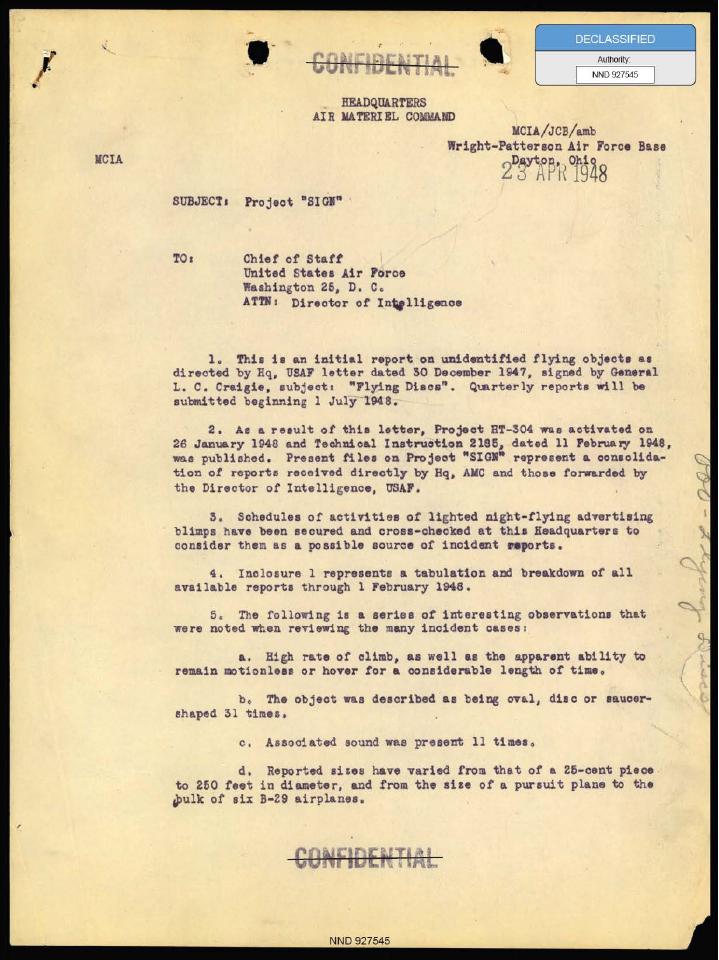
Project Sign progress report
What it shows: The Air Force organizes 100 reports into an early systematic UFO case corpus.
The limit: The compiled cases vary widely in source quality and cannot be treated as independent measurements of one phenomenon.
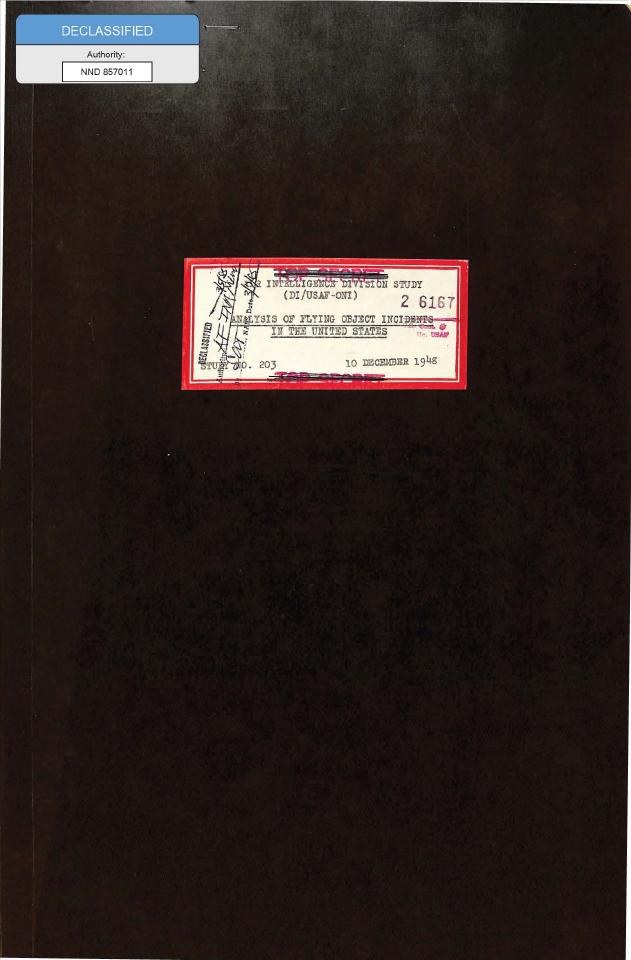
The people behind the program
What it shows: Personnel context shows that the investigation drew on military and technical expertise rather than a purely public-relations review.
The limit: Qualified investigators improve analysis but cannot reconstruct distance, timing, or sensor data that witnesses never collected.
Collection and method context
What it shows: The companion material documents efforts to define better technical handling of unusual reports.
The limit: A proposed method is evidence of intent, not proof that every historical case was collected to that standard.
What the record supports
The Air Force created an organized investigation in 1948, compiled one hundred reports, and attempted technical comparison during a period of rapid aerospace change and national-security secrecy.
What it does not establish
The number of cases does not indicate one phenomenon, and the unexplained subset cannot be treated as confirmed advanced craft. Historical files often preserve uncertainty better than the measurements needed to reduce it.