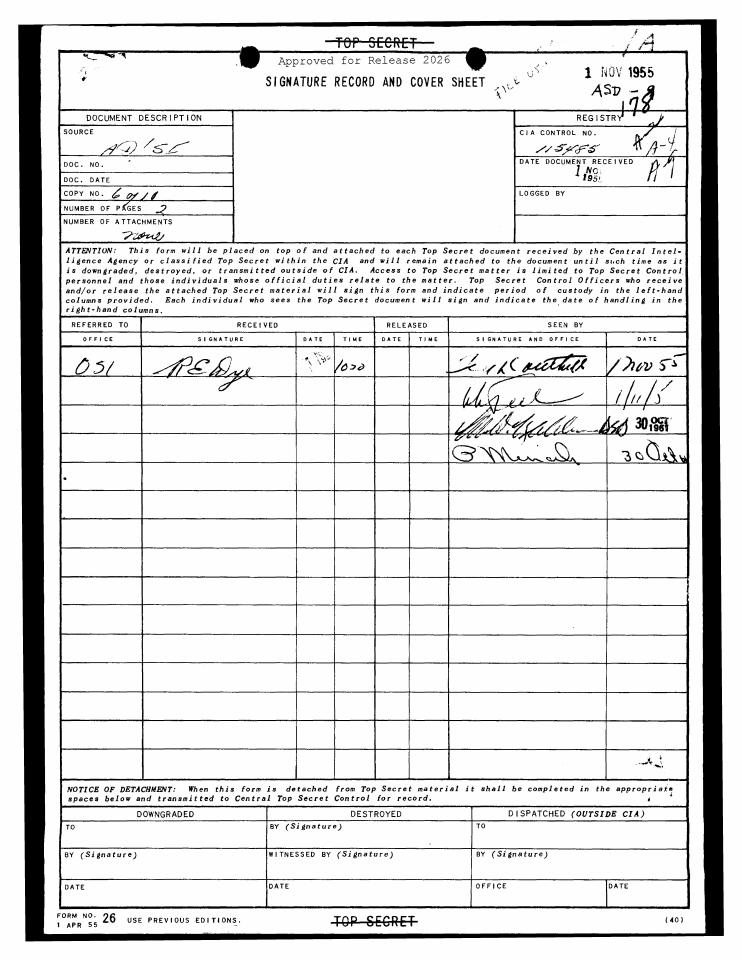
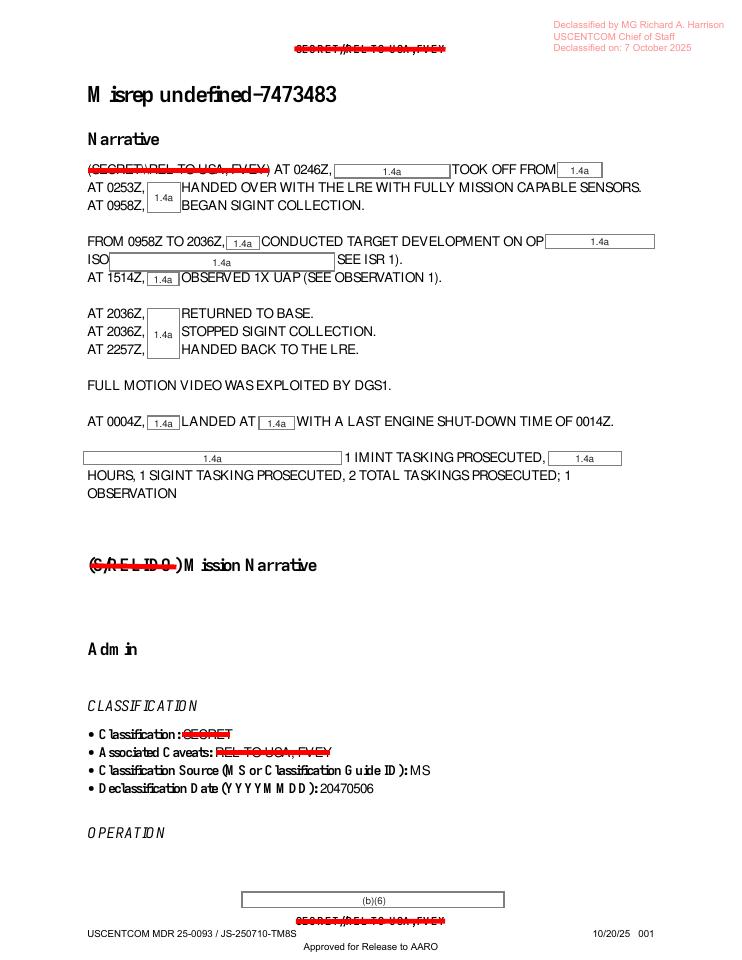
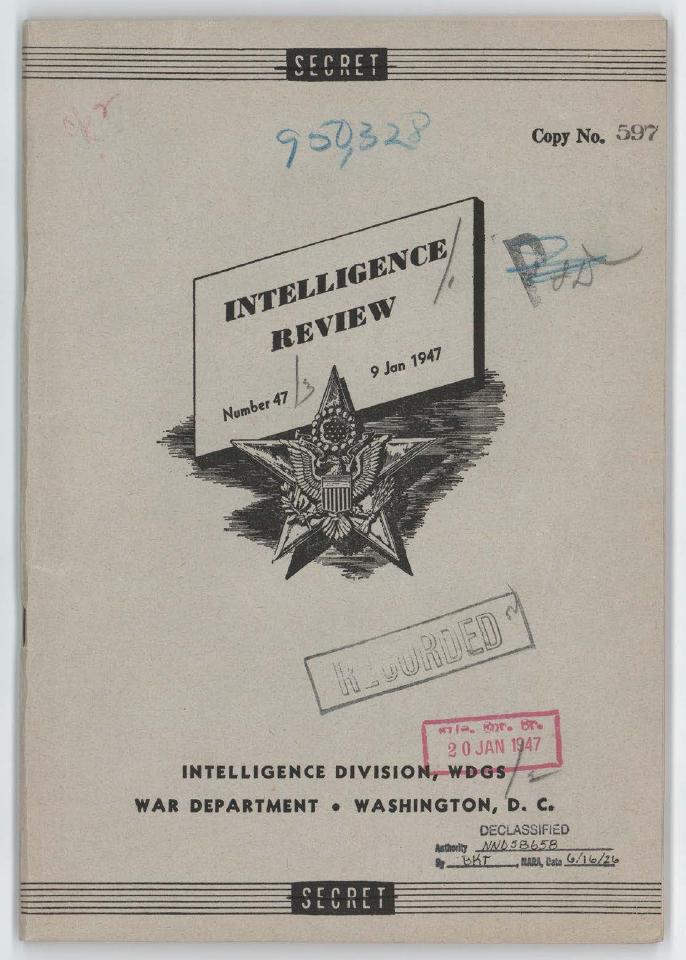
The memo is real. Its conclusions are an argument.
On May 27, 1971, O. H. Turner, head of the Nuclear Branch inside Australia’s Joint Intelligence Organisation, sent a minute paper titled “Scientific and Intelligence Aspects of the UFO Problem.” The released PURSUE excerpt is drawn from a larger Australian file now open at the National Archives of Australia. That provenance matters: this is not a later transcription, a leaked anonymous slide, or a document with disputed letterhead.
Turner’s thesis was unusually direct. He argued that early U.S. Air Force analysis had treated some reports as real phenomena with performance beyond known aircraft; that a deeper intelligence effort continued while Project Blue Book became a public-facing operation; and that U.S. funding for saucer-shaped aircraft and gravity research was best understood as an attempt to imitate UFO performance. He then turned the criticism inward, describing Australian handling as scientifically weak and too dependent on the public U.S. posture.
That is why the file deserves attention. It captures a technically placed official making a pro-investigation case inside government, not merely asking government from the outside. But Turner also tells the reader how he built it. The covering minute says the historical paper drew on official reports and statements while the companion material was compiled from both official and unofficial reporting, including material associated with Jacques Vallée and J. Allen Hynek. The document blends records, testimony, interpretation, and inference. Its classification and institutional address do not turn those layers into one level of proof.
What survives a direct cross-check
Several foundations of Turner’s argument are solid. The United States did run Project Sign, Project Grudge, and Project Blue Book. It did collect thousands of reports, and it did leave a residue unresolved. The U.S. National Archives says Blue Book received 12,618 sightings from 1947 through 1969 and categorized 701 as unidentified. “Unidentified” is not a synonym for extraterrestrial, but it is also not an invented after-the-fact talking point. It is part of the official record.
The 1948 Air Materiel Command material is more interesting than either camp’s slogan. One memorandum says that investigators studied roughly 180 incidents, believed that most observers had actually seen some kind of object, and still had cases without a reasonable everyday explanation. On the same page it says that no physical evidence had been obtained and that tangible evidence for vehicles from another planet was completely lacking. The next page says there was no conclusive proof that the unidentified objects—apart from known balloons—were real aircraft. This is genuine institutional uncertainty, not confirmation disguised as denial.
Turner was also right that information control became part of policy. The 1953 CIA-convened Robertson Panel worried that mass reporting could clog communications, create false alarms, and make the public vulnerable to manipulation. It recommended stripping UFOs of their special aura and using training and public education to reduce noise. Whatever one thinks of that choice, the policy-management layer was real. A government can be uncertain about objects while still trying to control the social and military consequences of reports about them.
His strongest original evidence may be the section on Australia itself. Turner wrote that the Royal Australian Air Force assigned no more than one part-time officer to analysis, lacked scientific competence for the work, and had produced suspect identifications. He urged a scientifically sound and intellectually honest program that would work closer to the public. That passage documents an internal fight over collection quality. It also explains how a country can possess UFO files without possessing a mature UFO science program.
Where the memo outruns its documents
The larger claims require a different standard. Turner inferred that the CIA studied reports in order to extract propulsion data, that Blue Book became a facade for a more serious covert effort, and that U.S. gravity research was irrational unless officials firmly believed UFOs were real machines. The released paper does not attach budgets, tasking orders, experimental results, program names, or a chain of internal directives proving those links.
Some of the same primary records Turner discusses push against his strongest conclusion. The Robertson Panel found no evidence connecting the reviewed objects to space travelers and no direct physical threat. The 1948 Air Materiel Command memorandum explicitly separated unresolved observations from physical proof. Later Air Force conclusions, preserved by the National Archives, said Blue Book found no evidence that unidentified cases represented technology beyond contemporary science or extraterrestrial vehicles.
Those official denials are not sacred merely because they are official. They should be tested like Turner’s memo. The key point is narrower: the archival record contains competing assessments, and the memo does not itself resolve them. It proves that Turner believed the public U.S. position was incomplete and tried to persuade Australian leadership to build a better program. It does not prove that he had first-hand access to a hidden propulsion effort.
The best ordinary explanation
The ordinary explanation is not that Turner fabricated anything. It is that an earnest advocate assembled authentic government history, public scientific debate, statements by former officials, and UFO research into a causal theory stronger than his direct evidence. His institutional position gave him a credible view of how intelligence bureaucracies behave, but not necessarily access to every U.S. program he inferred.
This happens in serious analysis. A pattern can be real while the proposed cause is wrong. Blue Book’s public role was limited; communications management was explicit; classified aerospace work existed; gravity research attracted military money; and officials sometimes offered bad identifications. From those facts Turner inferred one coordinated hidden program. Another explanation is less dramatic: different organizations pursued air defense, speculative physics, public reassurance, and report triage for different reasons, with no single secret answer connecting them.
The memo itself supplies evidence for that bureaucratic explanation. Turner was lobbying to change who owned the Australian problem. His paper is partly history and partly a proposal: accept the RAAF suggestion that another department take responsibility, bring intelligence and science together, and satisfy public interest more honestly. Advocacy does not invalidate the history, but it helps explain why the paper emphasizes failure, concealment, and the need for a new program.
The best case for taking it seriously
The strongest pro-disclosure reading begins with motive and audience. Turner was writing internally, under his own name and title, to senior officials. He had less reason to entertain the public than a magazine writer did. He distinguished intelligence questions—reality, propulsion, weapons, intent, detection, defense—from the simple question of whether a light was unidentified. He also identified a structural weakness that remains familiar today: a reporting program can look active while lacking the staff, scientific tools, and authority needed to investigate well.
His suspicion of a gap between public messaging and private interest also has documentary support. The Robertson Panel recommended active management of public attention even though some cases remained unexplained. Air Materiel Command advised emphasizing balloons and celestial bodies if the press demanded a statement while investigation continued. Neither document proves a concealed extraterrestrial program. Together, however, they justify asking whether public reassurance sometimes described institutional priorities more accurately than the full state of uncertainty.
That is the optimistic, skeptical middle. Disclosure does not require pretending every internal assertion is established. It requires exposing the records that let the public see where observation ends, analysis begins, and policy intervenes. Turner’s memo is valuable precisely because it reveals those boundaries—and because comparing it with the U.S. files prevents either a dismissal or a revelation narrative from doing all the thinking.
Evidence verdict: strong evidence of a dispute, not of recovered technology
For the institutional claim, this reaches layer five on UFOInform’s evidence ladder: a dated internal Australian paper links named offices, public programs, policy documents, and a concrete recommendation for reform. The U.S. records independently verify important parts of the historical scaffold. For the extraordinary claim—a covert program learning UFO propulsion—the public evidence remains near layer one. We have Turner’s allegation and reasoning, not reproducible program data.
The upgrade path is specific. Release the intelligence tasking or budget records Turner believed existed; identify the unnamed agency and responsible offices; produce dated directives connecting UFO cases to gravity or propulsion experiments; publish laboratory notebooks, test data, hardware provenance, and independent technical review; and release Australian routing comments showing how Turner’s superiors evaluated his claims. Any one of those would narrow the gap. A coherent chain of several could move the covert-program claim substantially upward. Until then, the memo is a powerful record of what one informed official thought government was doing—and an invitation to disclose the evidence that would show whether he was right.
Evidence on the page
What the released material actually shows
Open each source to inspect the complete record. The caption separates the useful fact from the limit that keeps it from carrying more weight.
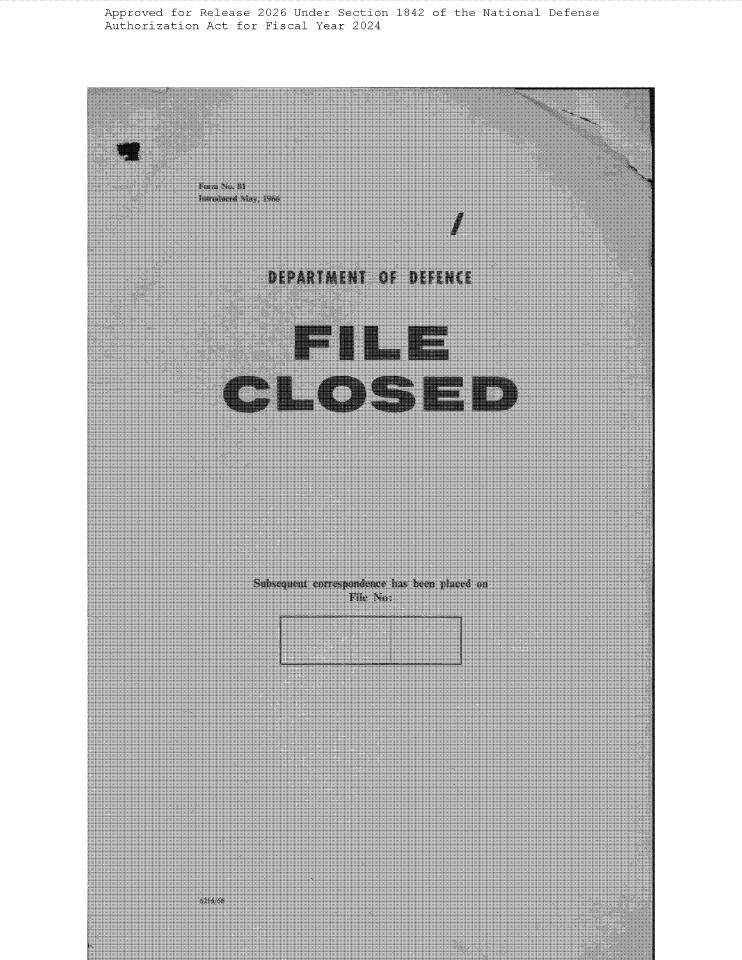
Turner’s 1971 Australian intelligence memo
What it shows: A named senior official argues internally that public UFO policy, scientific collection, and intelligence analysis had diverged, then recommends a better Australian program.
The limit: The paper combines official records with unofficial material and inference; it does not attach direct records for the covert propulsion program it proposes.
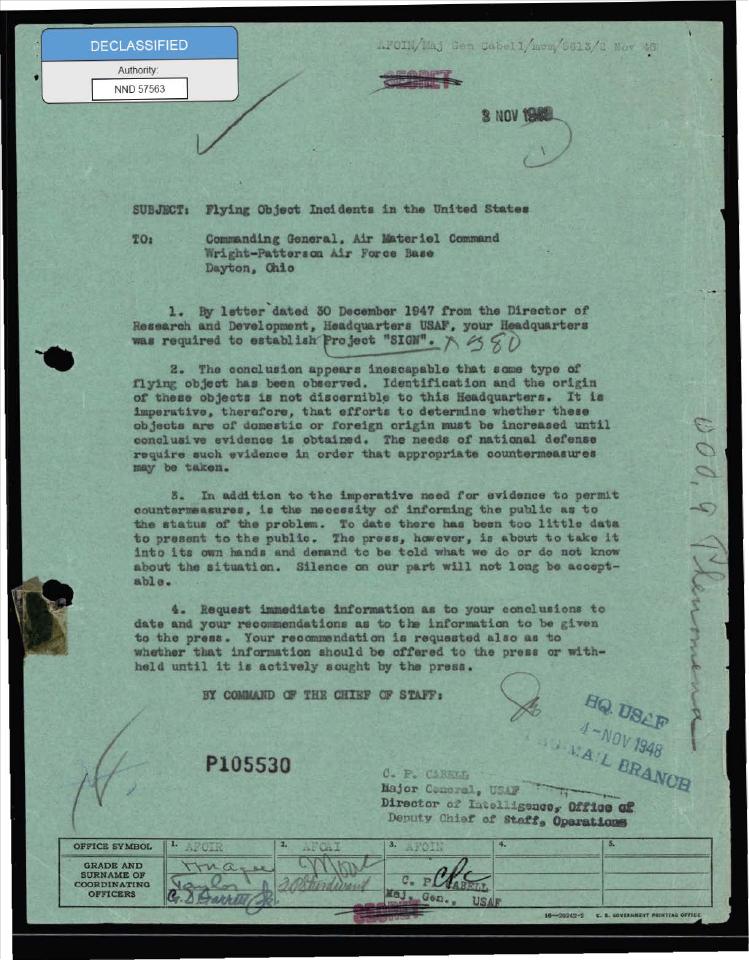
The 1948 Air Materiel Command assessment
What it shows: Investigators say many observers saw real objects and that some reports lacked an everyday explanation while inquiry continued.
The limit: The same assessment says physical evidence and tangible support for vehicles from another planet were lacking.
The Robertson Panel report
What it shows: The panel documents a real policy to reduce communications noise and shape public handling of UFO reports.
The limit: Information management is not proof that the panel possessed or concealed evidence of extraterrestrial technology.
What the record supports
A senior Australian scientific-intelligence officer made a serious internal case in 1971 that UFO investigation had been under-resourced, shaped by public-relations goals, and worthy of technically competent collection. U.S. primary records independently confirm organized investigation, unresolved cases, and deliberate concern about reporting channels and public reaction.
What it does not establish
The memo does not provide direct program records proving recovered craft, extraterrestrial vehicles, a successful gravity-control project, or a covert CIA effort to reproduce UFO propulsion. A government author’s inference remains an inference until the underlying orders, data, hardware, or corroborating insiders are produced.