AURA archive brief
At about 7:08 on the morning of September 1, 2015, surveillance radar at the Pantex Plant near Amarillo, Texas, detected an object roughly 1.75 miles southwest of a protected zone. Pantex is not an ordinary industrial site: it is a central facility in the United States nuclear-weapons enterprise. The alert therefore triggered a real security response. Gates were secured, protective-force personnel moved to observation positions, and officers attempted to follow the object as it travelled north to north-northwest.
The released report is unusually useful because it brings several kinds of observation into one official incident file: ground radar, binocular observations by security personnel, tracking by a camera team, a mapped path, and images later enhanced at Sandia National Laboratories. That combination makes the episode better corroborated than a distant light reported by one person. It does not, however, make the object's motion extraordinary. The same report describes a small, silent object moving at only 10 to 15 miles per hour, generally over open and unpopulated land.
A real response to a slow object
The incident narrative says the ground-surveillance radar first acquired the unknown object shortly after 7 a.m. Protective-force personnel responded under the site's unmanned-aircraft procedure. A lieutenant and a security police officer then observed it through binoculars for an estimated one to two minutes. They described no sound and no obvious means of propulsion. Their shape description was broadly diamond-like, with a more rounded top.
The two officers followed the object by vehicle for several miles until the available roads ended. They reported that it appeared to increase speed and change direction, but the file supplies no measured acceleration, turn rate, or revised speed. A county sheriff's deputy arrived after being contacted, yet did not see the object. This matters: the pursuit is documented, while the most suggestive motion claim remains a visual estimate without the numbers needed to test it.
A separate camera team operating a Common Remotely Operated Weapon Station, or CROWS, reportedly tracked the object for three to five minutes. Those observers estimated an altitude of 100 to 200 feet above ground and placed themselves about 75 to 100 metres from it. Other personnel estimated the object at roughly four feet high and two feet wide near the bottom, tapering toward the top. Those figures sound precise, but size and altitude estimates are coupled: without a known distance or calibrated geometry, an observer can mistake a nearer small object for a farther large one.
Three channels do not produce one perfectly consistent picture
The strongest feature is the convergence. Radar established a track; multiple security personnel saw an object along the general route; and an installed camera produced an image. The incident map plots successive radar positions moving northward. This is a linked event, not a collection of unrelated anecdotes assembled years later.
Yet the eyewitness details diverge. One account called the object black. Others reported silver, red, and blue. That disagreement does not erase the sighting. Morning light, viewing angle, distance, optics, and the possibility of a reflective or rotating surface can change apparent colour. It does warn against turning any single description into a definitive reconstruction. The released material supports the presence of a physical or radar-reflective object much more strongly than it supports a precise design.
The report also says the object remained over open areas, did not approach sensitive assets, and did not display threatening behaviour. The serious response tells us how a nuclear site treats an unknown object inside its surveillance picture; it does not tell us the origin of that object.
The images look more definite after enhancement than before it
The radar-tower video was reviewed, but the report says distance left it with little useful detail. A still was sent to Sandia for enhancement. The earlier public record, DOE-UAP-D001, preserves both the distant source image and enlarged, processed shapes. Those enhanced silhouettes make the object easier to locate on the page, but they should not be mistaken for a close photograph. Enlargement and contrast processing can reveal structure already present in pixels; they cannot restore detail that the sensor never captured.
This is a recurring archive trap. A processed outline can feel more concrete than a pale speck, even when both come from the same low-information source. The original frame is therefore the evidentiary anchor. It confirms that a camera recorded something in the reported area. It does not independently demonstrate a rigid craft, wings, propulsion, occupants, or technology beyond ordinary aerospace objects.
Why a balloon-like explanation belongs first
The best ordinary hypothesis is a balloon, aerostat fragment, lightweight debris, or another slow object carried by local air movement. That is an analytical hypothesis, not the report's official conclusion. It earns first position because it fits the measured or estimated features that are actually in the file: low speed, no sound, no visible propulsion, modest apparent dimensions, low altitude, a generally drifting route, and no aggressive approach to a protected asset.
The colour conflict can also fit a reflective or rotating object, especially in early-morning light. A small object moving with winds at different heights may appear to turn or accelerate as perspective changes or as it enters another layer of airflow. Nothing in the public numbers requires lift, speed, or manoeuvring unavailable to mundane objects.
But a hypothesis is not an identification. The report does not publish surface-wind and winds-aloft data synchronized to the radar track. It does not document a recovered balloon, launch report, operator, or matching debris. Nor does it show whether site personnel checked scheduled weather balloons, research activity, hobbyist launches, or every authorized unmanned system. Calling the case solved would go beyond the released evidence in the same way that calling it alien would.
What this case does better than most
Pantex offers something many UAP files lack: several observation channels tied to a narrow time and place. Radar, people, a camera, and an operational response all appear in the same contemporaneous account. The observers were not gathered because of later publicity, and the site's mission gave personnel a practical reason to notice and follow an unknown object. These facts strengthen confidence that something was present.
They do not automatically strengthen every reported property. Radar is powerful when its raw data and sensor characteristics are available; here the public sees a plotted summary rather than returns, track-quality flags, or error bounds. Security training supports careful reporting, but it does not eliminate the human difficulty of judging the size, range, and motion of an unfamiliar object against the sky. Camera corroboration is useful, but the available still is too indistinct for reliable classification.
The missing package that could change the assessment
A meaningful re-evaluation would require the original radar data with timestamps, confidence values, altitude method, and sensor limits; the uncompressed tower video rather than selected frames; any CROWS recording and its optical metadata; individual witness statements made before accounts could converge; the full Sandia processing chain; and weather observations at several altitudes along the plotted route. Investigators would also need contemporaneous logs for balloons, unmanned aircraft, maintenance activity, and any later FBI disposition.
Those materials could move the case in either direction. A track matching wind speed and direction, or a launch record matching the time and route, would make an ordinary identification much stronger. Conversely, calibrated data showing motion independent of the wind, abrupt acceleration, or a coherent object visible across multiple sensors would raise the case materially. The point of asking for raw data is not to preserve mystery. It is to make the competing explanations testable.
Evidence verdict
Layer 5 of 7: a linked official case below the raw-data threshold. The Pantex incident is credible as an occurrence and notable because radar, multiple security observers, a mapped track, and a site camera converge. It is not strong evidence of extraordinary technology. Its published flight profile is slow and balloon-like, its most dramatic manoeuvre descriptions are unquantified, and its imagery cannot identify the object. It would move upward only if original sensor data demonstrated motion that windborne objects could not reproduce, or if higher-quality synchronized imagery showed a structured craft. It would move downward if weather, launch, or operational records matched the track. Until then, the disciplined conclusion is narrower than either dismissal or disclosure: a well-documented unknown with an ordinary leading explanation.
Evidence on the page
What the released material actually shows
Open each source to inspect the complete record. The caption separates the useful fact from the limit that keeps it from carrying more weight.
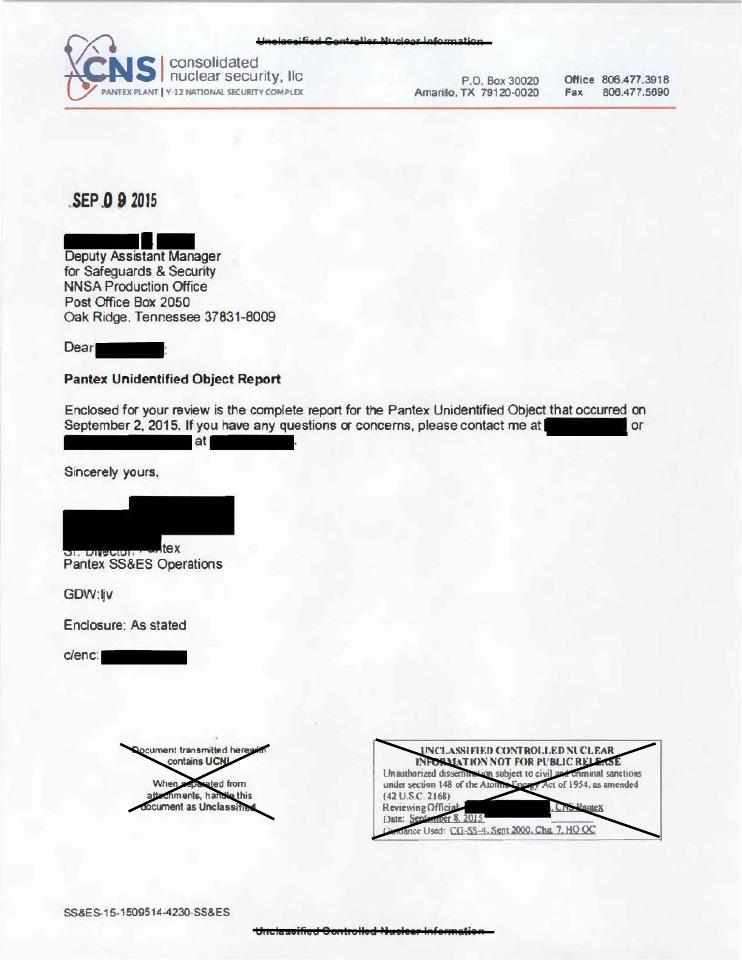
The complete Pantex incident report
What it shows: The file joins radar detections and a mapped northbound track to observations by protective-force personnel, a camera team, and the site's documented security response.
The limit: It is a compiled incident report, not the underlying sensor package; the public release omits raw radar returns, complete video, CROWS imagery, and calibrated measurements.
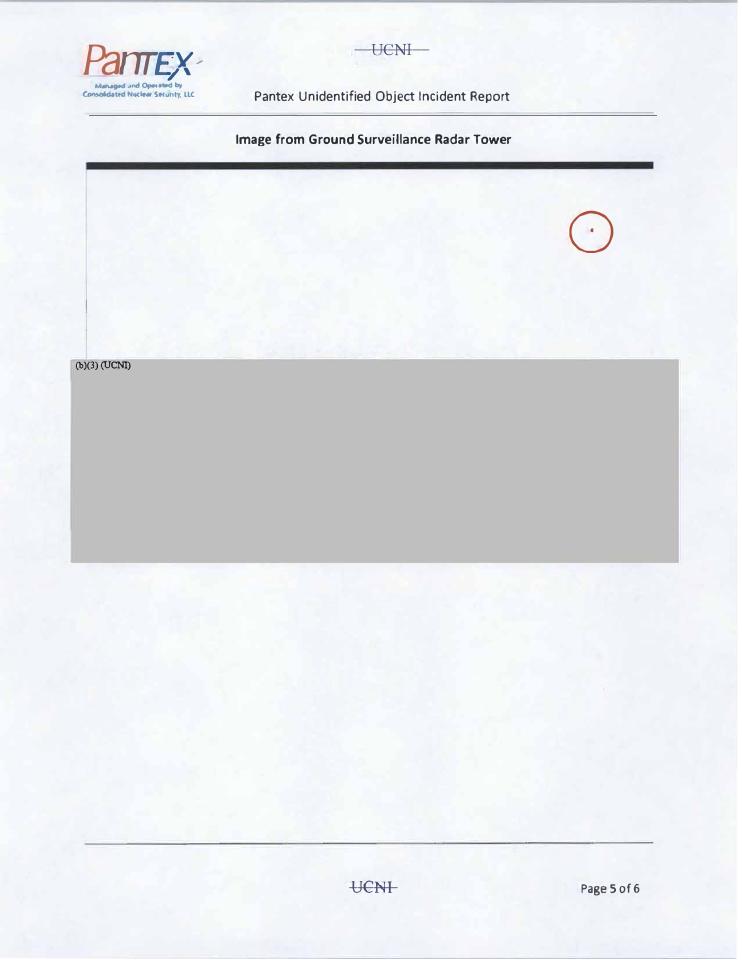
The earlier enhanced-imagery release
What it shows: The release preserves the distant tower still and the enlarged shapes produced after the image was sent to Sandia National Laboratories for enhancement.
The limit: An enlarged, contrast-adjusted blur cannot add source detail, and the public record does not provide the processing method needed to assess artifacts.
What the record supports
An unidentified object prompted a documented protective-force response at Pantex on September 1, 2015. The released file links a slow radar track with observations by several security personnel and imagery from a site camera. The plotted direction and narrative are mutually consistent, and the record indicates that the evidence was referred to the FBI.
That combination raises this case above an unsupported witness story. It gives researchers a date, place, approximate path, speed range, several observation windows, an institutional response, and two related government releases that can be compared.
What it does not establish
The public package does not establish exotic performance or non-human origin. It does not include raw radar returns, the complete tower video, any CROWS recording, calibrated range data, Sandia's enhancement method, contemporaneous weather measurements, local balloon or drone checks, or a final identification. The report's cover correspondence also uses September 2 while the incident narrative and timeline use September 1, a small documentary discrepancy that the release does not explain.
Most importantly, the reported 10-to-15-mile-per-hour motion is compatible with an ordinary windborne object. The file records apparent changes in speed and direction but supplies no measurement showing acceleration beyond that explanation.