AURA evidence audit
Release 6 contains two unusually useful modern case packages: a formal U.S. Central Command mission report paired with infrared video from July 2025, and another report-video pair from October. One report estimates a group of small objects at 480 miles per hour. The other says a bright round object moved as fast as 500 mph. Those numbers are the obvious headline. The more revealing fact is that the public files do not contain the geometry needed to reproduce either one.
This is still meaningful disclosure. The records show that UAP observations were being entered into routine operational reporting, reviewed inside military channels, declassified within months, and released with their media. They also show the boundary of the current transparency program: the public can see what operators reported and what their sensors displayed, but not yet the complete data package that would turn an estimate into a testable measurement.
The July formation is the more specific claim
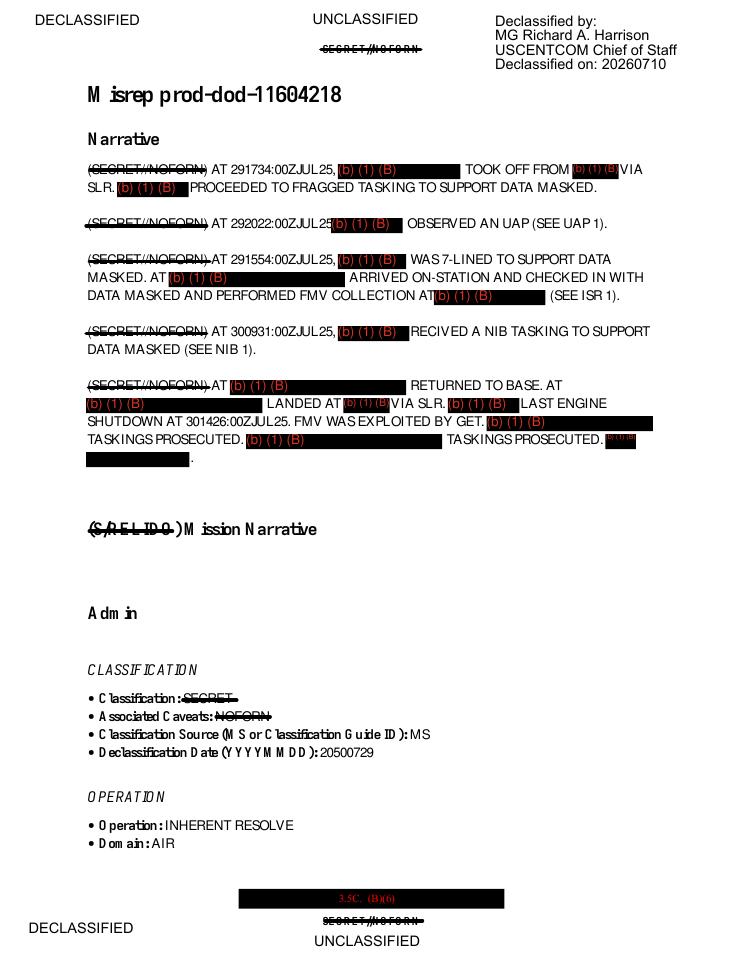
At 20:22:32Z on July 29, 2025, an Air Force mission supporting Operation Inherent Resolve recorded a UAP incident while in transit. The report describes “6X small spherical objects grouped together.” It says they seemed agile, changed direction frequently and simultaneously, travelled southeast, and were estimated at flight level 220—about 22,000 feet—and 480 mph. Weather is listed as clear. The observing aircraft's speed is given as 120 knots indicated airspeed.
That sounds like a compact technical summary, but its own qualifiers matter. Both the altitude and velocity are marked estimated. The form says the observation was not interrogated with another sensor, records no response to observer actions, lists no effects on people or equipment, and says advanced capabilities or materials were not observed. “Under intelligent control” is marked unknown. The report therefore preserves a trained operator's interpretation, not an official determination that six craft executed impossible manoeuvres.
The one-minute paired video contains useful visual evidence from roughly 00:05 to 00:47. Several bright infrared points remain in a compact, roughly linear grouping as the sensor pans. In sampled frames, not every reported object is always separately resolvable: four or five bright points may be obvious while others blend, dim, or fall below the display's contrast. The pixels support a grouped set of contrasts. They do not independently supply the targets' distance, altitude, physical diameter, or ground speed.
The October clip is longer, but the speed is less structured
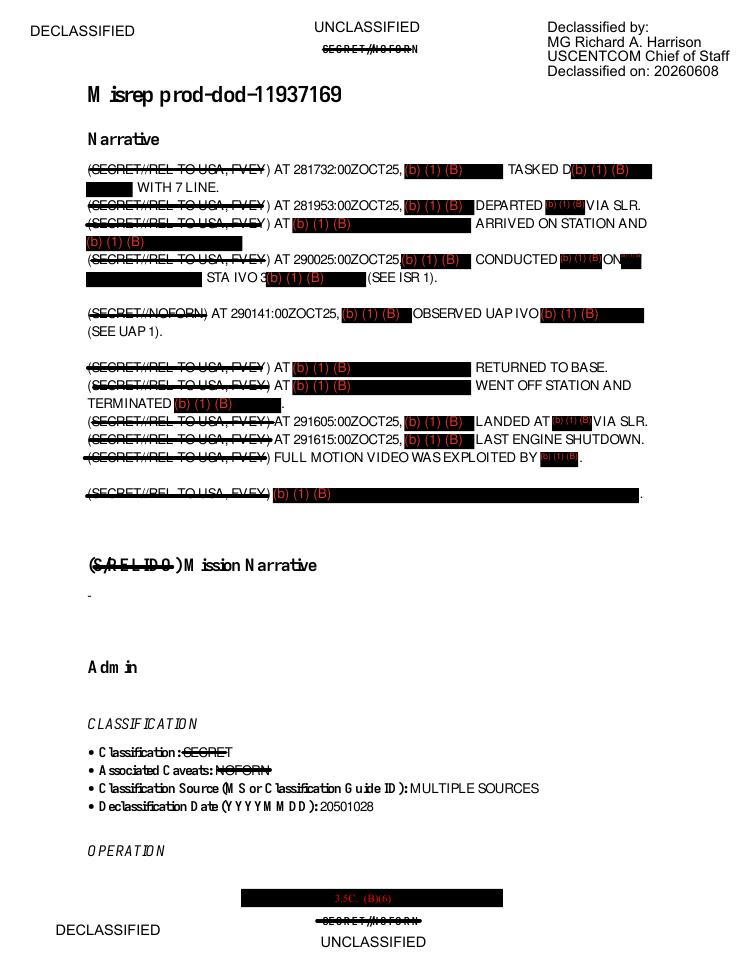
The second incident began at 01:41Z on October 29, 2025. Its mission report says an operator observed a UAP on the sensor feed until about 01:50Z and described it as looking like a “white round orbit”—apparently the exact wording entered in the report. The observing aircraft was at approximately 22,500 feet. The manoeuvrability field says “fast moving speeds up to 500MPH,” and the narrative repeats that estimate before saying the target was lost.
Yet the form's dedicated kinetic-velocity field is empty. So are the public fields for UAP altitude, trajectory, anomalous characteristics, sensor interrogation, and advanced capabilities. That mismatch is important. It tells us where the 500-mph figure lives: in the observation narrative and manoeuvrability description, not in a published derived track with an accuracy statement.
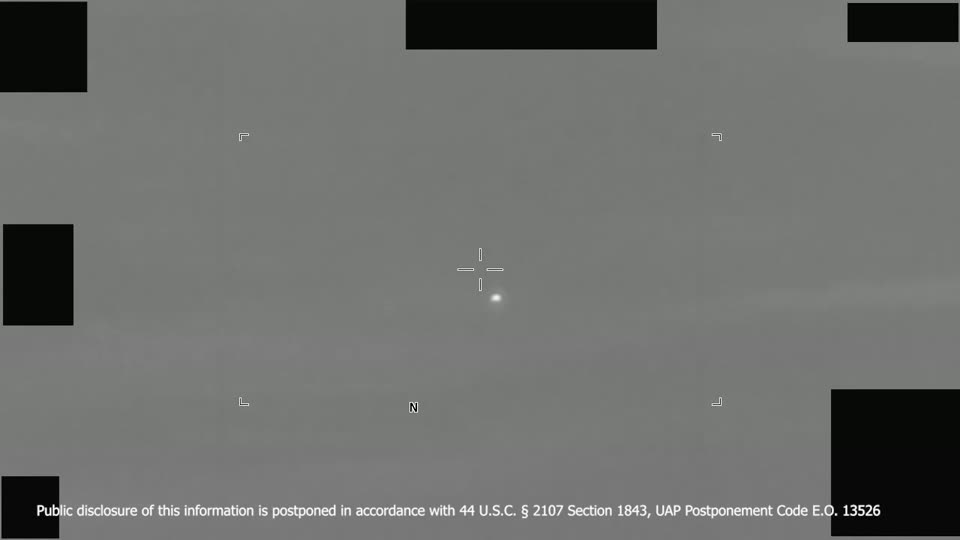
The paired video runs 4 minutes 58 seconds. A bright point is tracked while the sensor pans across terrain, cycles magnification, displays a focus box, loses the point at frame edges, and reacquires it. The footage is more informative than a still because it shows a sustained tracking attempt. It remains a two-dimensional, edited public display with masking over operational readouts. Camera motion, zoom changes, aircraft motion, and unknown range all affect apparent motion. The release catalog also contains a small but real metadata problem: the video description says the footage was collected in 2024, while its title, paired mission report, timestamps, and incident date place it in 2025.
Why the ordinary explanation remains open
The best ordinary explanation is not one confident identification for both events. It is a family of possibilities—conventional aircraft, balloons, birds, or other airborne objects—whose apparent speed and direction are distorted by moving-platform geometry, camera pan, zoom, and uncertain range. AARO's published analyses of other infrared cases repeatedly show why range matters: when platform motion and line of sight are reconstructed, an object that looks fast can be travelling near wind speed. Grouped balloons or birds can also create several infrared contrasts that seem to shift together.
Those comparisons are reasons to test, not licenses to declare these cases solved. If the July targets really were at FL220 and really moved at 480 mph while changing direction together, slow windborne objects would be poor fits. If the October target's 500-mph figure came from a measured range and a calibrated track rather than visual impression, the case would become substantially stronger. The public package does not tell us which foundation those estimates had.
The best case for taking the release seriously
The strongest pro-disclosure reading is institutional. These were not anonymous uploads. They were embedded in mission reports from operational Air Force units, tied to exact times, paired with original military video, reviewed for declassification, and placed in a public archive less than a year after the events. In the July case, the release exposes enough form fields to show both the dramatic observation and the reporter's restraint. That combination is more valuable than a sensational clip stripped of context.
There is also a genuinely testable signal in the July video: several contrasts maintain a recognizable group while the camera follows them. If synchronized telemetry confirmed that the points were distinct objects at a common range, and if calibrated tracking confirmed rapid simultaneous changes, the case would climb quickly. The video preserves something worth analyzing; it simply does not carry those conclusions by itself.
What the release strategy may be telling us
Inference, not established fact: pairing operational reports with media looks like a deliberate move toward normalizing UAP as a reportable defense and intelligence category. It lets the government say, in effect, that personnel do encounter things they cannot identify quickly, those events enter real systems, and some remain unresolved. That is a significant shift from treating the subject only as historical folklore.
But the same release preserves an information asymmetry. Sensor type, platform identity, location, coordinates, range, and much of the mission context are redacted. Some omissions are plainly defensible for operational security. Their effect is nevertheless clear: outsiders can audit the reporting process but cannot audit the physics. The optimistic interpretation is that PURSUE is building public literacy and a durable archive before more complete releases. The skeptical interpretation is that selected ambiguity demonstrates transparency without surrendering the data that could force a conclusion. Both can be true at once.
The exact package that would move these cases upward
For each event, independent analysts need the original uncompressed video and an authenticated chain of custody; frame-synchronized platform latitude, longitude, altitude, heading, and groundspeed; sensor azimuth, elevation, field of view, zoom, stabilization mode, and any slant-range or laser-range value; the unredacted method behind each speed and altitude estimate; contemporaneous radar or other sensor tracks; and winds at the target's estimated altitude. The July case also needs a track for each point to test whether the reported simultaneous turns are real motion or a display effect.
Those data could cut either way. A reconstruction matching aircraft, balloons, birds, or wind would close the cases without diminishing the value of the release. A reconstruction showing independently measured high speed, coordinated direction changes, or acceleration beyond ordinary flight would turn compelling footage into compelling evidence. Disclosure advances when a claim becomes falsifiable.
Evidence verdict
Layer 5 of 7: two linked official cases that stop below reproducible data. The released videos and contemporaneous mission reports establish that military operators tracked and reported two unidentified sets of infrared contrasts. They do not establish 480- or 500-mph target motion because the geometry and measurement chain are absent. The cases belong above a lone witness or context-free clip and below any claim of extraordinary technology. Their most important disclosure is not “objects moved impossibly fast.” It is that recent operational UAP reports, including cautious negative findings, are now being declassified quickly enough for the public to ask precise questions while the evidence is still fresh.
Evidence on the page
What the released material actually shows
Open each source to inspect the complete record. The caption separates the useful fact from the limit that keeps it from carrying more weight.
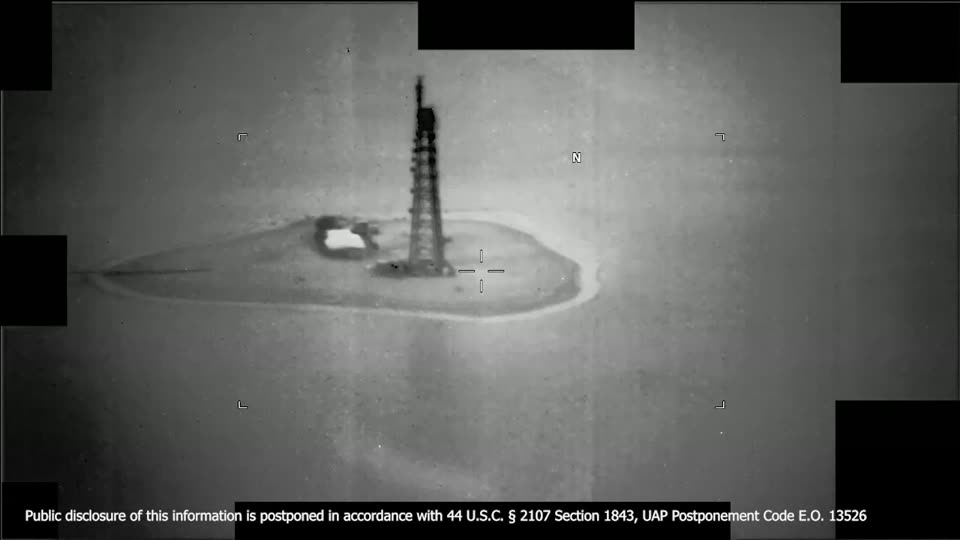
The July grouped-object video
What it shows: For about 42 seconds, the infrared display preserves several bright points in a compact grouping while the sensor pans to follow them.
The limit: The public encode masks operational readouts and provides no range or synchronized telemetry, so apparent motion cannot be converted into a defensible speed.
The July mission report
What it shows: The formal report describes six small spherical objects, clear weather, an estimated FL220 altitude, an estimated 480-mph velocity, and apparently simultaneous direction changes.
The limit: The report says no sensor interrogation occurred, labels the key figures estimated, calls intelligent control unknown, and records no advanced capability or material.
The October five-minute track
What it shows: A bright infrared point is repeatedly tracked, lost near frame edges, and reacquired as the sensor pans and changes magnification over visible terrain.
The limit: Camera motion, platform motion, zoom, and unknown range remain entangled; the catalog also conflicts with the paired report by calling this 2024 footage.
The October mission report
What it shows: The report gives an approximately nine-minute observation window, an observing-aircraft altitude near 22,500 feet, and a narrative estimate of speed up to 500 mph.
The limit: Its dedicated kinetic-velocity, target-altitude, trajectory, interrogation, and anomalous-characteristics fields are blank, leaving the speed claim unreproducible.
What the record supports
Two military aircrews or sensor teams recorded infrared contrasts during operational missions in the Middle East in 2025 and filed UAP sections in formal mission reports. The July package describes a grouped formation and preserves an estimated altitude, speed, and trajectory. The October package documents a several-minute track of one bright contrast and gives the observing aircraft's approximate altitude.
The report-video pairings make these stronger than detached clips with uploader-defined titles. They also show that UAP reporting has become part of an ordinary military workflow rather than a story reconstructed years later.
What it does not establish
The release does not establish that either target moved at the reported speed, performed beyond known aircraft, or had an extraordinary origin. Platform position, sensor pointing angles, range to target, complete telemetry, radar returns, wind data, and the analysts' calculation methods are not public.
The July report labels its altitude and velocity as estimated, says no sensor interrogation was performed, calls intelligent control unknown, and marks advanced capabilities or materials “no.” In the October report, the structured kinetic-velocity field is blank even though the narrative says “up to 500MPH.”