The useful way to read the Apollo material is not to collect every mention of a light under one dramatic label. It is to separate observations that only sound similar at first.
There is no single “Apollo UFO” story
The PURSUE archive brings together mission transcripts, technical debriefings, medical recordings, and photographs from Apollo 11, 12, 14, 16, and 17. Read in sequence, they describe at least four categories of event: objects outside the spacecraft, particles or debris near separated rocket hardware, flashes perceived inside the eye, and lights seen on or beyond the lunar surface.
Apollo 11: a nearby object, then two different kinds of light
In the Apollo 11 technical debriefing, Buzz Aldrin recalled a sizeable object seen through the monocular during the outbound journey. The crew considered the spent S-IVB stage, then learned it was thousands of miles away. They discussed shapes ranging from a cylinder to connected rings but reached no firm identification.
The same debriefing contains two unrelated observations. Aldrin described small flashes while the darkened crew tried to sleep. Later Apollo missions investigated that visual phenomenon directly; NASA research connected many such closed-eye flashes with high-energy cosmic rays passing through the eye and retina. On the return journey, Aldrin also saw a bright terrestrial light first considered as a possible laser, then judged more likely to be sunlight reflecting from water.
Apollo 12: “escaping the Moon” in context
Alan Bean’s phrase about lights “escaping the Moon” is memorable, but the transcript around it matters. Through the alignment telescope, the crew were watching small lights or particles moving across the field. A separate passage records illuminated debris outside the lunar module; when a tracking light went out, that debris was no longer visible. The archive preserves the observation without turning the phrase into a conclusion.
Apollo 17: fragments, rotating flashes, and a surface event
Early in Apollo 17, the crew described bright, angular fragments near the spacecraft and the separated S-IVB. Paint or ice was their working explanation. Later, Gene Cernan described a rhythmic flasher as “something physical in the distance”; the continuing exchange shows the crew comparing it with the S-IVB and other separated panels.
Harrison Schmitt also reported a brief flash on the lunar surface north of Grimaldi. The transcript records the location and reaction, but the excerpt does not supply enough information to determine a cause.
The photograph that remains open
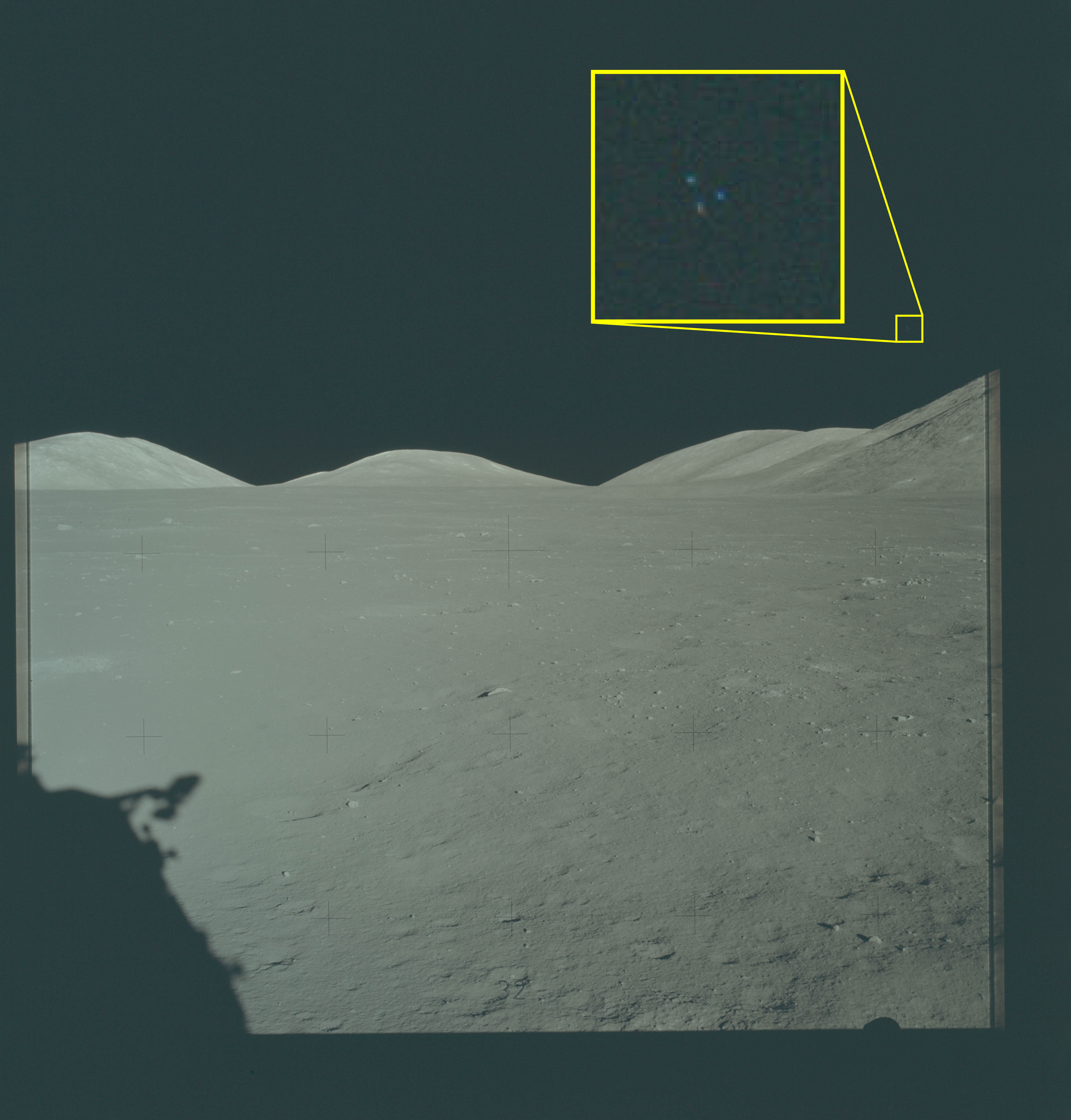
NASA-UAP-VM006 is different from a transcript. The Apollo 17 image contains three small points in a triangular arrangement above the lunar horizon. The government catalog says a case was opened, that preliminary analysis considered a physical object in the scene possible, and that original film was obtained for further study. It also says there is no consensus. That pending status—not a stronger claim—is the accurate takeaway.
What the record supports
Apollo crews reported several genuinely different visual events. Some were investigated experimentally, some were tentatively identified as spacecraft debris or reflected light, and some remain unresolved in the released excerpts.
What it does not establish
The collection does not establish that the events shared one cause, that the crews identified extraterrestrial vehicles, or that every light-flash report described an external object.
Open the records
For the light-flash context, see NASA’s Apollo Light Flash Investigations, which describes the cosmic-ray research and correlations with crew reports.