AURA archive brief
PURSUE Release 1 made an unusually specific claim about an Apollo 17 photograph. The government said three dots in a triangular formation were visible in the lunar sky, that preliminary analysis suggested the feature might come from a physical object in the scene, and that officials had obtained the original film for further NASA and Department of War analysis. Four releases later, that promised result has not appeared in the public archive.
The image deserves attention because the feature is real in the narrow photographic sense: the three colored points are present in NASA's unannotated public scan of frame AS17-147-22470. They were not painted into the picture when PURSUE added its yellow callout. But an authentic image feature is not yet an identified object, and three points do not by themselves establish one triangular craft. The next disclosure step is no longer another enlargement. It is the original-film analysis the government already said it would perform.
The dots survive the first provenance test
The PURSUE file is a 2026 editorial derivative: it places a yellow box around the relevant part of the sky and inserts an enlarged crop. The underlying photograph is older and independently recoverable. NASA's official astronaut-photography database identifies it as AS17-147-22470, offers an unannotated scan at the same 4400-by-4600-pixel dimensions, and describes the scene as the Moon's Taurus-Littrow Valley.
The Apollo 17 photography index adds useful context. Frame 22470 was made with a 60-millimeter lens on SO-368 film as part of a lunar-module window panorama before EVA 1, with the Sun about 13 degrees above the horizon. NASA's preliminary science report identifies the same frame as a view from the lunar-module window just after touchdown. That matters because it anchors the image to a real film magazine, a sequence, and a documented camera operation.
In NASA's unannotated scan, three tiny blue-green and amber points remain visible above the right side of the horizon. This confirms that the PURSUE graphic did not create them. It does not tell us whether the source was outside the lunar module, inside the optical path, on the film, or introduced during later digitization. The visible feature occupies too little of the frame to reveal edges, structure, or a reliable point-spread shape.
“Triangle” describes the layout, not an object
Three separated points always define a triangle. That geometric fact is not evidence that a solid triangular body connected them. The image contains no visible surface between the points, no shadow, no measured motion, and no second simultaneous camera angle. AURA's visual inspection of NASA's high-resolution scan confirms the cluster but cannot recover a physical size because no range is known.
We also inspected the adjacent official scans, AS17-147-22469, -22471, and -22472. They belong to the same window-pan sequence. The same compact cluster is not plainly visible in the corresponding displayed sky regions, but the camera is panning and the lunar terrain changes position sharply from frame to frame. That absence therefore cannot be promoted into proof that the feature moved or disappeared. Proper comparison requires registration of the optical geometry and, ideally, direct scans of the original film frames under controlled conditions.
The transcript records other lights—not this photograph
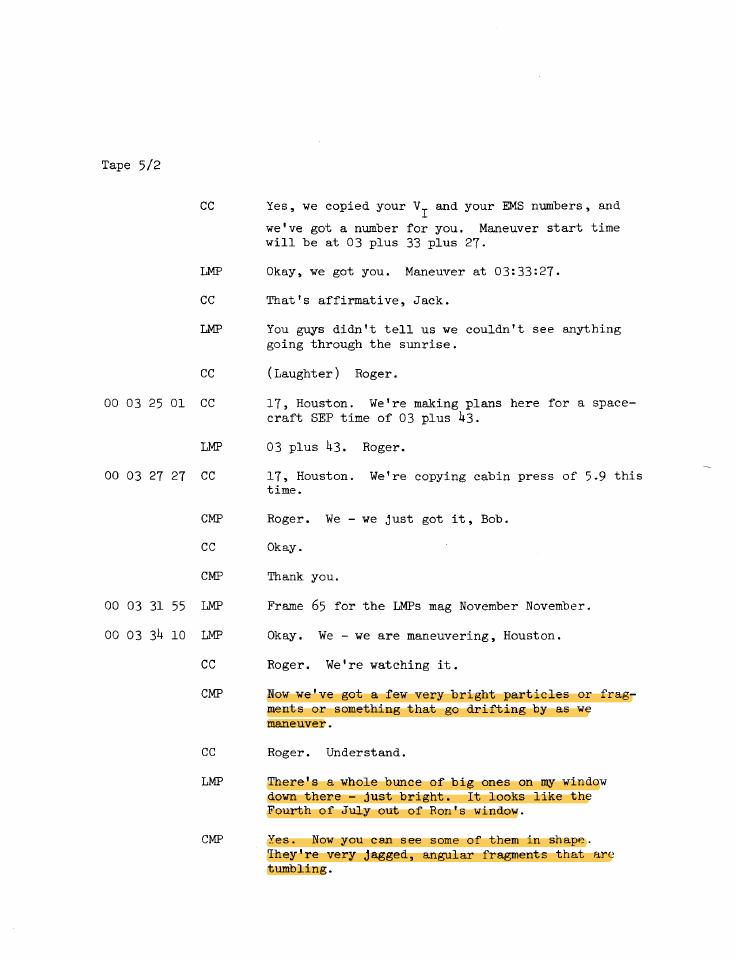
NASA-UAP-D002 is valuable precisely because it shows how many different things the crew called lights, flashes, particles, or objects. About three hours after launch, Ronald Evans saw bright, jagged fragments drifting during a maneuver. Gene Cernan described them as flat flakes, perhaps six inches across. The crew considered ice or paint from the S-IVB stage, and Evans noted that the field became essentially static when the maneuver ended. That is a strong ordinary explanation generated by the witnesses in real time.
Two days into the mission, Cernan discussed closed-eye streaks and a bright flash while trying to sleep. During the same long exchange, he also described a distant rhythmic flasher that he believed was physical. Harrison Schmitt thought it was the rotating S-IVB; later the crew saw two flashers and considered separated spacecraft-lunar-module adapter panels. These are not evasive explanations pasted onto the record decades later. They are the crew's own working hypotheses, offered while Mission Control tried to establish spacecraft attitude and viewing angles.
On the following day, Schmitt reported a thin bright flash on the lunar surface north of Grimaldi and suggested a small impact. Mission Control checked for a seismic signal. Later mission commentary also considered whether a cosmic-ray-induced visual flash might have been superimposed on his view. None of these events occurred at the Taurus-Littrow landing-site window panorama in frame 22470. Treating them as one connected encounter would make the story more dramatic and the evidence less accurate.
The debriefing shows why perception remains in the case
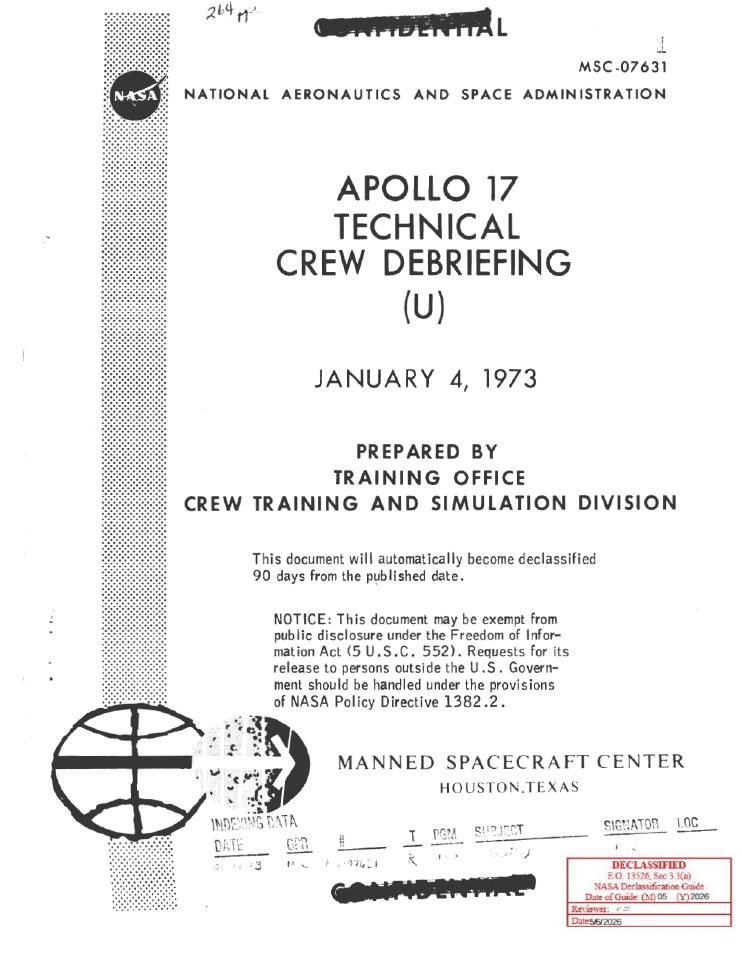
NASA-UAP-D006 preserves Schmitt's postflight summary. He said the crew experienced light flashes throughout the mission when dark-adapted and recalled one he initially thought was on the lunar surface. He also reported no visible flashes during one blindfolded ALFMED session, followed by their return later that night. That individual pattern is complicated, but NASA did not leave the broader phenomenon at the level of anecdote.
NASA's later Apollo Light Flash Investigations describes the helmet-like ALFMED detector used on Apollo 16 and 17 to record cosmic-ray tracks around an astronaut's head and compare them with reported flashes. The published program concluded that energetic cosmic rays penetrating the eyes and retinas were the most probable cause of the recurring dark-adapted flashes. That analysis applies to the visual-flash phenomenon. It does not explain pixels on film automatically, which is another reason the transcript and photograph must stay separate.
The best ordinary explanation is still a photographic one
For frame 22470, the leading ordinary family includes a defect or contaminant in the film emulsion, dust or damage introduced during handling, color-channel misregistration in a later scan, an optical reflection within the camera or lunar-module window, or a nearby particle catching sunlight. The different colors and tiny scale make imaging-chain explanations especially important to test. At present, no single one is demonstrated.
The strongest case for taking the anomaly seriously is equally specific. The feature is present in an official NASA scan, is not merely a PURSUE annotation, and has now prompted a government statement that the original film is under review. Original film can answer questions a web JPEG cannot: whether the feature is embedded consistently in the emulsion layers, whether it repeats after independent scans, whether its optical profile matches scene light, and whether neighboring exposures constrain motion.
What disclosure owes this case
AURA analysis: the release strategy here is more consequential than the dots. PURSUE did not simply repost an old Apollo image; it announced a live review and said a higher-quality primary source had been secured. That is exactly how a historical anomaly should move forward. It also creates an obligation to publish the method and result, including an ordinary identification if that is what the film shows.
The decisive package would include lossless multispectral scans of the original frame and adjacent frames; the film magazine and processing chain; repeat scans made with the film rotated or repositioned to separate scanner defects from emulsion features; optical and window geometry; color-channel measurements; and a documented comparison with dust, scratches, reflections, and known spacecraft hardware. Publishing only a conclusion would be less useful than publishing the tests.
Evidence verdict
Layer 4 of 7: an authentic official image with an unresolved source, below a linked case. The public can independently confirm that three points exist in NASA's scan and that the PURSUE callout did not invent them. It cannot reconstruct their physical cause, and the crew's other Apollo 17 observations are not synchronized corroboration. The case would move to Layer 5 if original-film analysis linked the feature to the scene with recoverable context, and to Layer 6 only if calibrated scans, metadata, adjacent-frame comparisons, and methods were released for independent reproduction. The most pro-disclosure conclusion is also the simplest: the government opened a real question and now needs to show its work.
Evidence on the page
What the released material actually shows
Open each source to inspect the complete record. The caption separates the useful fact from the limit that keeps it from carrying more weight.
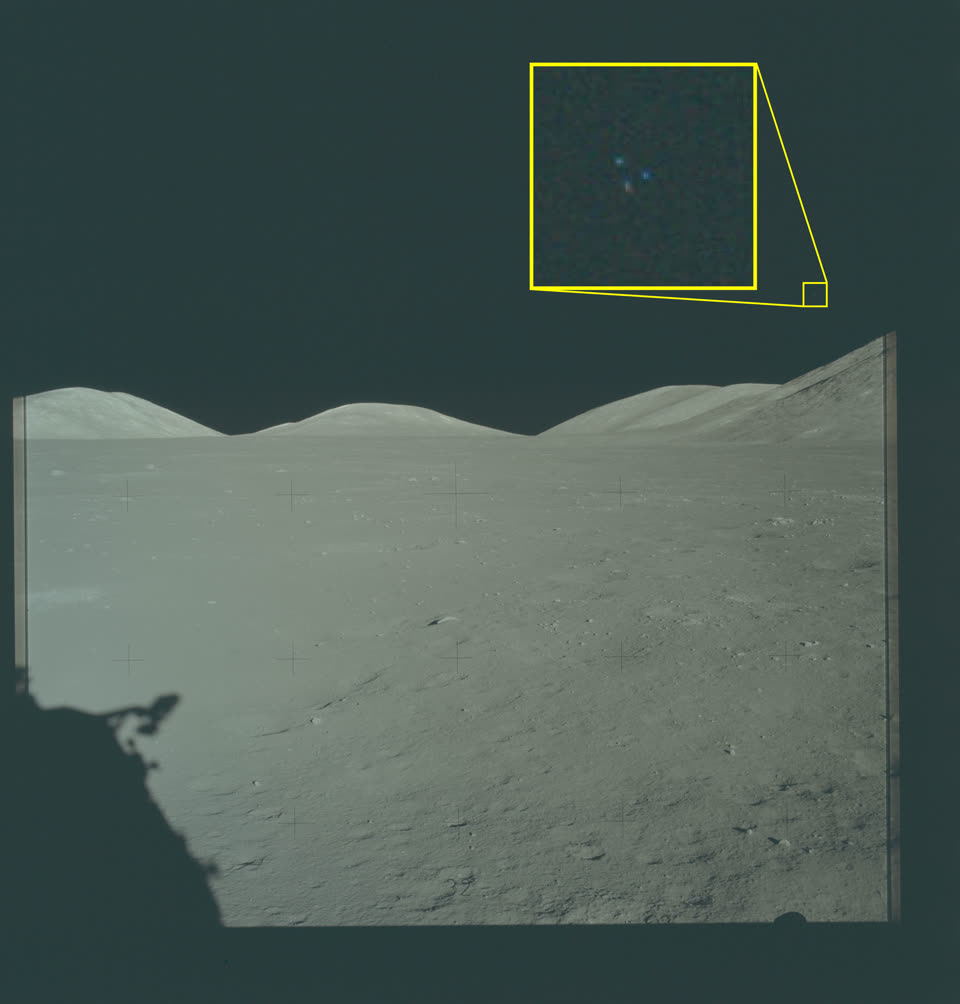
The annotated Apollo 17 frame
What it shows: The PURSUE image highlights three colored points that are also present in NASA's unannotated scan of AS17-147-22470.
The limit: The released file is an annotated derivative, and a single scan cannot determine whether the feature was in the scene, optics, film emulsion, or digitization chain.
The mission's separate light reports
What it shows: The transcript preserves drifting fragments, rhythmic distant flashers, dark-adapted visual flashes, and a reported lunar-surface flash, along with the crew's own ice, paint, booster, panel, and impact hypotheses.
The limit: These observations occurred at different times and do not document anyone seeing the three-dot cluster when the landing-site photograph was taken.
Schmitt's postflight light-flash account
What it shows: Schmitt recalled recurring flashes while dark-adapted and one that he initially located on the lunar surface, preserving uncertainty in his own interpretation.
The limit: The debrief concerns visual perception, not the film feature; NASA's later cosmic-ray research explains many crew flashes but does not identify pixels in AS17-147-22470.
What the record supports
NASA frame AS17-147-22470 contains a tiny cluster of three colored points above the Taurus-Littrow horizon. The feature exists in NASA's unannotated 4400-by-4600-pixel scan as well as the PURSUE derivative. NASA's photo index identifies the frame as part of a 60-millimeter lunar-module window panorama made before the first Apollo 17 moonwalk.
PURSUE has formally described the feature as unresolved, disclosed a preliminary judgment that it may reflect a physical object in the scene, and said the original mission film was obtained for fuller analysis. That is a testable institutional commitment, not proof of a conclusion.
What it does not establish
The public image does not establish distance, scale, motion, solidity, or a shared body connecting the three points. It does not rule out film-emulsion damage, dust, scanning or color-registration artifacts, internal reflections, window effects, or nearby illuminated debris.
The mission transcript's other lights occurred at different times and in different contexts. They cannot be used as independent witness confirmation of this frame. No released witness statement says the crew saw the photographed cluster when AS17-147-22470 was exposed.