Most public UAP videos arrive as orphans: a bright point, a dramatic label and almost no recoverable context. This northeastern United States case is different. The released package connects three phone videos from 2021, 2022 and 2024 to an FBI interview, video collection, two site surveys and a November 2024 surveillance visit during which two special agents reported lights of their own.
That paper trail makes the case worth taking seriously. It also makes its limits unusually visible. The FBI documented a real investigation and first-hand observations; the public files do not provide the calibrated geometry needed to turn luminous pixels into a measured craft.
Eight records describe one investigative thread
The official catalog says FBI-UAP-D004 through D008 and FBI-UAP-PR001 through PR003 concern reports from the same general area. The sequence begins with a private witness who said unusual lights had appeared near the property since November 2021. In October 2024 the FBI collected clips and interviewed the witness. Agents then surveyed the site, returned after dark to observe, and made a daylight follow-up visit to the area across the water.
The witness told investigators that the events occurred near a wooded nature area and sometimes near water or the tree line. The witness also reported using trail cameras and other sensors, checking aircraft against ADS-B data, and seeing possible gamma-radiation, GPS and electronic effects. Those latter claims remain witness reports: the released package does not include the raw radiation log, device data, ADS-B work sheet or calibration records needed to test them.
The FBI’s assessment that the witness was highly credible matters as a reason to investigate. It does not establish the distance, altitude or nature of a light. Credibility is about the person; measurement is about the event. This file becomes strongest where the government’s own observations begin.
What the agents actually reported
During an overcast November 2024 surveillance visit, one agent described a white pulsating light near the far edge of a pond. The memo says it moved horizontally with somewhat erratic motion, appeared at or below tree-line height, did not visibly illuminate the ground or water and vanished in under ten seconds. Agents also saw shorter white or blue flashes near the tree line and broad plumes of light followed by red or white flashes.
At about 5:30 p.m., both agents reported a bright white light above a bright red light at the far end of the pond. The pair appeared near tree-top height, moved quickly right to left, disappeared, then appeared again at the starting point and repeated the movement. That is the most important testimony in the package because it is contemporaneous, shared by two agents and recorded in an official investigative memorandum.
But the same memo records the imaging failure. Five attempted photographs were mostly blurry and lacked context; the agents concluded that long exposure required a tripod or stable platform. The public PDF lists many photo enclosures, yet the released four-page file does not contain those images. We therefore have the agents’ written observation, not a public instrument record of the motion.
The daylight follow-up narrows some possibilities, not all
In December, three agents walked an approximately two-mile loop around the area and checked the locations implicated by the November sighting. They found nothing unusual on the ground or at tree-top level. They noted an old-looking fire pit without evidence of a recent burn and judged night drone flying through the moderate tree cover risky. Those are useful negative checks.
The survey also records an important complication: investigators could see the witness’s property from across the water, and multiple homes had lines of sight into the same area. That keeps ordinary artificial lights in play. A source near a house, path, vehicle or other property could look elevated or detached when seen through branches, darkness and haze. The survey did not identify such a source, but it did not eliminate every one.
There is no published follow-up test in which a light was placed at candidate locations and filmed from the patio with the same phone, zoom and exposure. That missing reconstruction matters because it could separate apparent motion created by camera shake, autofocus and foliage from motion of the source itself.
Three videos, three different evidentiary problems
“Triangle Orbs” (2021) shows a very small cluster of bright points against a mostly black frame. The official description says the witness estimated a distance of 2,000 feet, saw one light resolve into several and reported slow lateral movement. It also notes that the iPhone 12 Pro was handheld. With no stable horizon or known-size reference in the visible frame, the public video cannot independently recover range, altitude, speed or physical separation between the points.
“Red Orb Rotation” (2022) provides more visible structure: two saturated reddish lights remain close together while their apparent arrangement changes. The catalog’s 2,500-foot distance and rotational description come from the witness. Saturation, focus breathing, digital zoom and small hand movements can change the outline and relative position of unresolved lights. The clip establishes that two bright image regions were recorded; it does not by itself establish two nearby bodies rotating around each other.
“Orbs Over the Pond” (2024) is the most visually legible and the most carefully described. A bright point persists over a dim landscape while its shape stretches, contracts and occasionally appears to divide. The government says the video was authenticated, cropped for privacy and otherwise not altered. Authentication is valuable provenance: it supports that this is the submitted recording rather than a manufactured composite. It is not a finding that the light’s apparent shape matches its physical shape.
The public description says the witness estimated the source at 2,700 feet and observed it for about 45 minutes. The released clip is about four minutes and twenty-five seconds. Without the original uncropped field of view, precise camera position and bearing, focal-length and exposure history, synchronized second viewpoint or radar track, viewers cannot test the distance or reconstruct a trajectory.
The strongest ordinary explanation is a mixture of distant lights and imaging effects
No single prosaic answer is proved in the released material. The best ordinary model is a mixture: distant fixed or moving artificial lights seen through a cluttered low-elevation sightline, plus handheld phone motion, autofocus, saturation and atmospheric or foliage effects. The model fits the small unresolved targets, apparent shape changes and lack of scale. It is less satisfying for the two agents’ shared report of a red-and-white pair repeating a quick path—unless the source was intermittently occluded or the apparent path was created by viewpoint and tree-line structure.
The witness’s ADS-B checks do not close the aircraft question because the work is not released and ADS-B is not a universal inventory of every airborne or ground light. The daylight survey makes casual drone use in the trees less attractive, but “risky to fly” is not “impossible,” and lights beyond or around the tree line remain possible. Overcast conditions during the agents’ visit reduce the usefulness of a star or planet explanation for that particular evening.
This is exactly the data problem described in NASA’s independent UAP study: observations made by sensors not designed or calibrated for the task often lack the metadata and multiple measurements needed to distinguish an unusual object from an unusual image of an ordinary source.
The best case for taking the anomaly seriously
The strongest pro-anomaly argument is not that a glowing pixel looks exotic. It is the continuity of the investigation. The same general area produced reports over three years; the witness preserved media and allowed agents onto the property; two agents then reported a brief event themselves; and a later team inspected the far shoreline rather than ending with a desk review. The 2024 video also has a government provenance statement, which is more than most viral clips receive.
The case therefore clears a meaningful bar: there was a recurring stimulus that persuaded federal investigators to return, observe and document. The released record does not show that the stimulus was one object across all dates, that it possessed extraordinary performance, or that it was extraterrestrial. Optimism about disclosure should mean asking the government to finish the evidentiary chain, not lowering the standard because the investigation is intriguing.
The official PURSUE archive still lists Release 06 as the latest public drop. This Archive Brief examines a linked FBI case released in Release 03.
Evidence verdict: Layer 5 case file, Layer 3 physical claim
As a public case file, this reaches Layer 5 of 7: linked videos, contemporaneous FBI memoranda, two-agent observation and site follow-up provide recoverable context across several sources. The core physical claim remains at Layer 3. Multiple people observed lights, but the public package contains no calibrated measurement that confirms extraordinary motion, range or structure.
That split verdict is the honest middle. The case is stronger than a lone witness and deserves continued disclosure. It is weaker than the captions can make it feel, because “estimated 2,700 feet,” “highly credible” and “authenticated” answer different questions from “measured at 2,700 feet,” “independently corroborated” and “identified as anomalous.”
To move upward, the government should release the original phone files with privacy-safe metadata; the agents’ listed photographs and their camera settings; the witness’s contemporaneous ADS-B, radiation, GPS and trail-camera logs; safe-resolution observer positions and azimuths; weather and astronomical checks; and a reconstruction using calibrated cameras on tripods at two separated locations. A repeat event should trigger synchronized optical and infrared recording plus radar or other range data. With that geometry, the lights could become measurable. Without it, the file documents a serious investigation of an unresolved stimulus—not evidence of a craft.
Evidence on the page
What the released material actually shows
Open each source to inspect the complete record. The caption separates the useful fact from the limit that keeps it from carrying more weight.
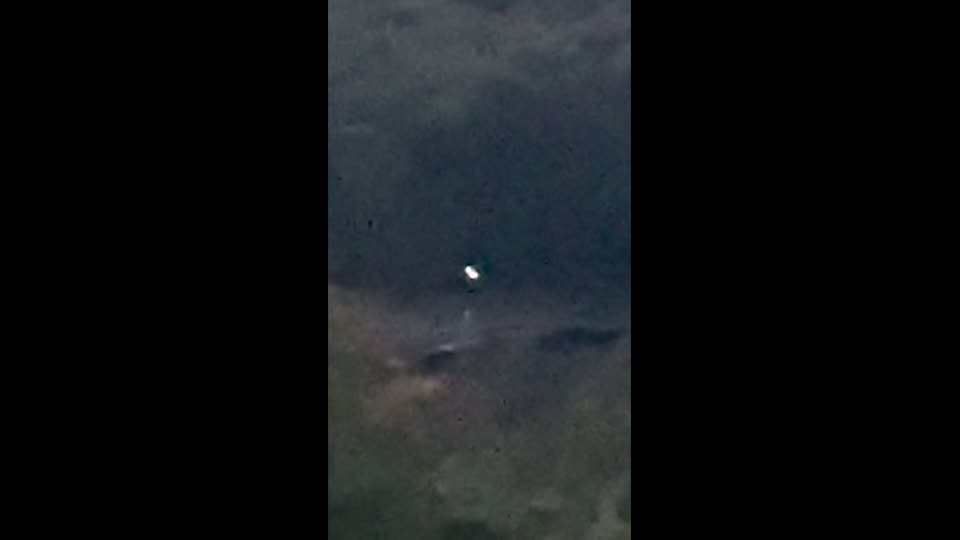
Orbs Over the Pond: strongest provenance, missing geometry
What it shows: The released 2024 clip preserves a bright source over a dim landscape, and the government says it authenticated the recording and altered only the crop used to protect privacy.
The limit: The 2,700-foot distance and 45-minute duration are witness estimates; the public clip lacks the original field of view, full metadata and a second measured viewpoint.
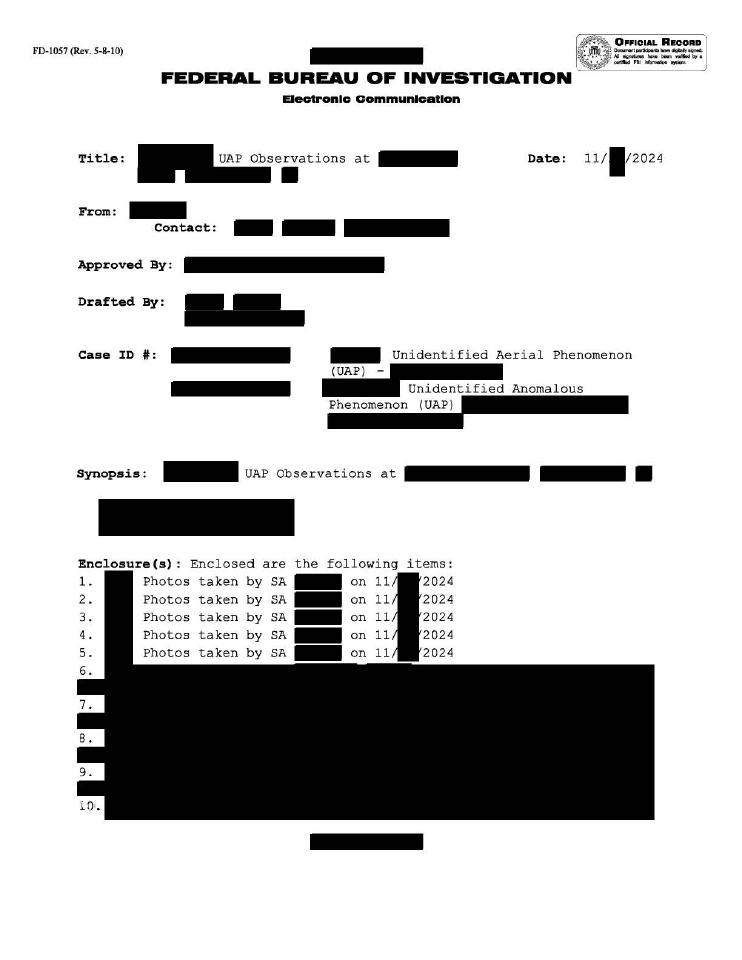
Two agents report the same red-and-white light pair
What it shows: The memorandum records both agents seeing a white light above a red light move right to left, disappear, then repeat from the starting area during a November 2024 visit.
The limit: Their five photographs were described as blurry and lacking context, and the listed images are not included in the released four-page file.
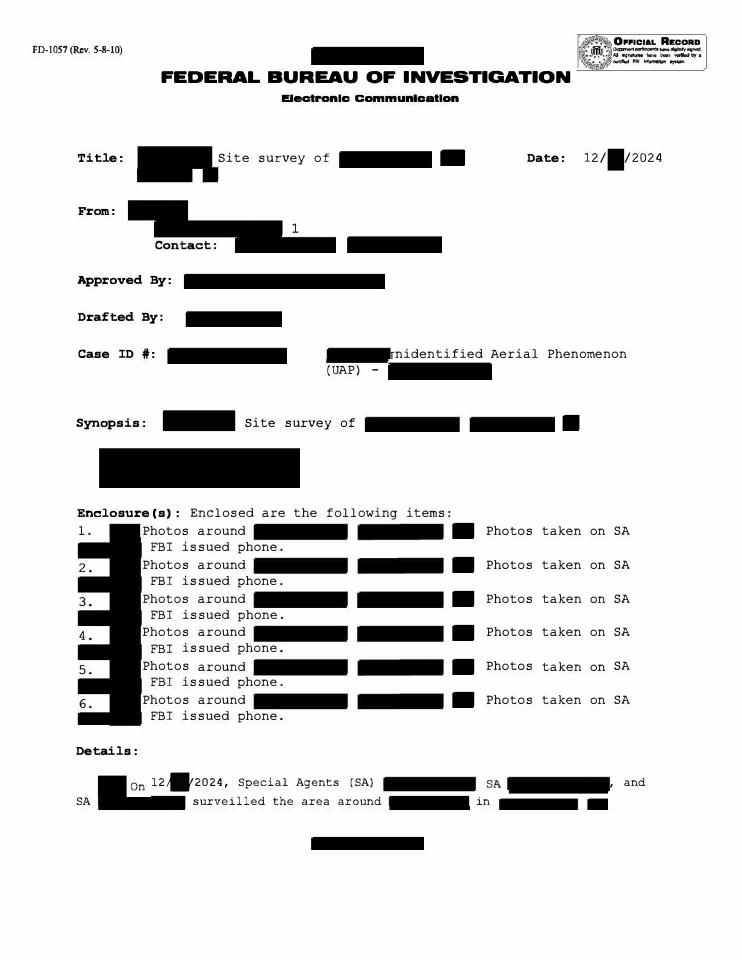
The daylight survey checks the far shoreline
What it shows: Three agents walked the area, found no unusual object or recent burn, confirmed cross-pond sightlines and judged night drone flight through the trees risky.
The limit: The survey occurred later, identified no source and also documented lines of sight to multiple homes, leaving ordinary distant lights possible.
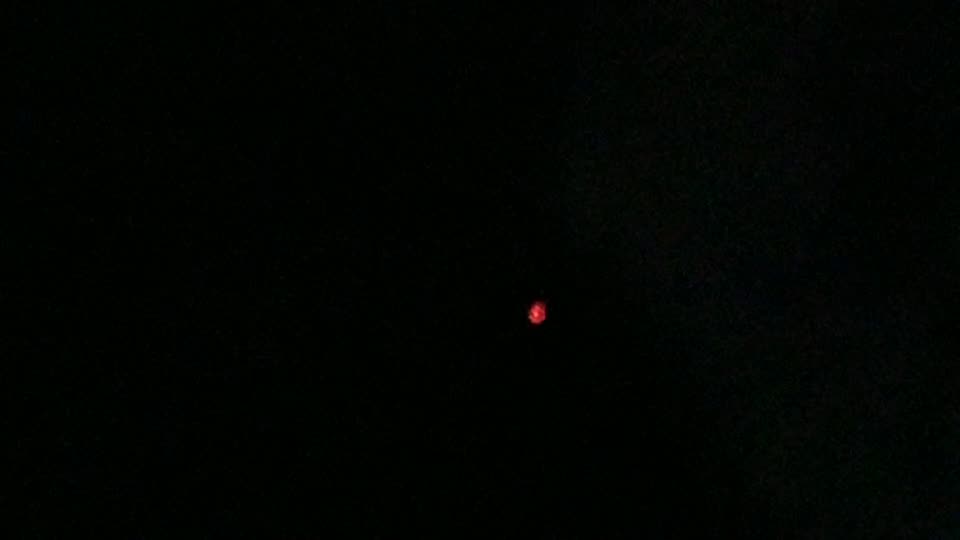
Red Orb Rotation: two saturated light regions
What it shows: The 2022 video shows two close reddish light regions whose apparent arrangement changes while the source remains small in the frame.
The limit: The distance and rotation are witness interpretation; an unresolved handheld phone image cannot separate source motion from focus, saturation, zoom and camera movement.
Triangle Orbs: a real recording with almost no scale
What it shows: The 2021 clip records a small cluster of bright points, matching the witness’s account that one bright source appeared to resolve into several lights.
The limit: A black background, handheld capture and no stable reference prevent the public video from establishing distance, speed, altitude or physical separation.
What the record supports
A private witness repeatedly recorded distant lights in one general area; the FBI collected and documented the media; two agents later reported brief lights from the property; and investigators performed follow-up site surveys. The 2024 video has an official provenance statement.
What it does not establish
The files do not measure the lights’ range, size, altitude or speed; show that all three videos and the agents’ observations share one cause; publish the listed photo and sensor enclosures; or demonstrate technology beyond ordinary human systems.