Seventy-two records, two unusually complete paper trails
Release 6 arrived September 18, 2026 with 72 records: 56 PDFs, 15 videos, and one audio file. Its best contribution was not a new shape in the sky. It was documentation. The drop supplied administrative and technical records for AAWSAP, a broad historical file around the 1952 Tremonton film, Edward Ruppelt’s presentation on early Air Force methodology, and local-law-enforcement video from Colorado.
That combination matters because provenance is usually the first casualty of a famous UFO story. Release 6 often lets a reader move backward from later claims to the statement of objectives, contract instrument, original analysis, preserved media, and internal qualifications.
AAWSAP becomes a program instead of an acronym
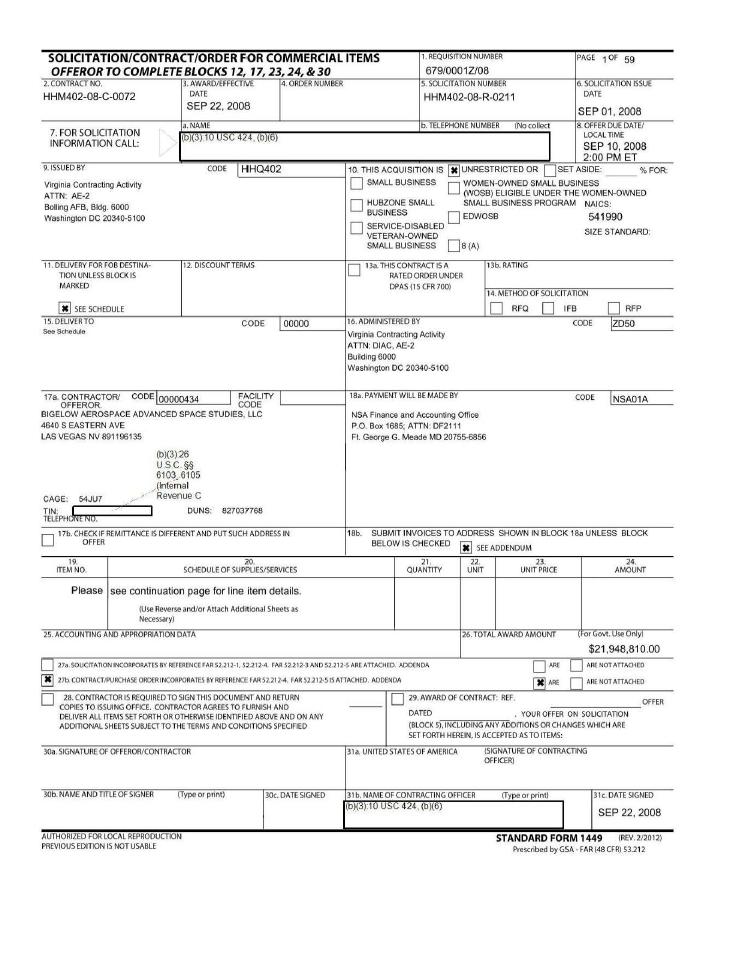
The July 2008 statement of objectives defines a contractor-supported effort to examine possible far-future aerospace threats across twelve technical areas. The September order names Bigelow Aerospace Advanced Space Studies and turns those goals into priced deliverables. Contract modifications and 38 Defense Intelligence Reference Documents follow, covering topics from ordinary advanced materials to warp drives, wormholes, antigravity, and negative energy.
The existence of those studies proves the government paid for literature reviews and technical synthesis on those subjects. It does not prove the proposed systems worked. Contracts are excellent evidence of expenditure and intent; they are surprisingly poor evidence of a functioning stargate.
Tremonton becomes a process instead of a clip
The Tremonton package includes the Project Blue Book investigation, a photographic file, personnel context for witness Delbert Newhouse, related Air Force records, and preserved 16mm footage. Early reviewers considered birds, balloons, mirage effects, and other possibilities. Later Air Force assessments favored sunlit seabirds. Across the record, missing fixed reference points kept distance, size, altitude, and linear speed beyond reliable recovery.
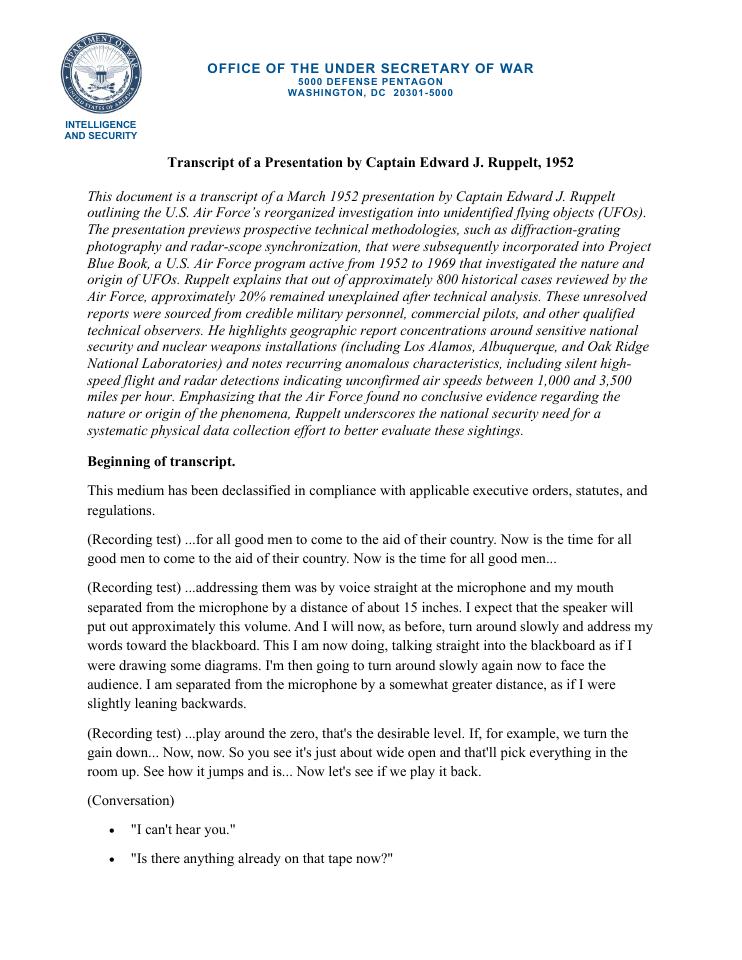
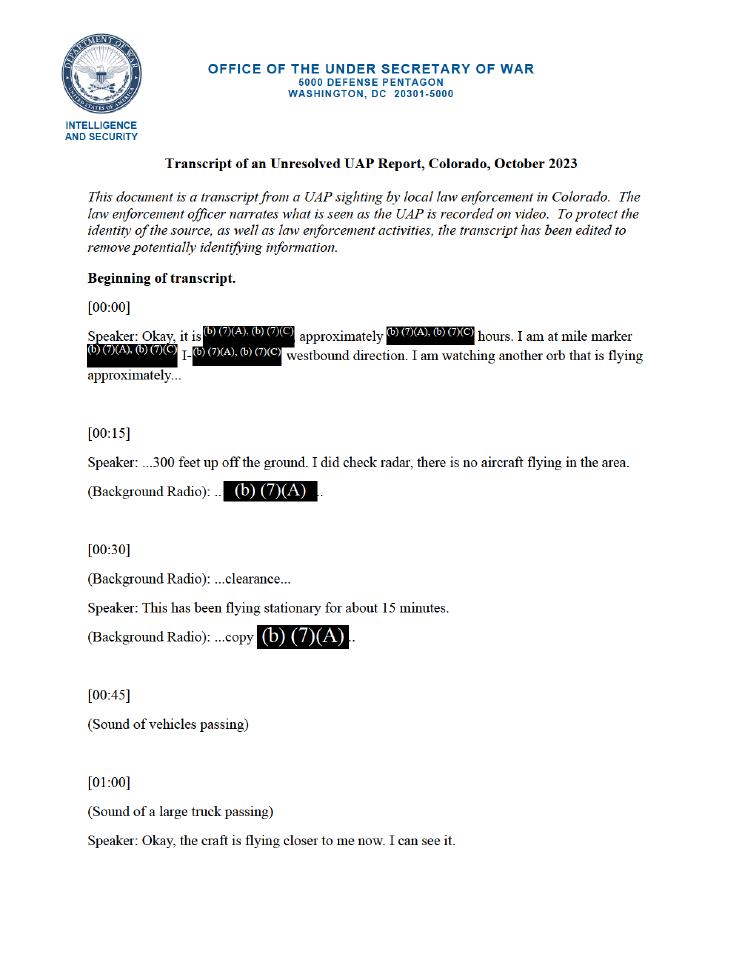
Ruppelt’s 1952 presentation makes that measurement problem explicit at the program level. He argued for diffraction gratings, synchronized radar photography, and systematic collection. The local Colorado videos add a modern echo: long recordings can preserve exactly what the camera saw while autofocus and digital processing complicate what the apparent form means.
Release 6 is strongest when treated as an audit kit. The contracts show what was purchased, the technical papers show what was discussed, the Tremonton file shows how conclusions changed, and the local video records show how a modern camera can preserve ambiguity in high definition. None needs embellishment to be useful.
AAWSAP is finally auditable as a procurement program
The statement of objectives defines a far-term aerospace-threat research effort across twelve technical areas and requires management plans, monthly reports, technical studies, and an integrated assessment. The September 2008 order identifies Bigelow Aerospace Advanced Space Studies and converts the work into priced deliverables. Contract modifications and 38 technical reference documents show what the program purchased.
That is substantial evidence about government activity. It answers questions about scope, contractor, outputs, and administrative intent. It does not demonstrate that warp drives, wormholes, antigravity, or negative energy devices existed. A commissioned study proves that a topic entered a research portfolio; its scientific weight depends on methods, sources, peer review, experiments, and reproducible results.
Tremonton becomes stronger history and weaker spectacle
The file establishes that Delbert Newhouse was treated as an honest, experienced Navy photographer and that he recorded 12 to 14 reflective objects on 16mm Kodachrome. Early reviews tested birds, balloons, and optical effects without agreement. Later Air Force assessments favored sunlit seabirds and cited identifiable birds and comparable footage.
The surviving film cannot recover distance, size, altitude, or linear speed because it lacks fixed reference points. That limitation is more important than whether one generation of analysts found the points visually impressive. The Release 6 chain also resolves a persistent format confusion: the original was 16mm, while 35mm positive and negative blowups were later produced for analysis.
Ruppelt explains what investigators knew they were missing
Edward Ruppelt’s 1952 presentation says roughly 20 percent of about 800 reviewed cases remained unexplained and describes credible military and technical observers, geographic concentrations near sensitive sites, and reports of high speed. More important, he proposes diffraction-grating photography and synchronized radar-scope imaging. Those proposals show that unresolved testimony was not considered enough.
The Colorado law-enforcement video is the modern echo. A long recording and live narration preserve much more than a brief 1952 description, but camera focus and unknown range still obstruct physical interpretation. Collection improved; the need for calibration did not disappear.
Evidence verdict: the archive’s best audit trails, not its final proof
Release 6 reaches layer five for AAWSAP procurement and the Tremonton investigative history because linked records permit a reader to reconstruct institutional action over time. The Tremonton object itself remains at layer four: authentic official imagery, insufficient geometry. The technical studies document ideas and literature, not functioning breakthrough systems.
Independent experimental results, underlying datasets, peer review, and demonstrated hardware would be required to elevate AAWSAP’s speculative topics. Original film scans with complete camera and scene reconstruction would improve Tremonton, though missing 1952 range may never be recoverable. Release 6 is the most auditable drop so far because it exposes process. Transparency about process should not be mistaken for confirmation of every proposition the process examined.
Evidence on the page
What the released material actually shows
Open each source to inspect the complete record. The caption separates the useful fact from the limit that keeps it from carrying more weight.
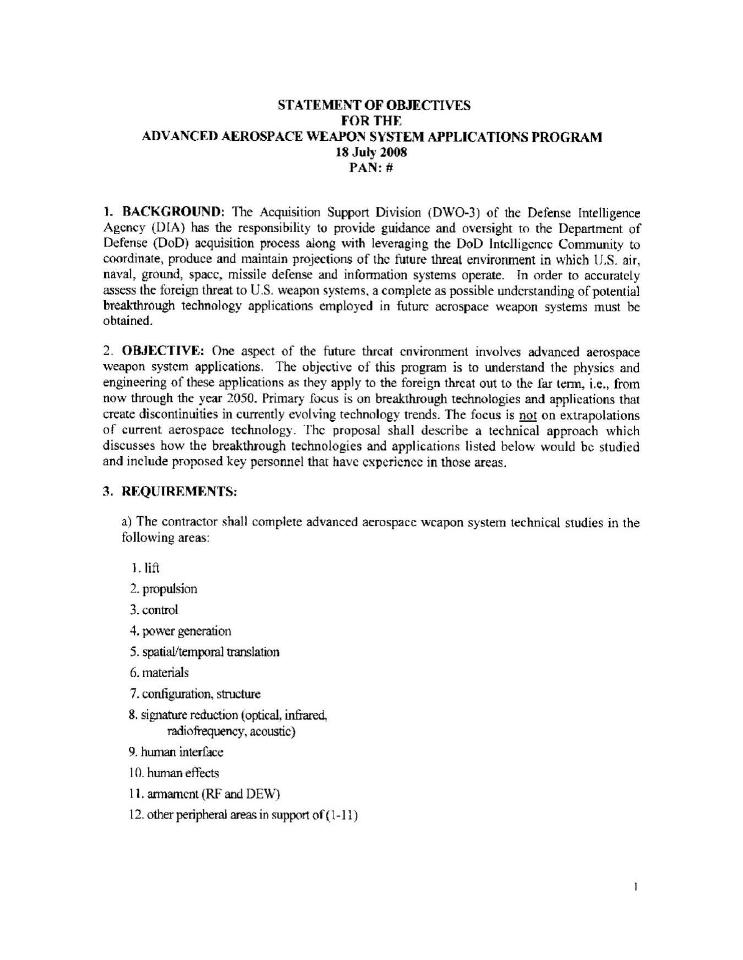
AAWSAP statement of objectives
What it shows: The document defines twelve research areas, required reports, and a far-term threat-assessment mission.
The limit: A scope of work documents questions the government paid to study, not technologies it proved.
AAWSAP solicitation and order
What it shows: The contract names the contractor and translates research goals into priced deliverables.
The limit: Procurement evidence establishes expenditure and intent rather than scientific validity.
Tremonton investigative file
What it shows: The record links witness background, original filming, competing hypotheses, and changing Air Force assessments.
The limit: The film lacks fixed reference points, preventing reliable recovery of distance, size, altitude, or speed.
Ruppelt’s 1952 methods presentation
What it shows: The program chief describes unresolved cases and proposes better instrumented collection.
The limit: Reported high speeds and case percentages still depend on underlying files of uneven measurement quality.
Colorado law-enforcement transcript
What it shows: Live narration can be read alongside the released video of a modern unresolved observation.
The limit: The camera records apparent form without the range and optical calibration needed to identify it.
What the record supports
Release 6 documents AAWSAP’s scope, contractor, deliverables, and technical products; preserves an extensive chain around Tremonton; and adds historical and modern examples of officials trying to improve collection.
What it does not establish
Commissioned speculation is not demonstrated technology. A historically important unresolved film does not recover missing scale, while modern phone video does not escape the limits of autofocus, magnification, and absent range data.