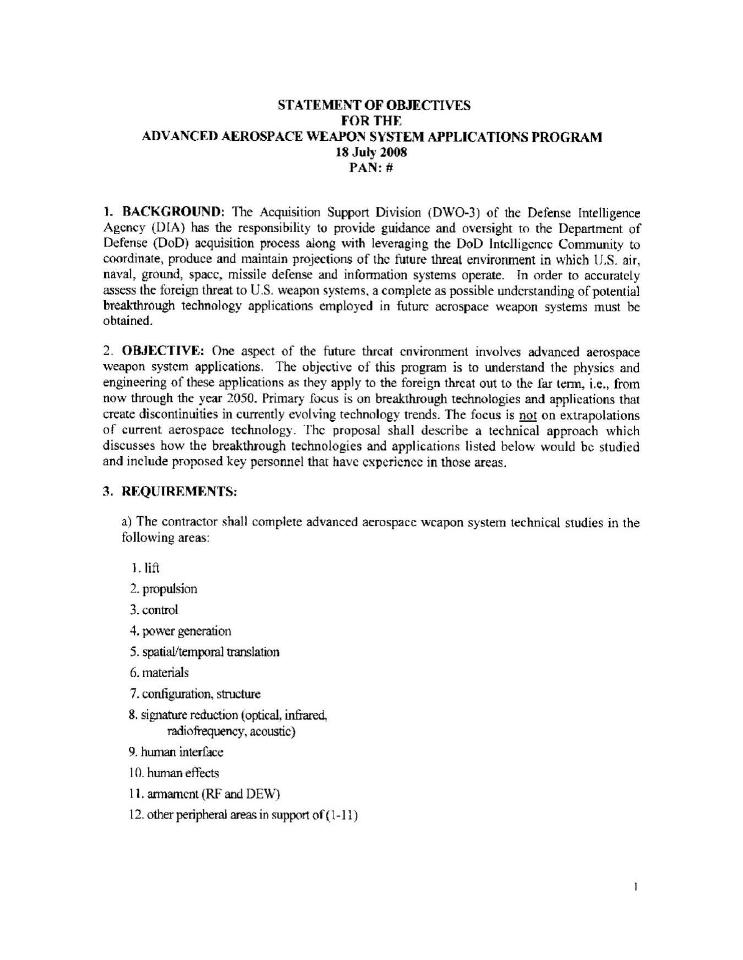
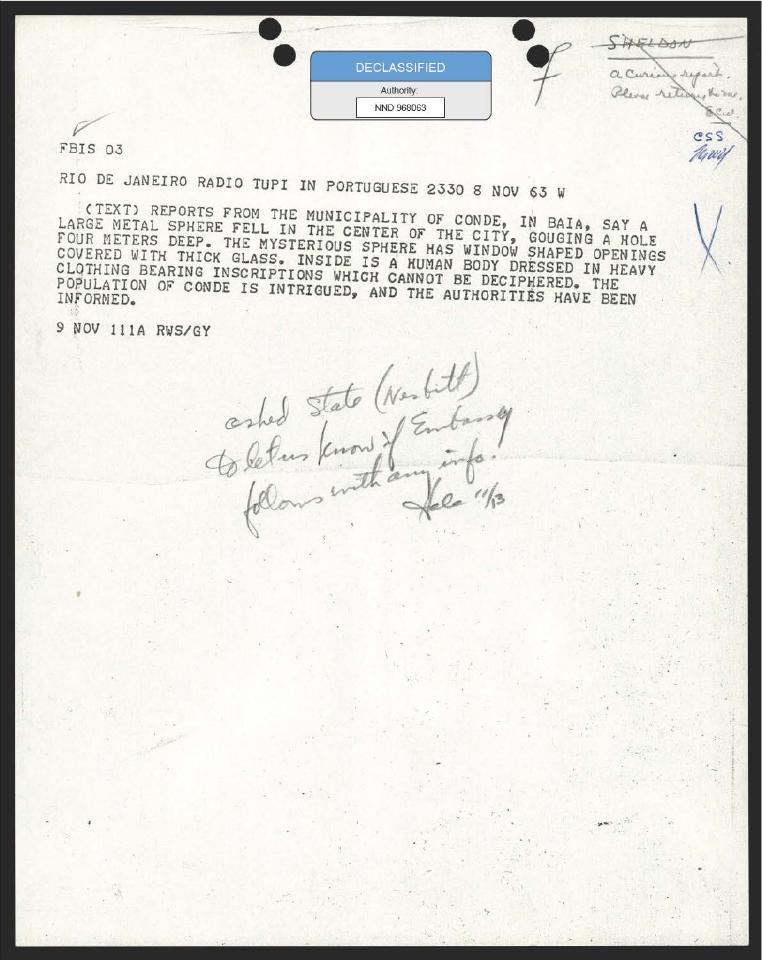
Seventy-two records about both sightings and systems
Release 3 landed June 12, 2026 with 72 records: 53 PDFs, ten images, six videos, and three audio files. Its strongest material did not merely ask what someone saw. It showed how intelligence agencies, investigators, and analysts decide which questions are worth institutional attention.
The historical centerpiece was the CIA’s 1952–1953 Scientific Advisory Panel report. The panel concluded that flying saucers did not present a direct physical national-security threat and found no evidence requiring new scientific concepts. Its larger worry was communications overload and public reaction. It recommended debunking and better observer training to reduce noise. That recommendation is historically important whether a reader approves of it or not: it documents a policy response, not just a technical evaluation.
Known secret aircraft complicate the historical record
The release also included the CIA history of the U-2 and OXCART reconnaissance programs. Those aircraft flew higher and looked stranger than familiar traffic, while their missions could not be openly explained. The document does not retroactively solve every report from the period. It does show a durable mechanism by which genuine government secrecy can produce sincere public mystery.
That is an uncomfortable but useful middle category. A witness can accurately report something extraordinary relative to ordinary experience while still observing human technology. Secrecy can make both official denial and public suspicion rational responses to incomplete information.
The modern files were unusually layered
The Colorado Springs case preserves an FBI interview, a first-person narrative, a witness-guided digital rendering, and a later low-confidence analytic hypothesis involving reflected light and low clouds. The Western United States event includes several government witnesses and multiple described phenomena near a sensitive site, while the released analysis says the case remained unresolved.
These cases are compelling because the archive exposes multiple stages rather than supplying only a clip. They are also frustrating for the same reason: each stage introduces its own uncertainty. Memory becomes an interview summary; a description becomes a rendering; an explanation receives a confidence label. Release 3 rewards readers who keep those layers separate.
That makes the drop an unusually good guide to institutional uncertainty. Officials can collect a credible account without endorsing its interpretation, commission a rendering without calling it a photograph, and leave a case unresolved while still testing ordinary mechanisms. Those distinctions are not evasions when the file makes them visible; they are the structure of the evidence.
The Western United States event is the release’s hardest case
Six federal law-enforcement agents, working in three teams, reported related phenomena over two days near a sensitive site. Their descriptions were consistent across multiple viewing angles: short-lived orange “mother orbs,” clusters of smaller red lights, coordinated motion, and in one account a red light that remained stationary for hours. AARO considered the agents contextually aware and familiar with military systems.
The released analysis does real hypothesis work. Historical flight, radar, and ADS-B data made military aircraft and flares plausible for roughly 60 percent of the reported activity. The remaining 40 percent did not align with known aircraft in the observers’ estimated lines of sight. A prolonged stationary light was physically inconsistent with known flare burn time and descent. AARO called unrecognized technology a provisional exclusion-based hypothesis—but explicitly said it was supported only by narrative testimony, not technical or physical evidence.
That last sentence is the whole case
The event is stronger than a lone anecdote because the witnesses were multiple, operationally experienced, and separately positioned, and because investigators checked several external datasets. It is weaker than a demonstration because no witness collected contemporaneous photo, video, or instrument data. Radar and ADS-B were used mainly to test known traffic, not to produce a public track of the unresolved phenomena.
This is exactly where “credible” and “proved” split. The agents can be honest and accurate about seeing repeated lights while still misestimating distance, duration, or whether separate appearances came from one source. Conversely, the lack of imagery does not make their consistent accounts meaningless. It places the case at a clear evidentiary ceiling.
The Colorado case shows how layers can be confused
The FBI FD-302 documents what the witness told an interviewer. A first-person statement preserves a different layer. A digital rendering translates reported morphology into an image. A later analytic hypothesis tests reflected light and low cloud with low confidence. None should be substituted for another. The rendering is not a photograph; the hypothesis is not an identification; the interview is not raw perception.
Paired with the Robertson Panel and U-2 history, these modern files show government analysis becoming more transparent about confidence. Release 3 is not merely “the government admits it is unexplained.” It is a release where the public can see why some hypotheses were rejected, which remained plausible, and exactly what evidence was missing.
Evidence verdict: the best witness-led case, still below public proof
The Western event reaches layer three strongly and touches layer five through linked official analysis and external flight-data checks. It does not reach layer six because the central unresolved component lacks public raw sensor data. The policy and program-history files independently reach high provenance for what they say about institutions, not for an extraordinary origin.
A repeat event captured by calibrated cameras from the separate team locations, time-synchronized with radar and known exercise logs, would move the Western case dramatically. Release 3 raises confidence that something worth investigating was repeatedly observed. It does not identify what produced it.
Evidence on the page
What the released material actually shows
Open each source to inspect the complete record. The caption separates the useful fact from the limit that keeps it from carrying more weight.
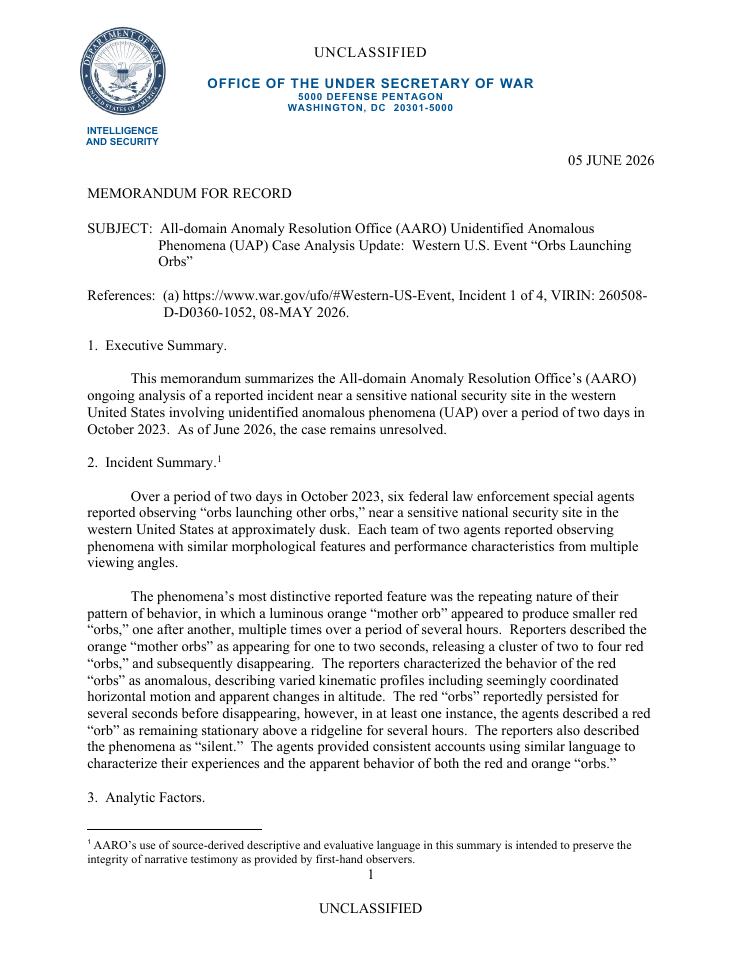
Western event analysis update
What it shows: AARO documents six agents, multiple angles, tested hypotheses, and a remaining unresolved component.
The limit: The provisional “unrecognized technology” hypothesis rests on testimony and exclusion, not technical or physical evidence.
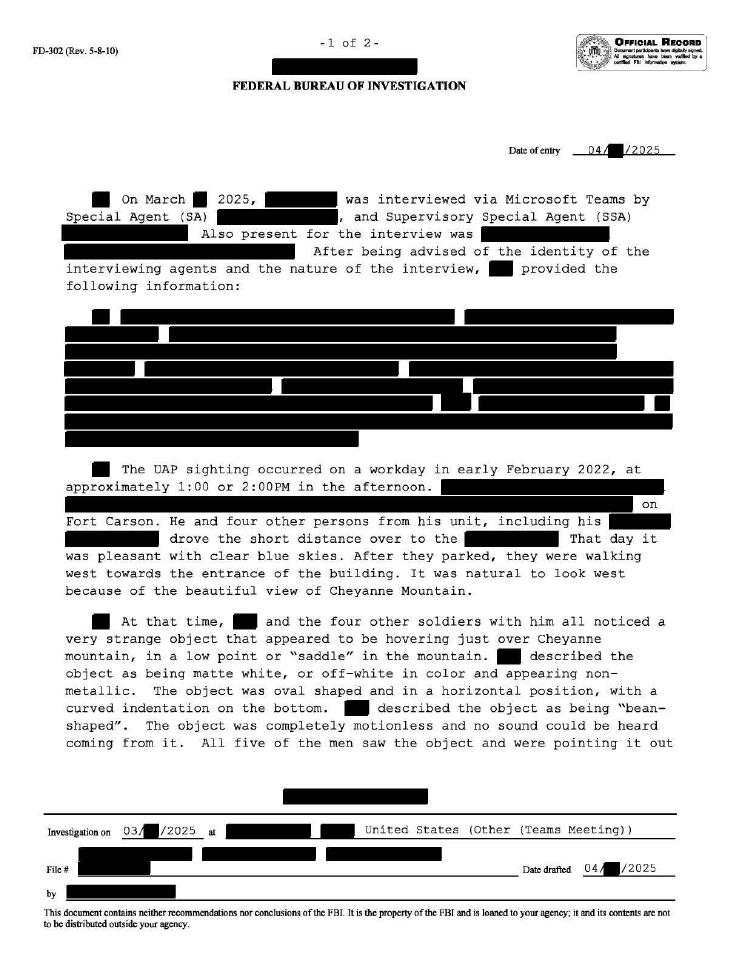
Colorado Springs FBI interview
What it shows: The FD-302 preserves a military witness’s account of a motionless, silent, patterned object.
The limit: It is an interview summary made years after the event and does not contain original sensor imagery.
Robertson Panel report
What it shows: The file documents how Cold War officials framed UFO reporting as a communications and public-reaction problem.
The limit: Its policy conclusion is not a technical resolution of every case considered.
U-2 and OXCART history
What it shows: The official history shows how secret high-altitude programs could generate sincere unexplained reports.
The limit: A demonstrated source of some historical sightings cannot be generalized to every report.
What the record supports
Release 3 documents changing government policy, the role of classified aerospace programs in public interpretation, and modern cases with unusually rich witness and analytic records.
What it does not establish
Historical debunking policy does not prove every case was dismissed dishonestly. Secret aircraft do not explain every sighting, while detailed modern documentation does not automatically turn an unresolved case into a confirmed extraordinary object.