Spaceflight has its own vocabulary of surprise
Early astronaut transcripts are irresistible UFO material because trained observers sometimes use words such as “bogey,” describe glowing objects, or react to lights they cannot immediately identify. The temptation is to lift one phrase out of the recording and treat it as a technical classification. The records become more interesting—and usually more complicated—when the exchange continues.
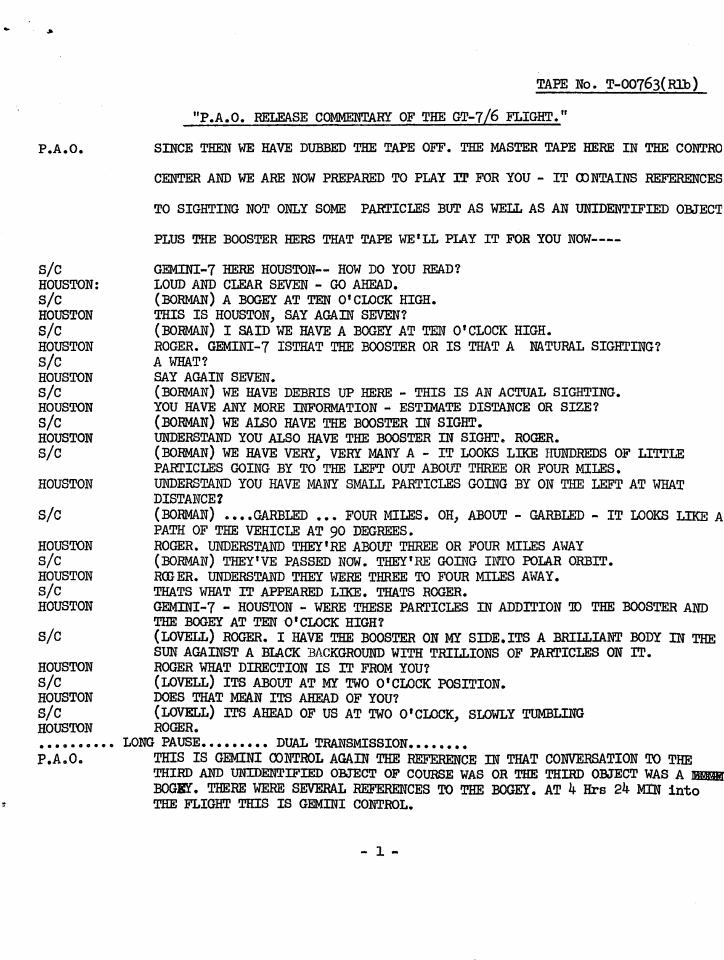
In Gemini 7 communications, Frank Borman reports a “bogey” and also describes a large debris field. Jim Lovell refers to a brilliant body against the black background with countless particles around it. The handwritten file label calls it a UFO sighting, accurately reflecting that something was unidentified in the moment. It does not tell us whether one object, several objects, and the particles shared a cause.
Mercury reports belong to the spacecraft environment
The Mercury audio excerpts preserve similarly immediate observations. Astronauts describe lights or objects while operating a small spacecraft surrounded by hardware, ice, vented material, separated components, and changing illumination. That environment does not automatically explain every report. It does make nearby debris and optical effects necessary hypotheses rather than after-the-fact excuses.
Orbital perception is unusually unforgiving. Against black space, an illuminated particle may offer no familiar scale. Relative motion can come from the observer, the object, or both. A point that looks distant may be close; an apparently rapid departure may be a change in illumination. The transcript captures the observation, while orbital geometry determines how much can be inferred from it.
Skylab shows observers updating their own explanations
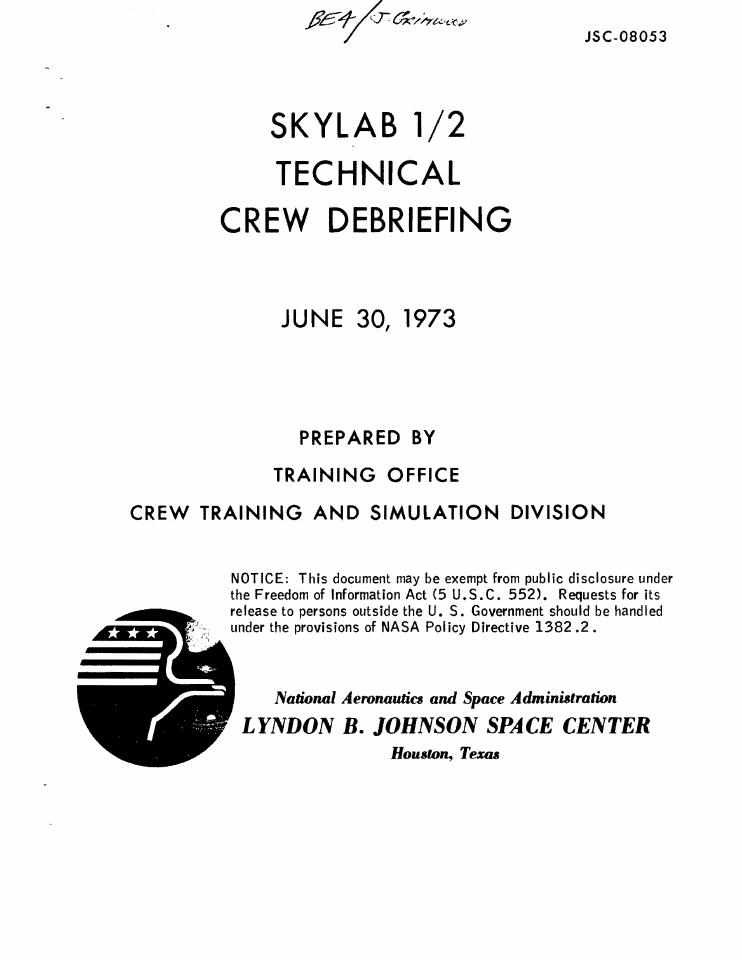
The Skylab debriefing is valuable because it includes several types of event and several levels of confidence. Crew members discuss closed-eye light flashes, a bright reddish object considered a satellite in a similar orbit, and moving exterior lights presumed to be pieces of Skylab or other satellites. The astronauts did not flatten these into a single mystery. They proposed different explanations based on timing and context.
That habit is worth borrowing. “Unidentified when first seen” is a description of a moment in an investigation. It is not a permanent property of the object. Conversely, a plausible onboard explanation is not the same as a confirmed identification when the necessary tracking data are absent.
The pattern is uncertainty management
Across Gemini, Mercury, and Skylab, the recurring feature is not a consistent craft shape or behavior. It is the work of interpreting unexpected visual information in a novel environment. The strongest reading preserves the astronauts’ competence without pretending human perception becomes a calibrated rangefinder in orbit.
Read the call, then read the correction
The most useful part of astronaut testimony is often the exchange after the memorable phrase. A crew member notices a “bogey,” a light, or a body; another crew member asks about position, motion, or nearby debris; the discussion evolves. That sequence reveals observation under uncertainty. Isolating the first noun removes the very reasoning that makes the source valuable.
Gemini 7 is the clearest case. Frank Borman’s “bogey” sits in a conversation that also identifies large numbers of particles outside the spacecraft. Jim Lovell describes a brilliant body against black space with smaller material around it. The transcript confirms surprise and a real attempt to orient the observation. It does not establish that the bright body and particle field were one object, much less a controlled craft.
Why space destroys familiar scale cues
On Earth, haze, horizon, known objects, gravity, and sound quietly help the visual system estimate distance. In orbit, a sunlit ice particle close to a window and a larger object far away can both appear as bright points against black. Apparent motion combines the spacecraft’s translation and rotation, the observer’s gaze, the object’s own path, and changing illumination. A transcript can preserve what the crew saw without preserving enough geometry to solve that equation.
Mercury adds vehicle-specific candidates: vented material, separated hardware, frost, and small debris could become visible as lighting changed. Those are not universal explanations to be pasted onto every observation. They are hypotheses demanded by the environment. The right question is whether the timing, direction, persistence, and relative motion in a particular record match them.
Skylab shows classification happening in public
The Skylab material is particularly instructive because the crew does not use a single explanation for every light. Closed-eye flashes were treated differently from a reddish object thought to be another satellite, and moving exterior lights were discussed as possible pieces of Skylab or nearby objects. Expertise appears not as instant certainty but as the ability to keep hypotheses separate.
The later scientific understanding of closed-eye light flashes also shows why unresolved-at-first is not unresolved-forever. The experience was genuinely strange to the person having it. A radiation interaction with the visual system can still be the better explanation. An ordinary cause does not make the original report fraudulent; it makes the investigation successful.
Evidence verdict: excellent testimony, weak geometry
These records sit at layer two or three: identifiable first-hand observers, sometimes with multiple crew members and immediate mission communications. They are unusually good historical evidence for what trained humans noticed and how they reasoned. They do not reach the instrumented layer for most central claims because the released excerpts lack synchronized imagery, ranging, or tracking data.
To move upward, a case would need time-matched camera frames, spacecraft attitude and trajectory, cataloged nearby objects, lighting geometry, and independent tracking. The archive supports repeated unexpected observations during early spaceflight. It does not support treating every evocative word as a technical finding or every light as the same phenomenon.
Evidence on the page
What the released material actually shows
Open each source to inspect the complete record. The caption separates the useful fact from the limit that keeps it from carrying more weight.
Gemini 7 mission transcript
What it shows: The crew reports a “bogey” while also discussing a large field of particles and relative position.
The limit: The exchange provides no reliable range or scale and does not prove the bright body and particles shared a cause.
Mercury observation audio
What it shows: Contemporaneous speech captures the observer’s immediate attempt to describe an unexpected light or object.
The limit: Audio preserves testimony but not the visual geometry needed to distinguish distant objects from nearby illuminated debris.
Skylab debriefing
What it shows: Crew members sort several observations into different tentative explanations rather than one unified mystery.
The limit: The explanations remain provisional where matching tracking or imagery is absent.
What the record supports
American astronauts repeatedly reported unexpected lights, particles, and objects during early human spaceflight, and mission records preserve both their initial reactions and several working explanations.
What it does not establish
Shared words such as “bogey” or “UFO” do not show that the events shared a cause. The transcripts alone generally cannot determine distance, size, composition, or whether an observation was external debris, radiation, another satellite, or something else.