The Colorado Springs case is unusually instructive because the archive preserves four distinct layers: what a witness remembered, what investigators recorded, what an artist rendered, and what an analyst later proposed.
The observation
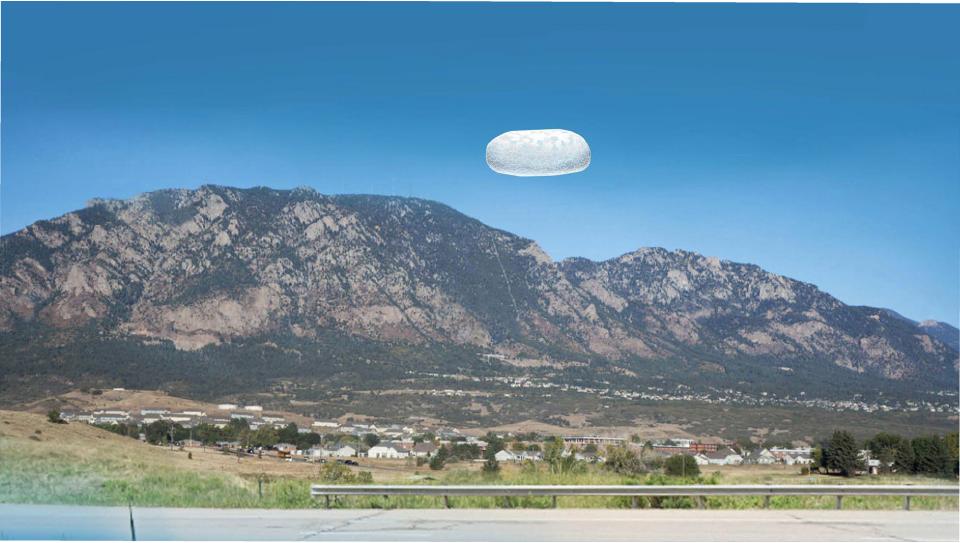
A U.S. military service member described a February 2022 airborne object near Colorado Springs. In the later FBI interview, the witness characterized it as bean-shaped, matte white or off-white, motionless, and silent, with intersecting ridges forming an irregular polygon pattern.
A separate first-person narrative was collected to support a digital artistic interpretation. That rendering is useful, but it is not a photograph. It represents a witness-guided reconstruction produced after the event.
The proposed explanation
An intelligence-community partner assessed with low confidence that sunlight reflecting from mountain snow cover may have illuminated the underside of low clouds, producing the apparent object. That is a physically ordinary mechanism, but the confidence label matters: it was not presented as a definitive resolution.
As of the June 2026 release, AARO still listed the incident as unresolved.
Why the file matters
The case demonstrates why a database should not collapse every record into “explained” or “unexplained.” A proposed explanation can be plausible while still depending on assumptions the available evidence cannot fully test. A witness can be credible while visual perception remains vulnerable to distance, lighting, and missing reference points.
What the record supports
A service member reported a structured, motionless phenomenon. The FBI documented the account, a rendering was created, and an IC partner proposed a weather-and-light explanation.
What it does not establish
The rendering is not sensor imagery. The low-confidence analysis is not a confirmed solution, and the unresolved status is not evidence for a particular extraordinary cause.